Features

Everything you need to run delivery

Dispatch and auto-dispatch, live tracking, proof of delivery, messaging, an open API, and a branded customer experience: more included on every plan than any other delivery software on the market.

The platform

One platform, more capabilities than any competitor

Smart dispatch & routing

Proximity and zone assignment plus route optimization.

Live GPS tracking

Real-time driver map and an Uber-style customer tracking link.

Proof of delivery

Photo, signature, and GPS on every drop.

Branded customer experience

Tracking pages, SMS and email updates, rewards.

Industry Filters

Free vertical presets, terminology and workflow tuned to your business.

Open API & webhooks

Connect your POS, store, or systems.

Dispatch & routing

Get the right stop to the right driver

Route optimization

Up to 200 stops, ordered in seconds

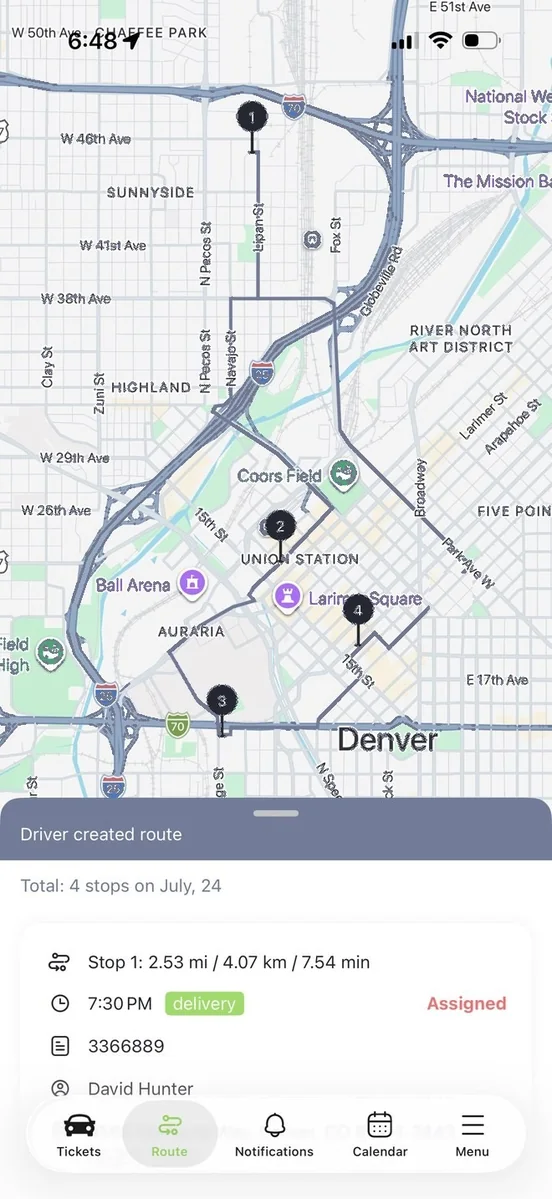
Drop the day's tickets on a driver and the optimizer sequences them into the shortest run, on foot, on a bike, on transit, or driving. The driver gets turn-by-turn navigation to the next stop without thinking about the order.

  • Up to 200 stops in a single optimized run
  • Re-optimizes when you add a ticket mid-route
  • Hands off to Google Maps, Waze, or Apple Maps
  • Every leg's distance and drive time recorded on the route
Optimized multi-stop route in the Zippykind driver app
Flash Routes

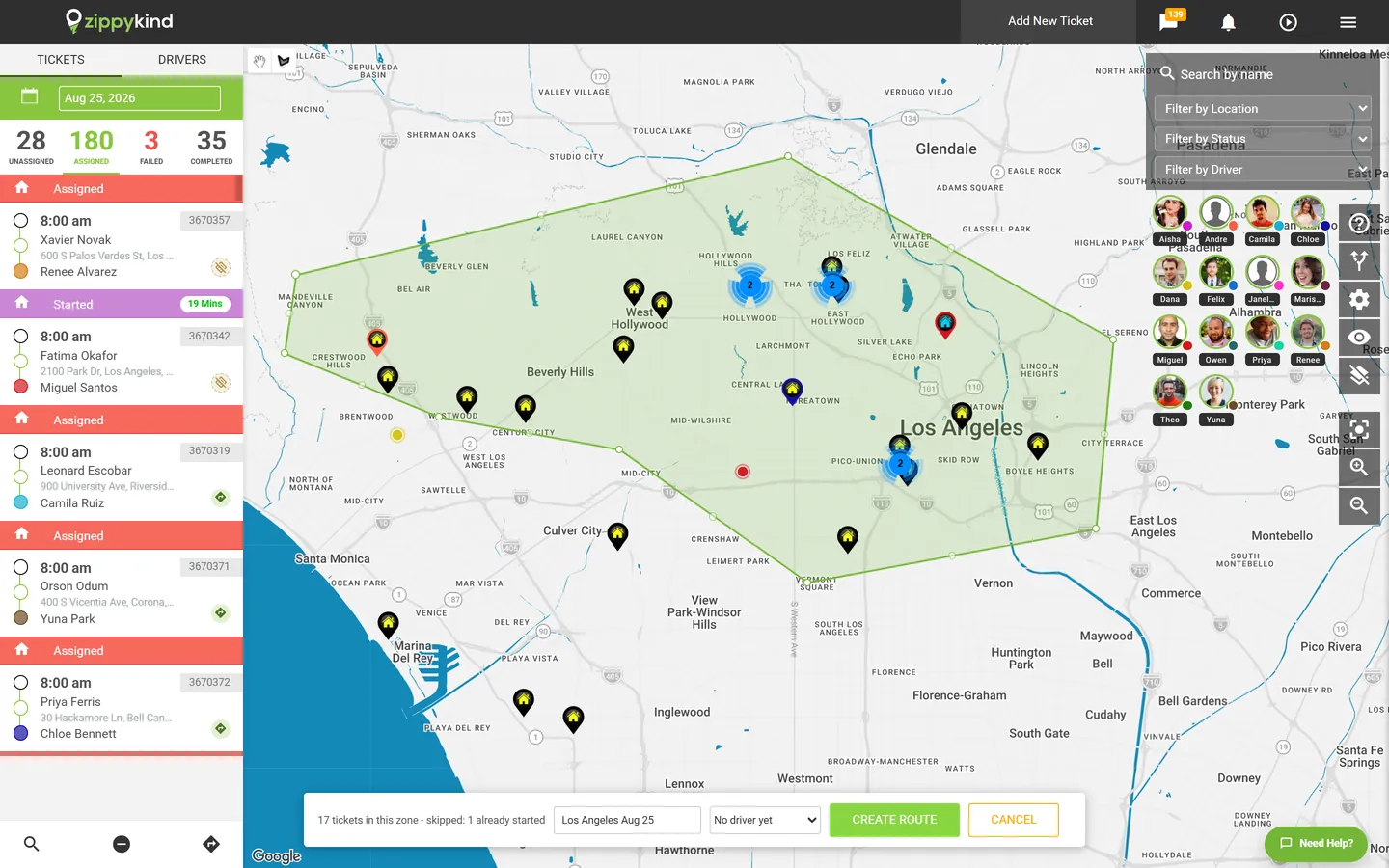
Draw a zone, get a route

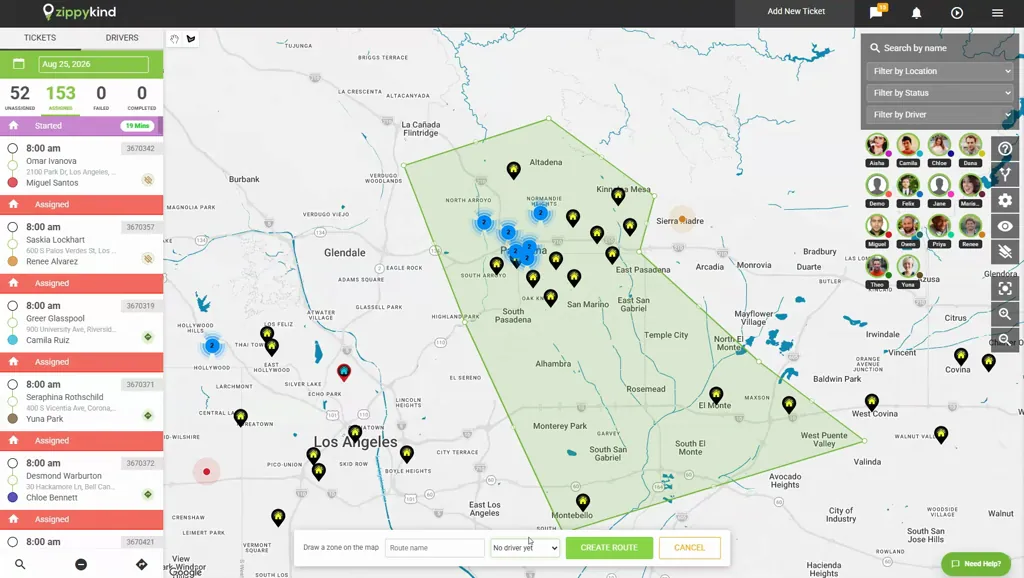
Draw a polygon around the day's tickets and Zippykind builds the route and hands it to a driver. Flash Routes is part of the Routing Suite add-on.

A zone drawn around the Pasadena tickets on the Zippykind dispatch map, with the Create Route bar ready
Flash Routes in the dispatch dashboard, 1 minute 25 seconds
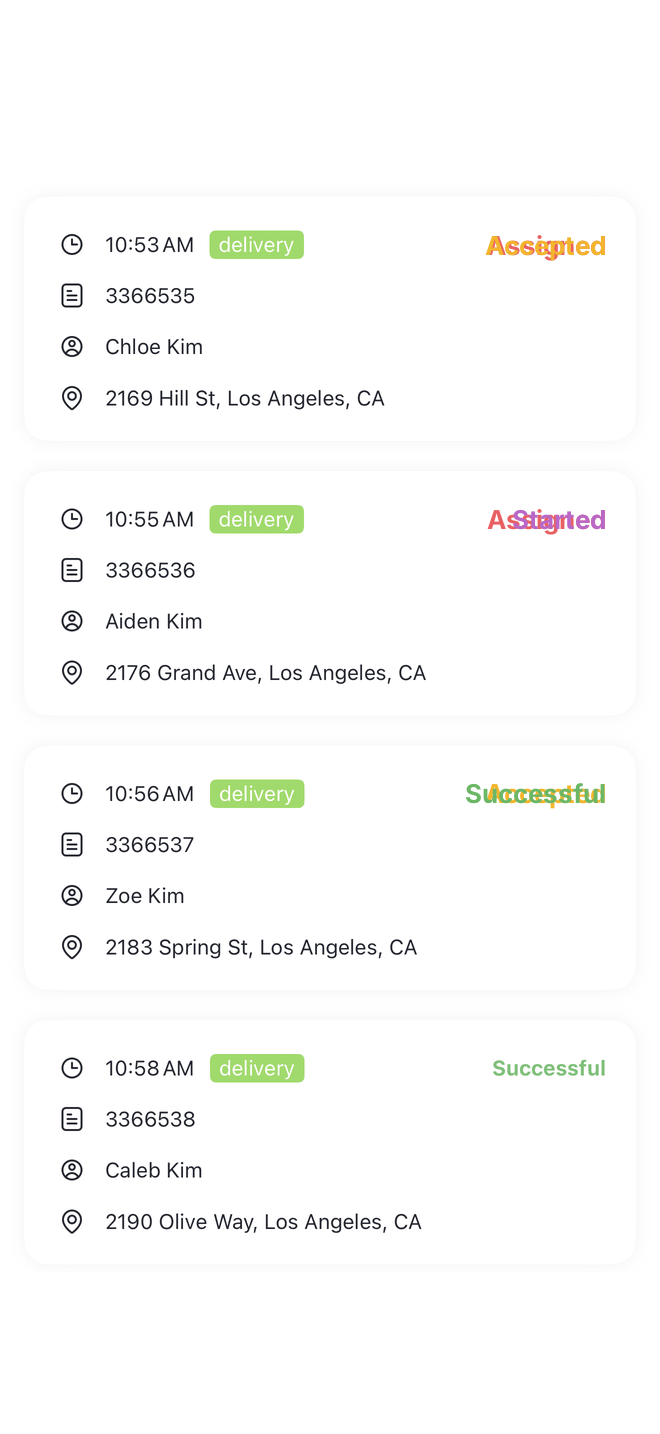
Delivery ticket list in the Zippykind driver app
The driver's day

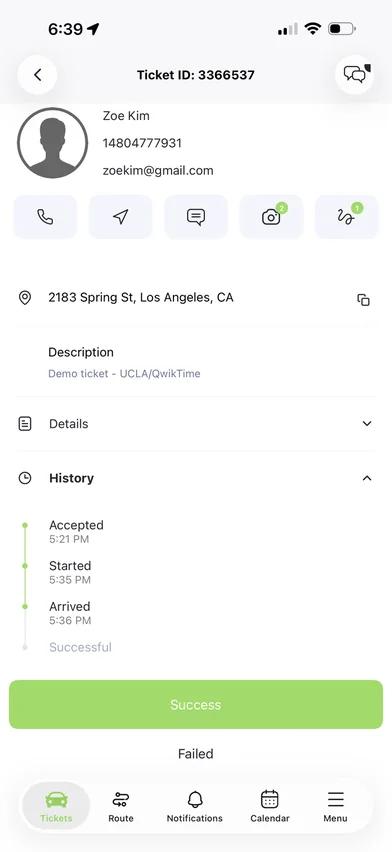
One list, always current

Every assigned ticket in one place, color-coded by status, updating live as dispatch moves work around. Drivers accept, start, and close out from the same screen, and the dashboard sees each change the moment it happens.

  • Assigned, accepted, started, arrived, and successful statuses
  • Auto-dispatch to the closest driver, or first to accept
  • Reassign from the dashboard and the driver sees it instantly
  • Full status history retained on every ticket
Scheduling

Plan the week, not just the hour

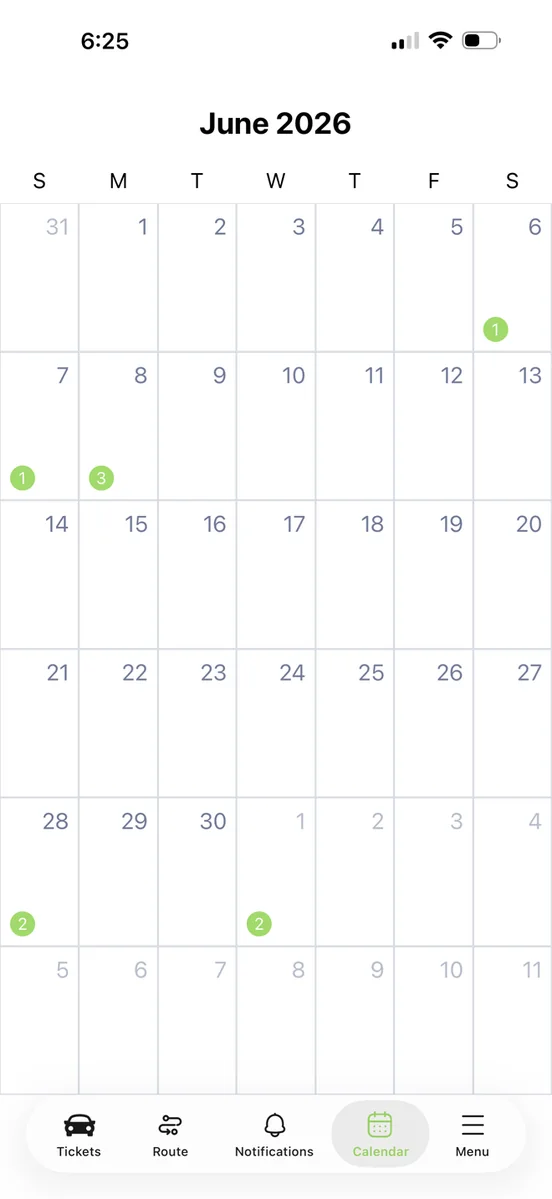
A drag-and-drop scheduler with day, two-day, list, week, and month views, plus recurring subscriptions for the customers who order on a rhythm, daily, weekly, bi-weekly, or monthly, several at once if they need it.

  • Drag a delivery onto a driver to schedule it
  • Day, two-day, list, week, and month views
  • Recurring orders, including multiple per customer
  • Driver sees the day's load before it starts
Delivery calendar in the Zippykind driver app
Proof of delivery

Prove every drop, without paperwork

Photo proof

A picture, a location, and a timestamp

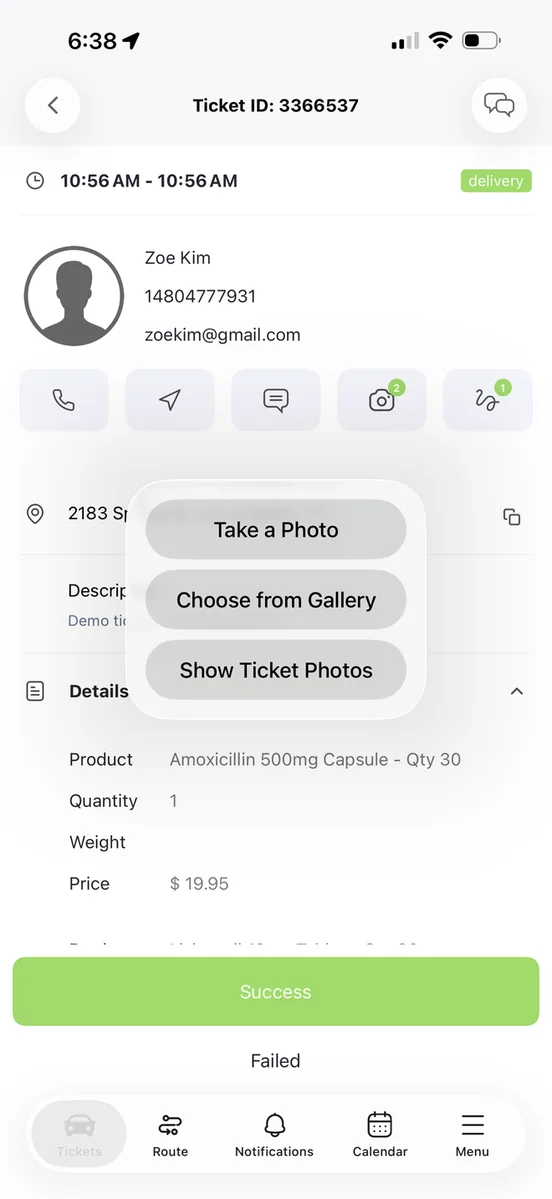
Drivers close out each delivery with a photo taken at the door, and the app logs GPS coordinates and the time alongside it, an audit-grade record attached to the ticket, not a note in someone's memory.

  • Photo captured in the app at the moment of delivery
  • GPS coordinates and timestamp logged automatically
  • Attached to the ticket and visible from the dashboard
  • Download any ticket as a printable PDF record
Delivery photo capture in the Zippykind driver app
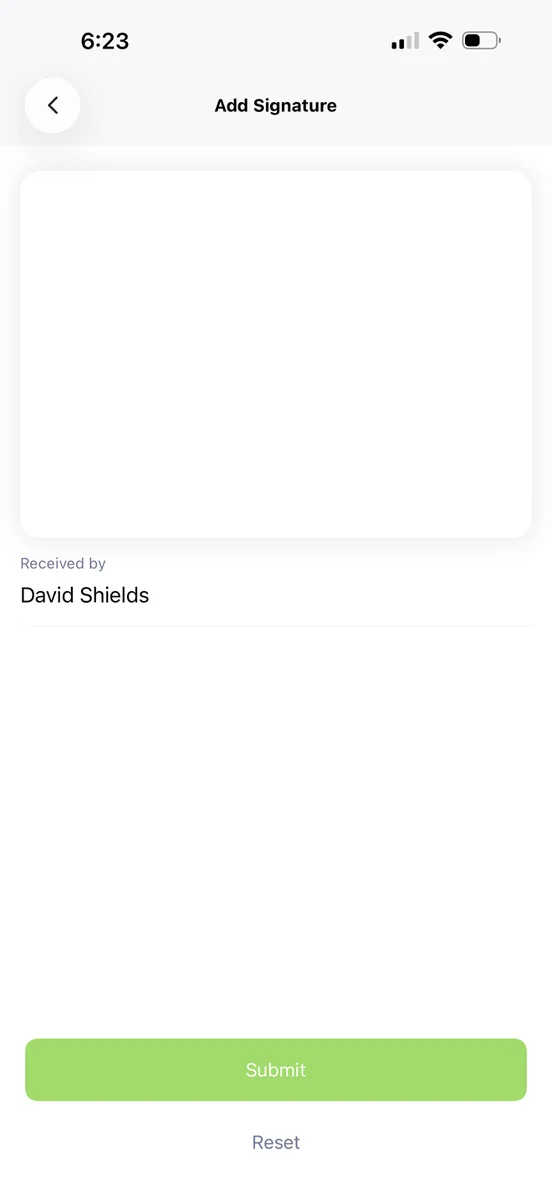
Customer signature capture in the Zippykind driver app
Signature capture

Signed for, on the glass

Recipients sign on the driver's phone and the signature lands on the ticket with the rest of the proof. When a hand-off isn't possible, contactless signature keeps the record intact without the two of you sharing a screen.

  • Signature captured on the driver's device
  • Contactless signature when hand-off isn't possible
  • Stored with the photo, GPS, and timestamp
  • Included in the printable PDF proof
Scanning

Scan it to the right stop

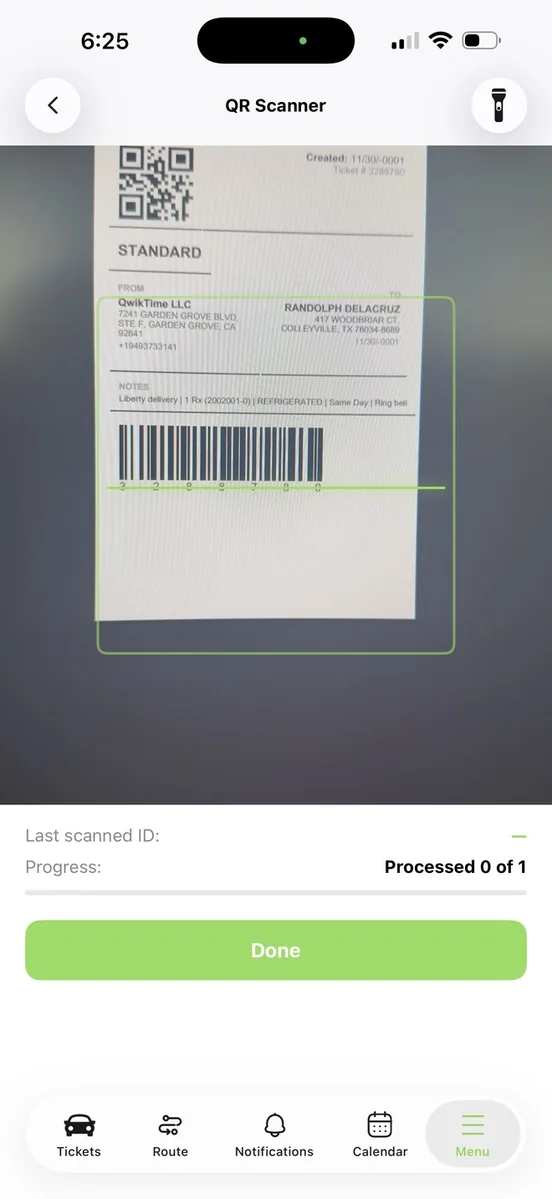
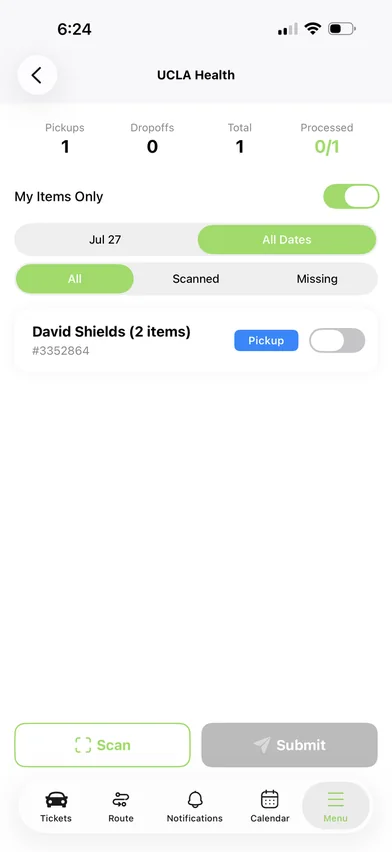
Scan a printed label or an order item at pickup and at the door, and the app checks it against the ticket. The count on screen tells the driver what is still in the vehicle before they pull away.

  • Scan printed labels or individual order items
  • Item counts verified against the ticket
  • Chain of custody from pickup to doorstep
  • Product-level logs exportable to CSV
Scanning a printed delivery label in the Zippykind driver app
Your customers

The experience customers expect

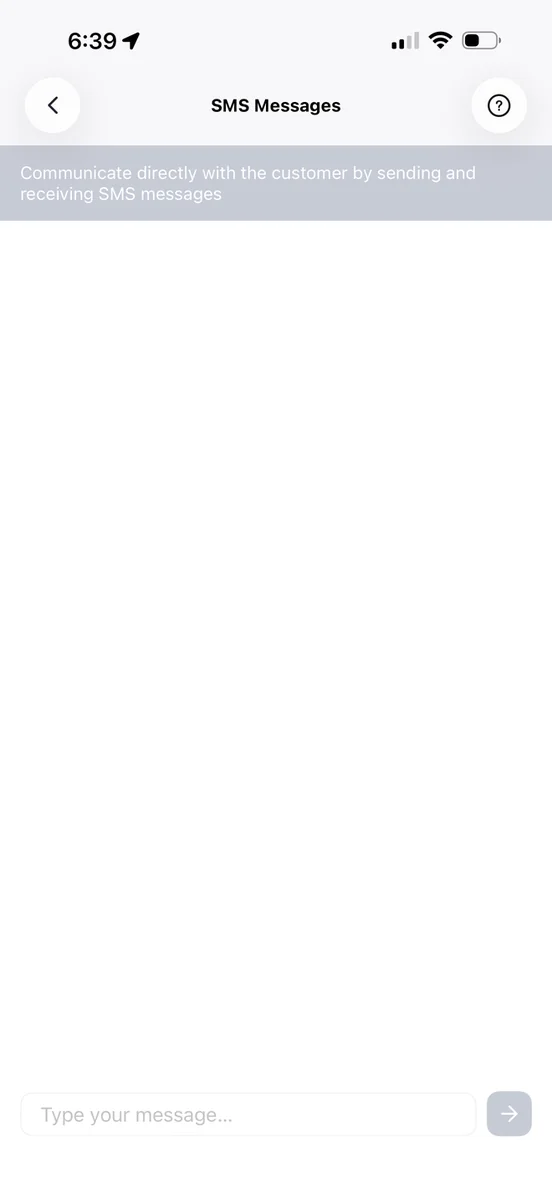
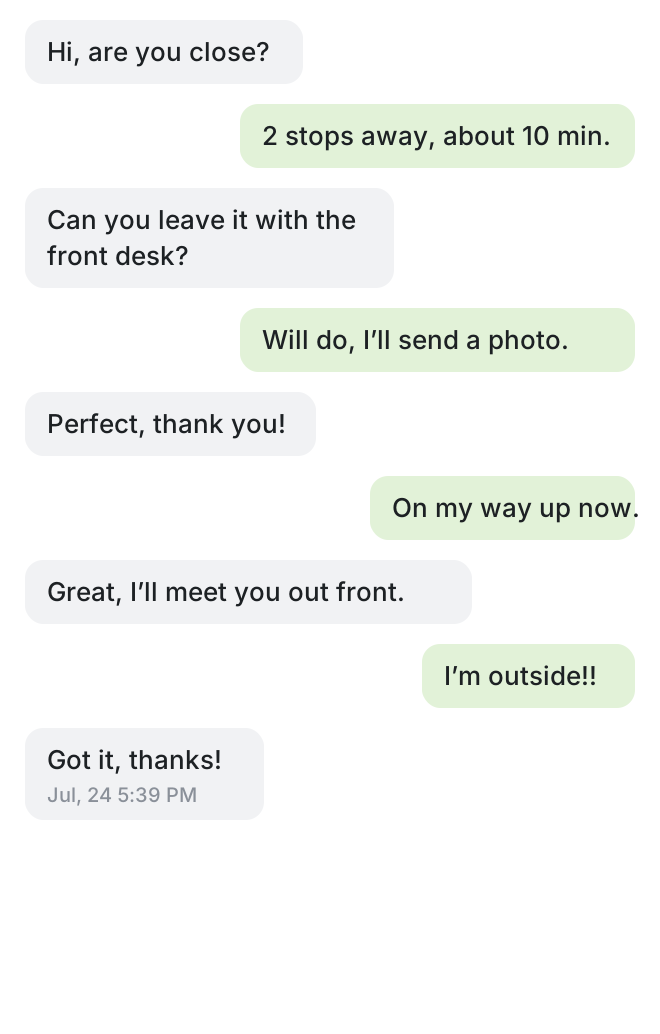
SMS conversation with a delivery recipient in the Zippykind driver app
Messaging

Every update, on the channel they read

Automated SMS and email fire at each milestone, and driver, dispatch, and customer can carry on a real conversation from inside the ticket. Nothing important lives in someone's personal text thread.

  • Automated status updates by SMS and email
  • Group messaging across dispatch, driver, and customer
  • Custom notification templates per milestone
  • Full message log kept on the ticket
Calls

Talk without giving out a number

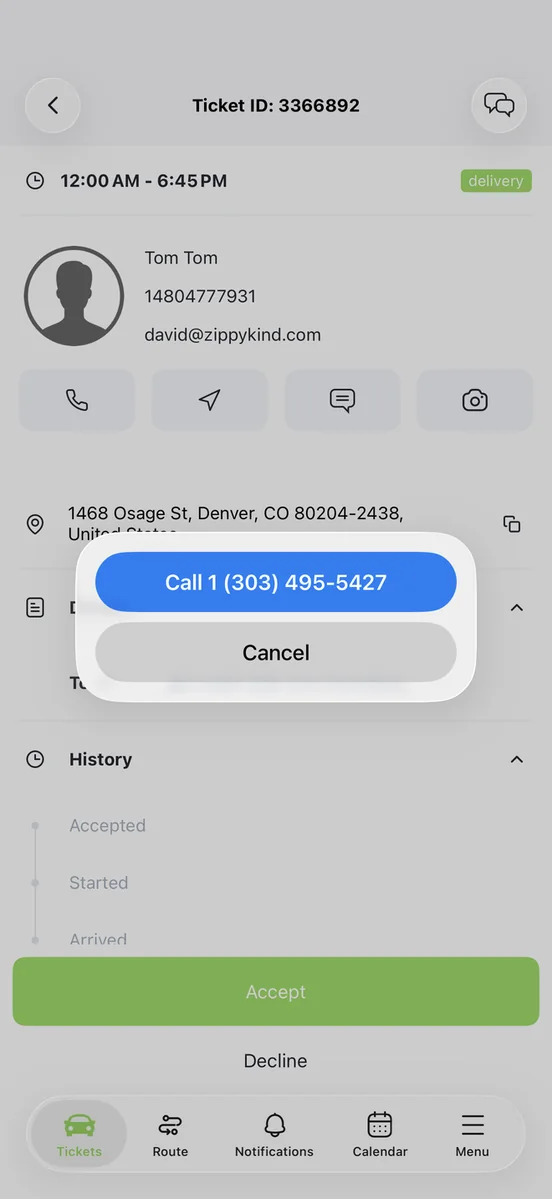
A dedicated virtual number sits between your drivers and your customers. Calls and texts route through it in both directions, so a driver's personal number never leaves the app and every call is logged against the ticket.

  • One virtual number for the whole operation
  • Driver and customer numbers stay private
  • Calls and texts logged against the ticket
  • Works in both directions, including callbacks
Calling a delivery recipient from the Zippykind driver app
The driver app

Every screen your drivers touch

Ticket detail & history

Ticket detail & history

Order items, notes, and the full status history of the ticket.

Navigation hand-off

Navigation hand-off

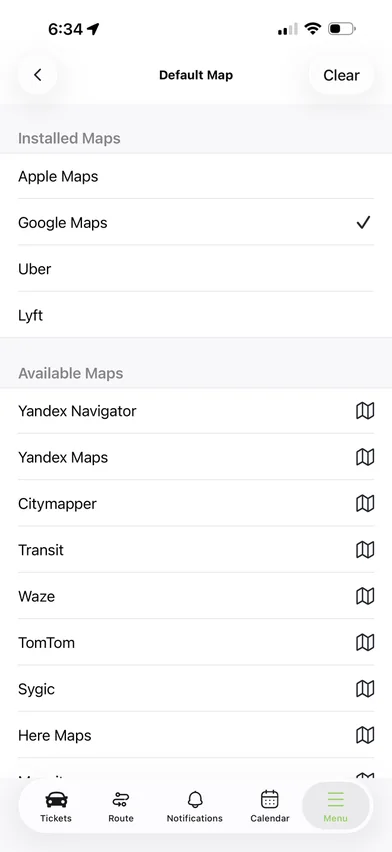
One tap into Google Maps, Waze, or Apple Maps for the next stop.

Item scanning

Item scanning

Scan each order item and watch the processed count tick up.

Push notifications

Push notifications

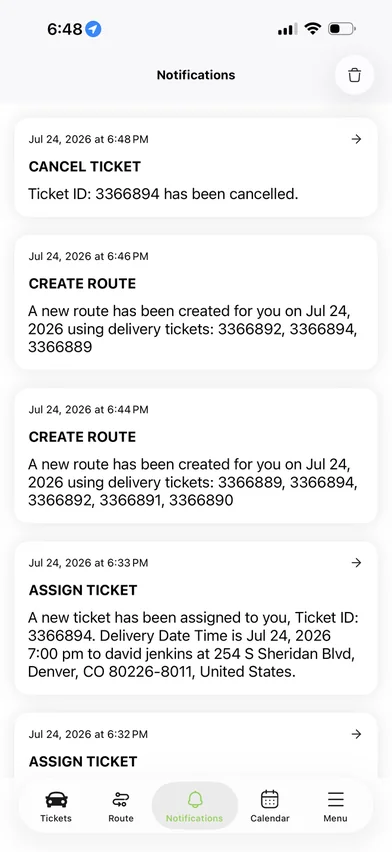
New assignment, reassignment, and message alerts on the phone.

Screens are from the shipping iOS and Android driver app.

Dispatch software

The screen your day actually runs on

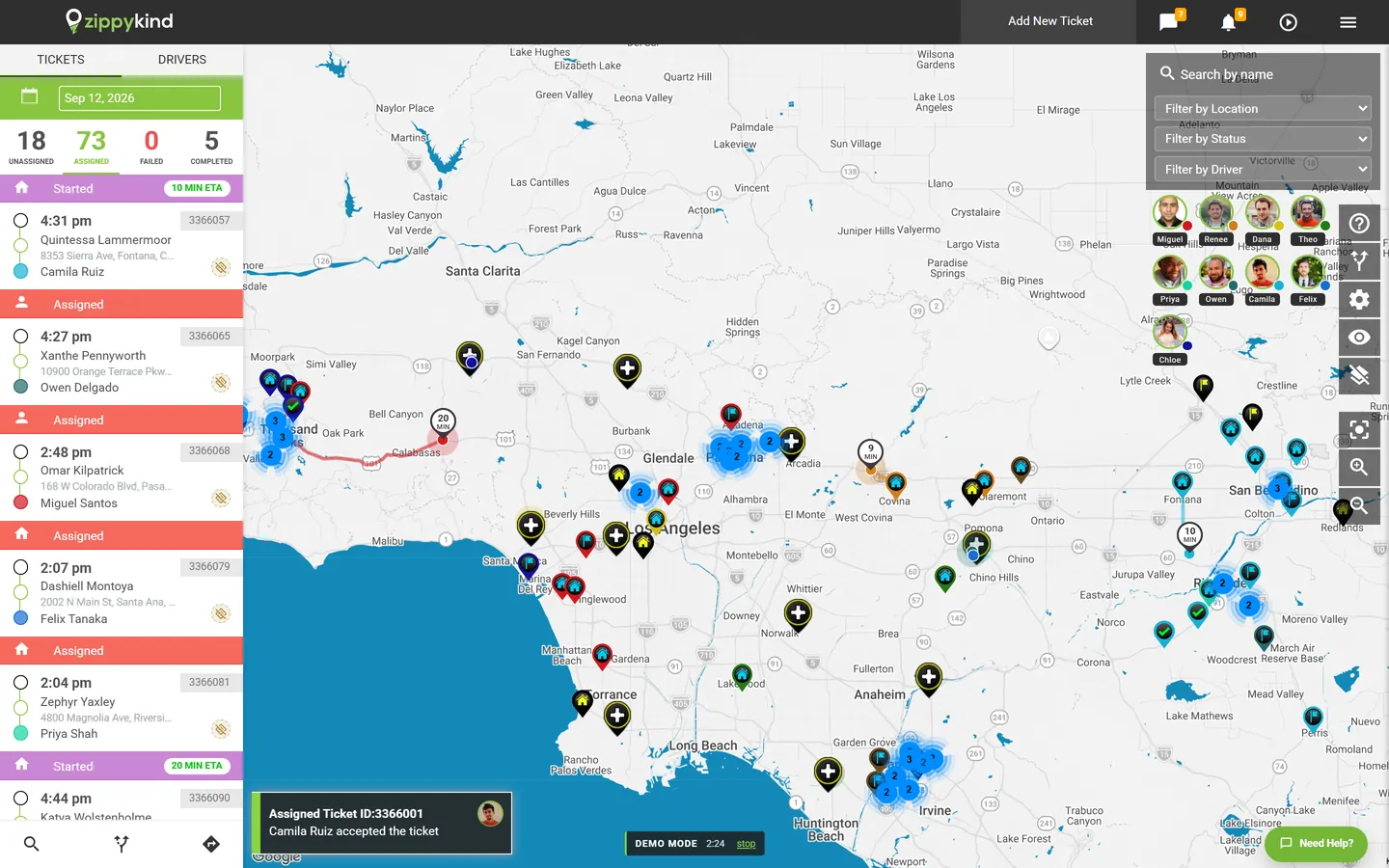
The dispatcher side of Zippykind: every driver on one map, every ticket on one dashboard, and the routing, scheduling and messaging that move them.

Dashboard

The whole day, on one screen

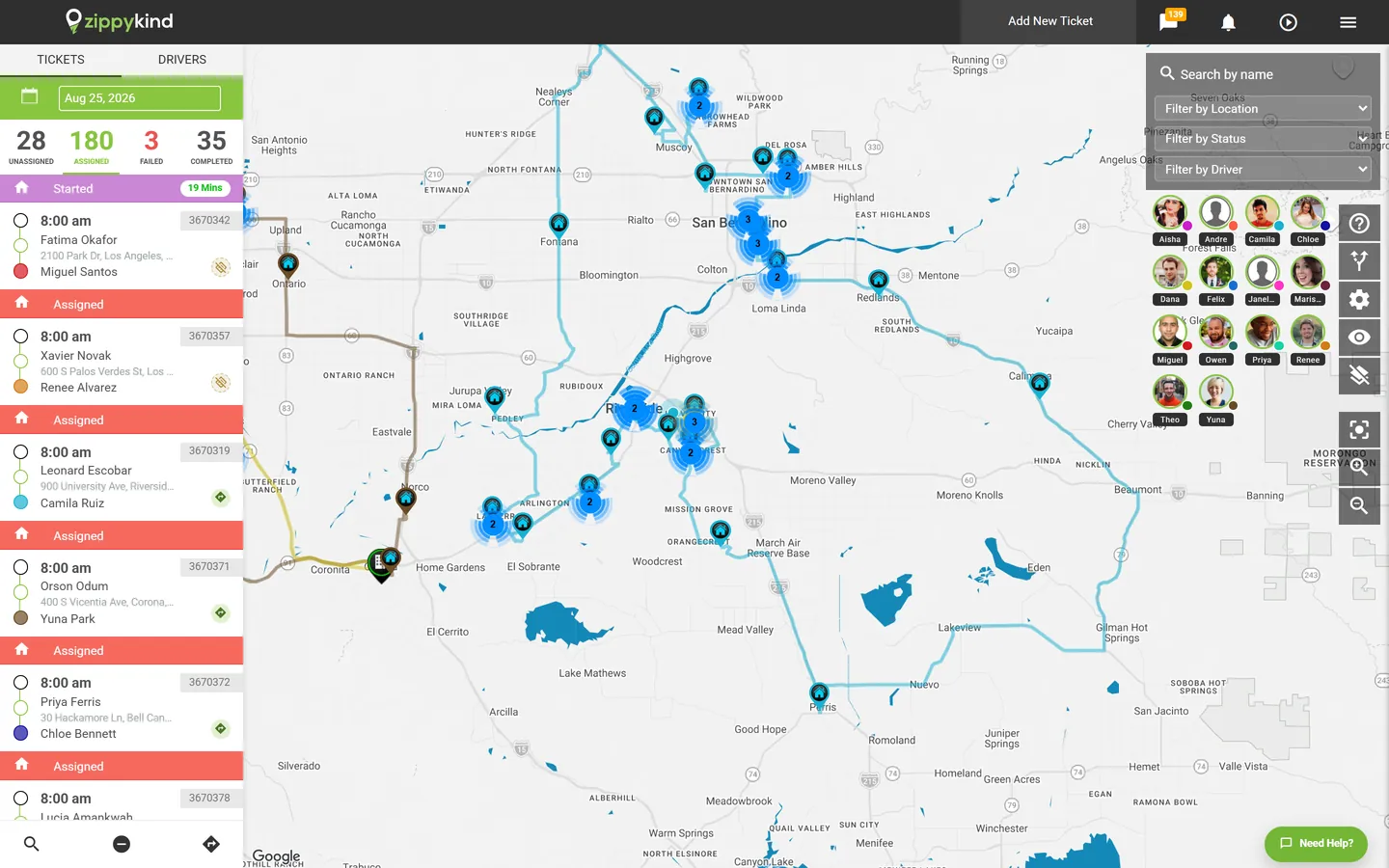
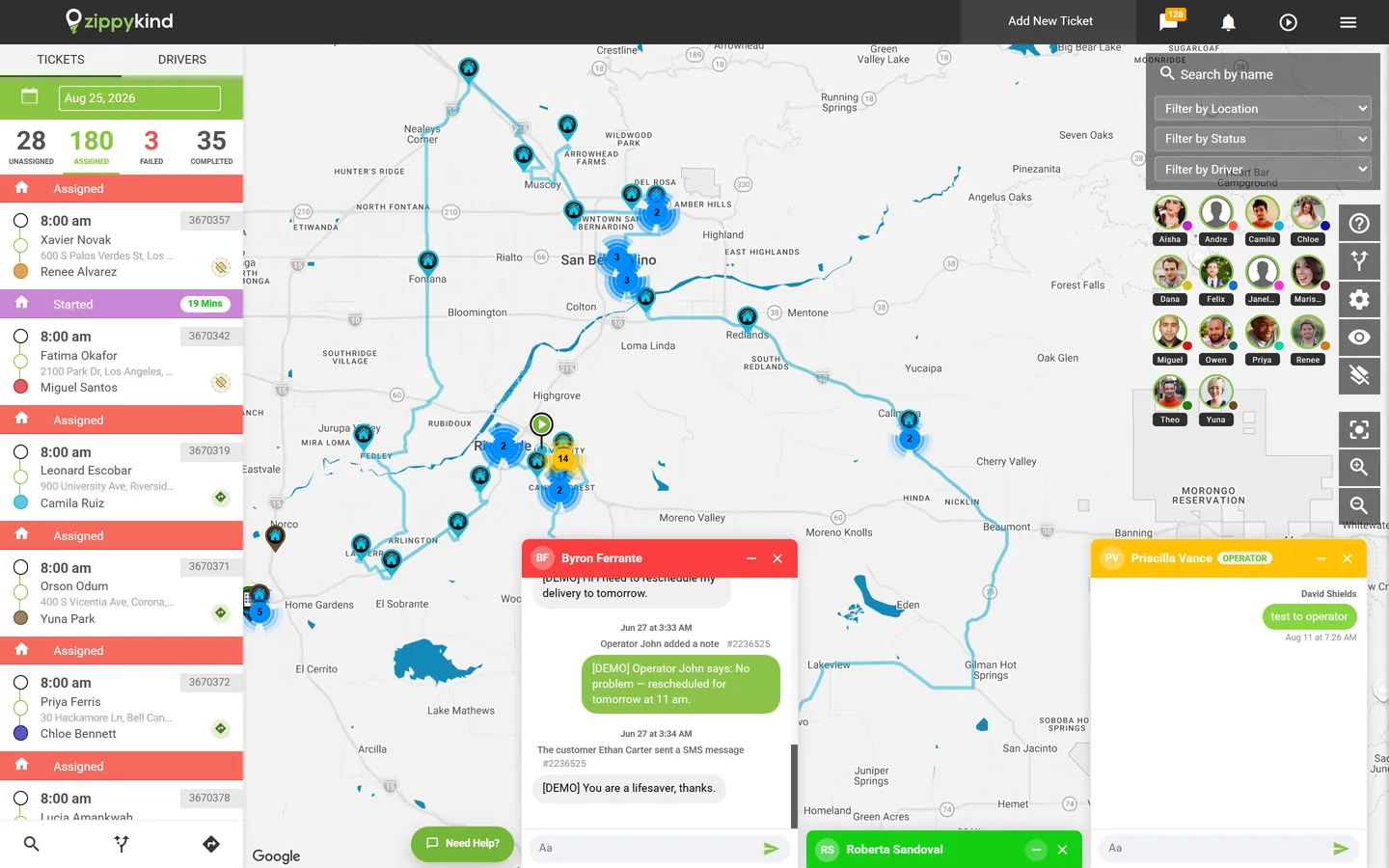
Zippykind opens on a live map with every driver and every stop on it, and a rail down the left that counts the day as it happens. Routing, zoning, messaging and reassigning all start here, without leaving the page.

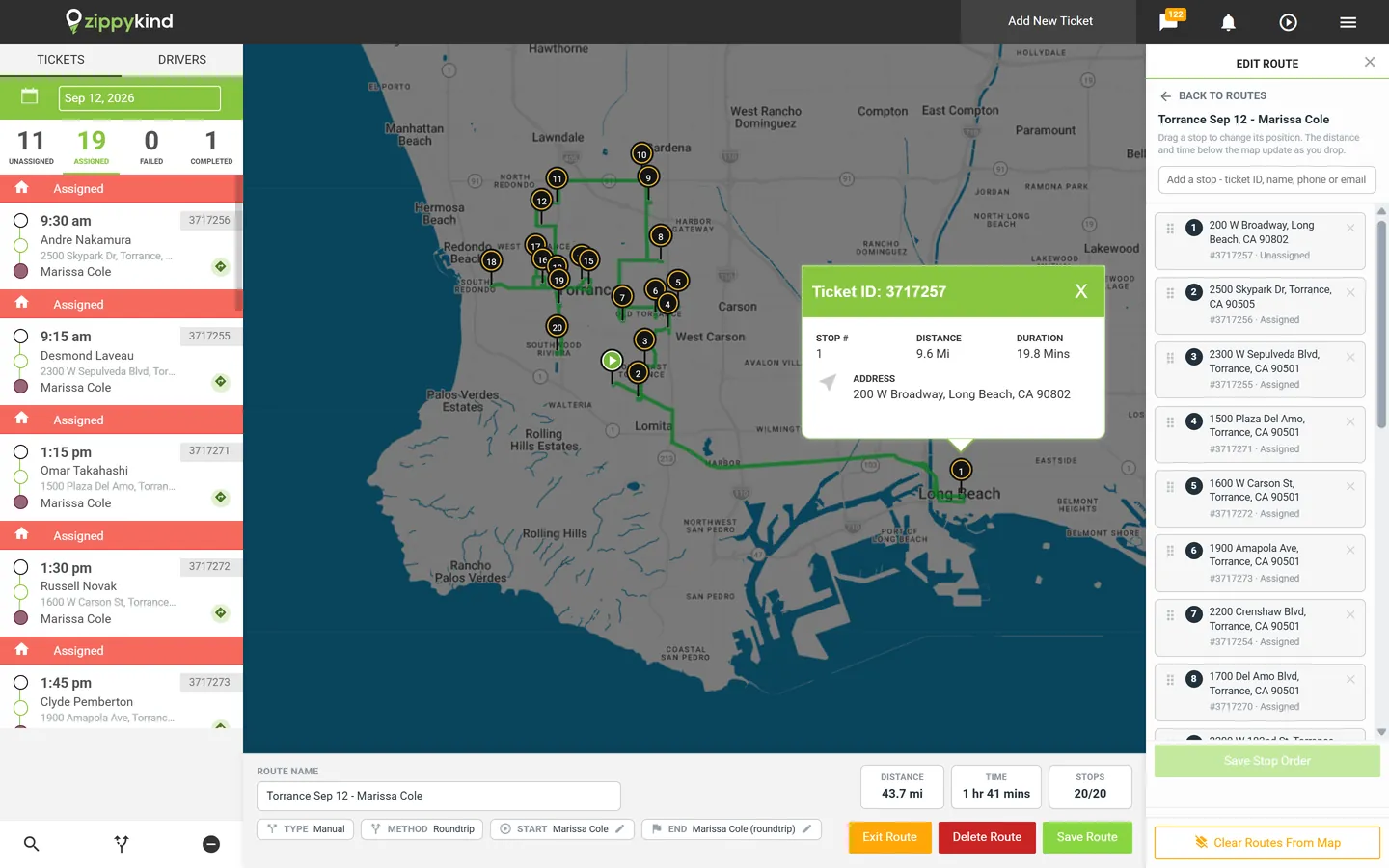
20 stops 43.7 miles, 1 hr 41 — the route panel prices a change before you commit it

The Zippykind dispatch dashboard with a ticket rail and a live driver map
Tickets down the left, drivers on the map, and the day counted across the top: unassigned, assigned, failed, completed.
The dispatch map zoomed out across a wide service area with clustered stops
Zoom out and the clusters open. Every pin is a stop, every avatar a driver on duty.
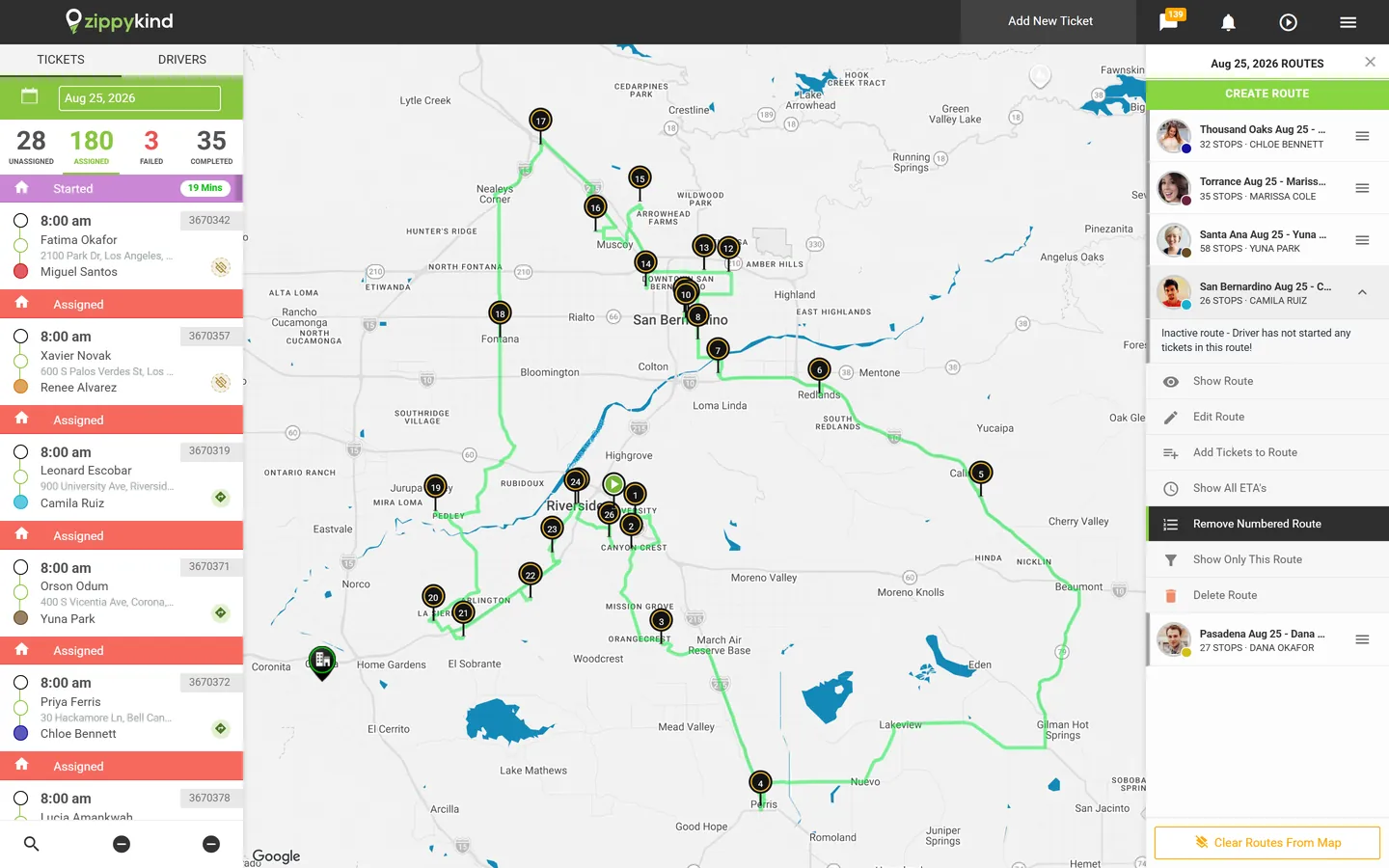
The routes panel listing the day’s routes with one drawn on the map
The routes panel lists the day by driver and stop count, and draws whichever one you pick.
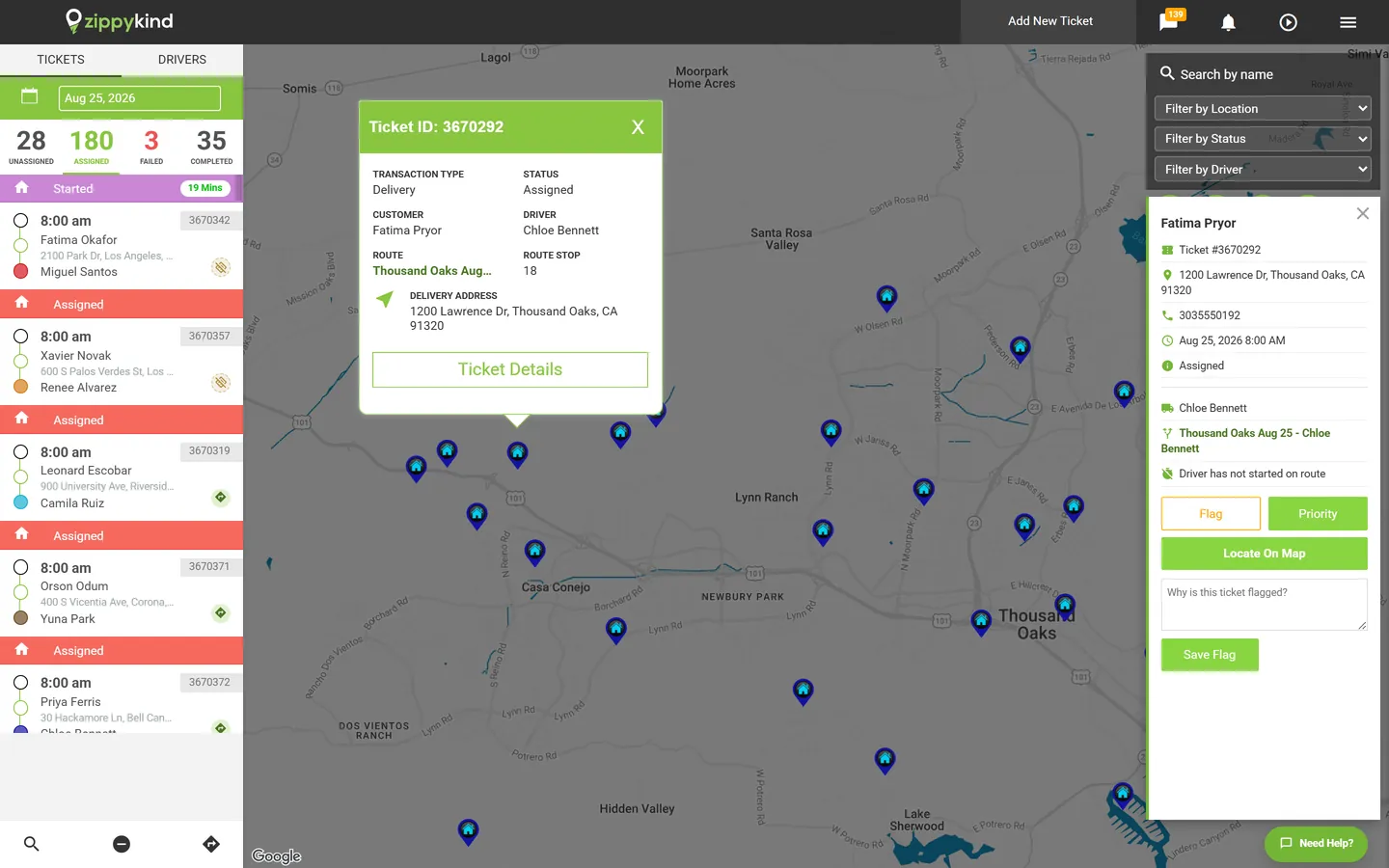
A ticket detail popup open on the dispatch map
Click a pin for the ticket behind it — customer, driver, route position, address — and flag it without opening anything.
A polygon drawn on the dispatch map with a ticket count and a create-route prompt
Draw a zone and Zippykind counts the tickets inside it, ready to become a route.
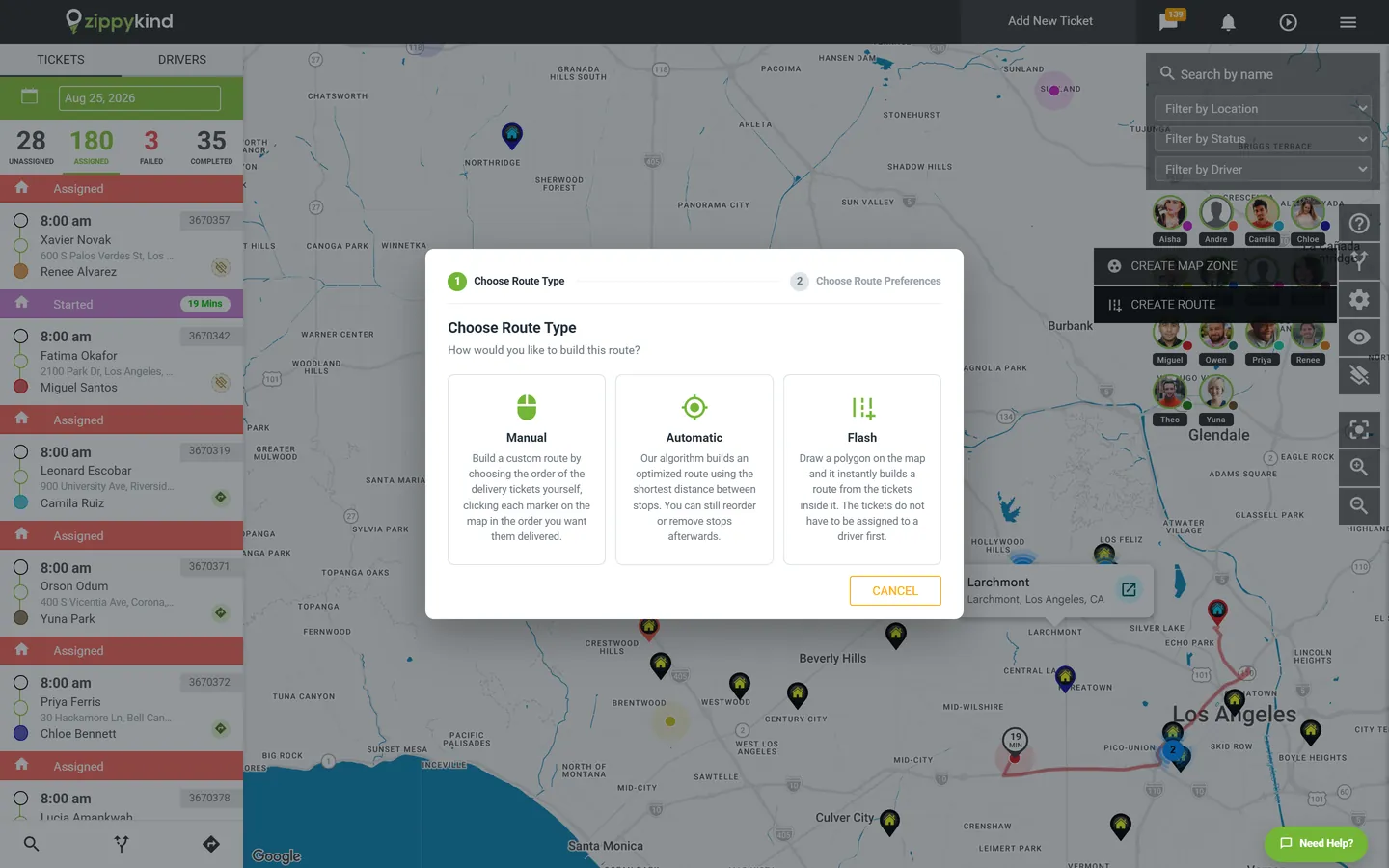
The route type chooser offering manual, automatic and flash routing
Three ways to build a route: order the stops yourself, let the algorithm shorten the drive, or draw a polygon and take everything inside it.
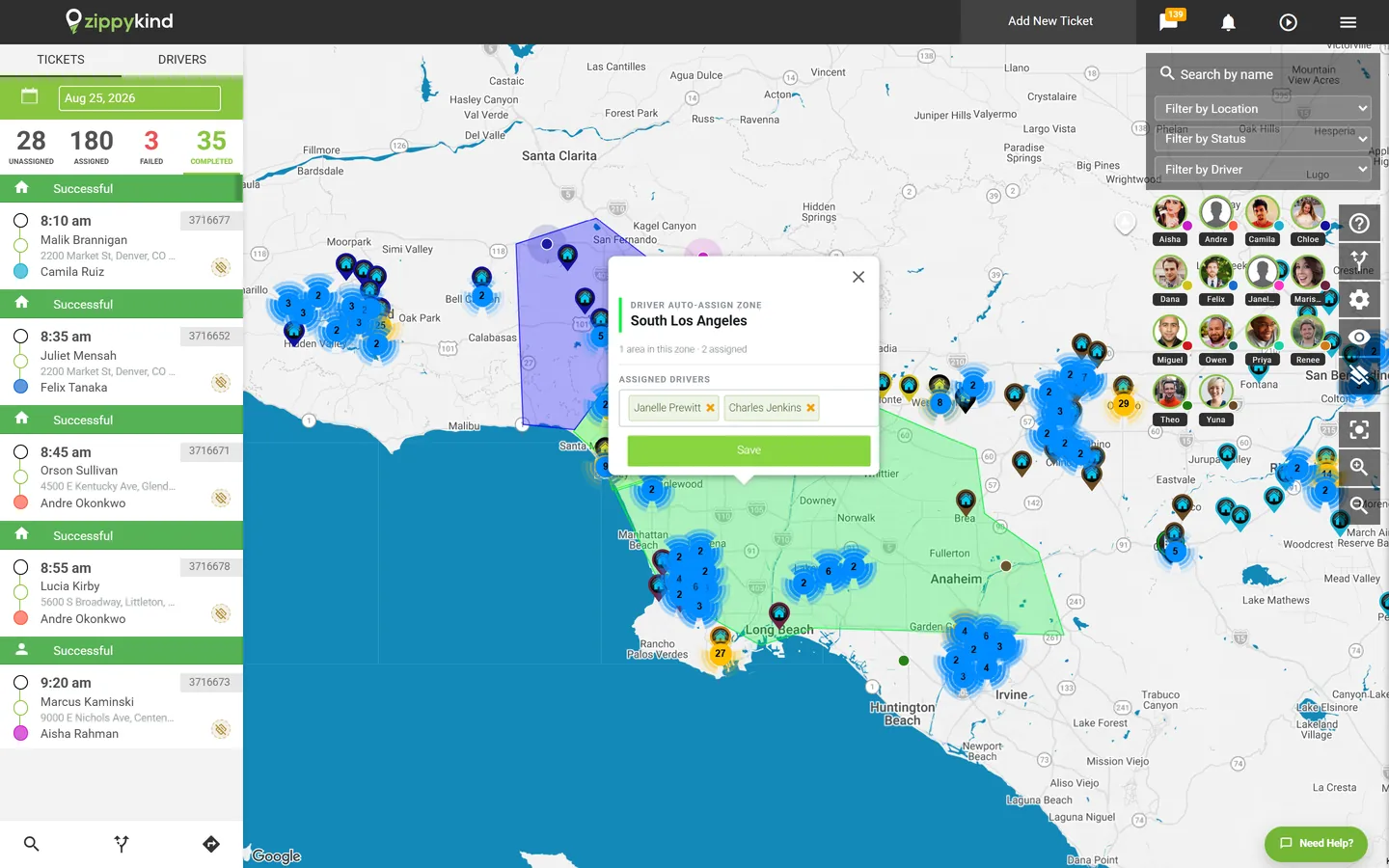
A driver auto-dispatch zone on the map with assigned drivers listed
Auto-dispatch zones: draw the area, name the drivers, and new tickets inside it go to them.
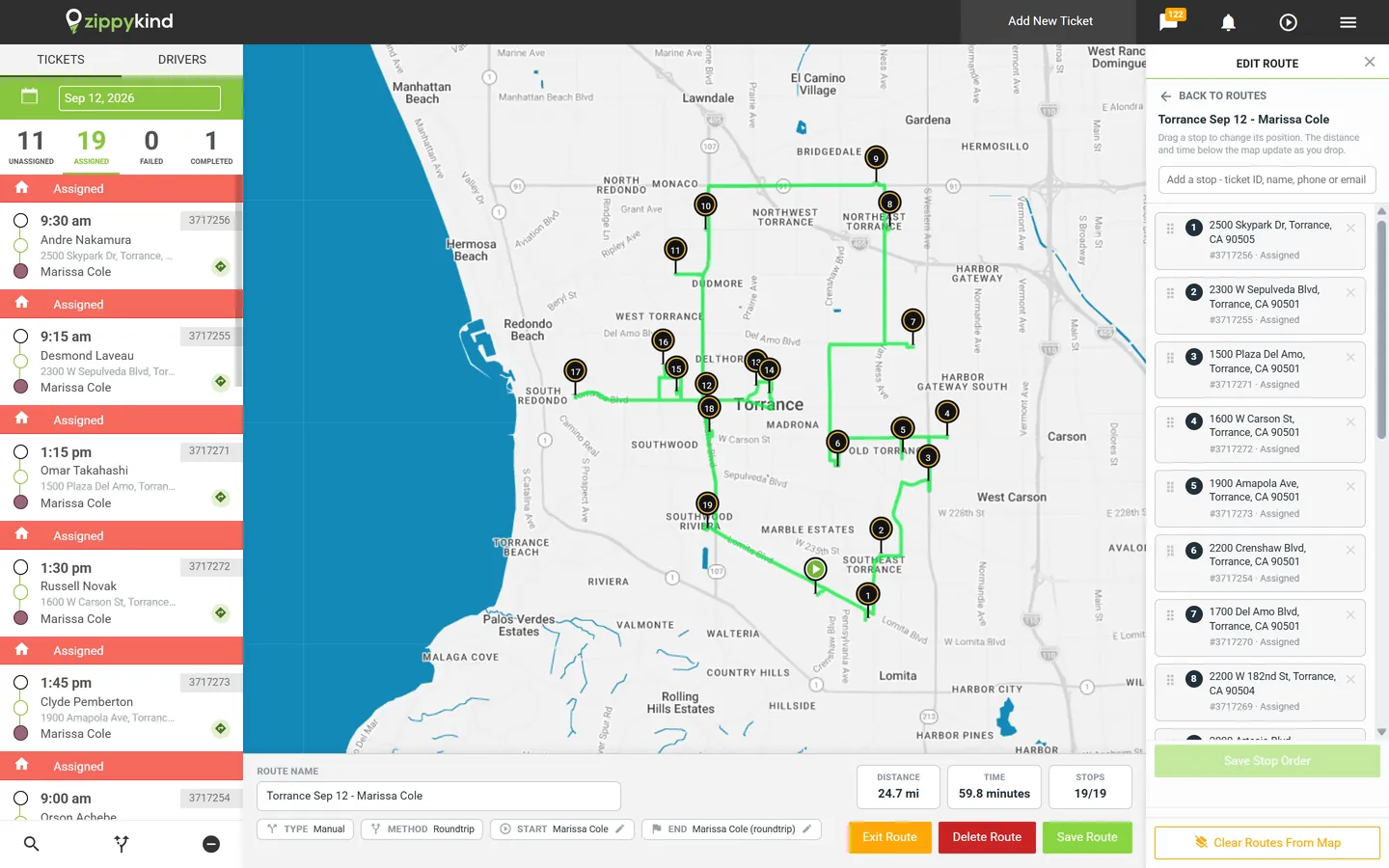
The route editor with a draggable stop list and live distance and time totals
Drag a stop to move it and the distance, time and stop count follow as you drop.
A stop being added to an existing route, with the totals updating
Adding a twentieth stop re-prices the route in front of you: 24.7 miles became 43.7.
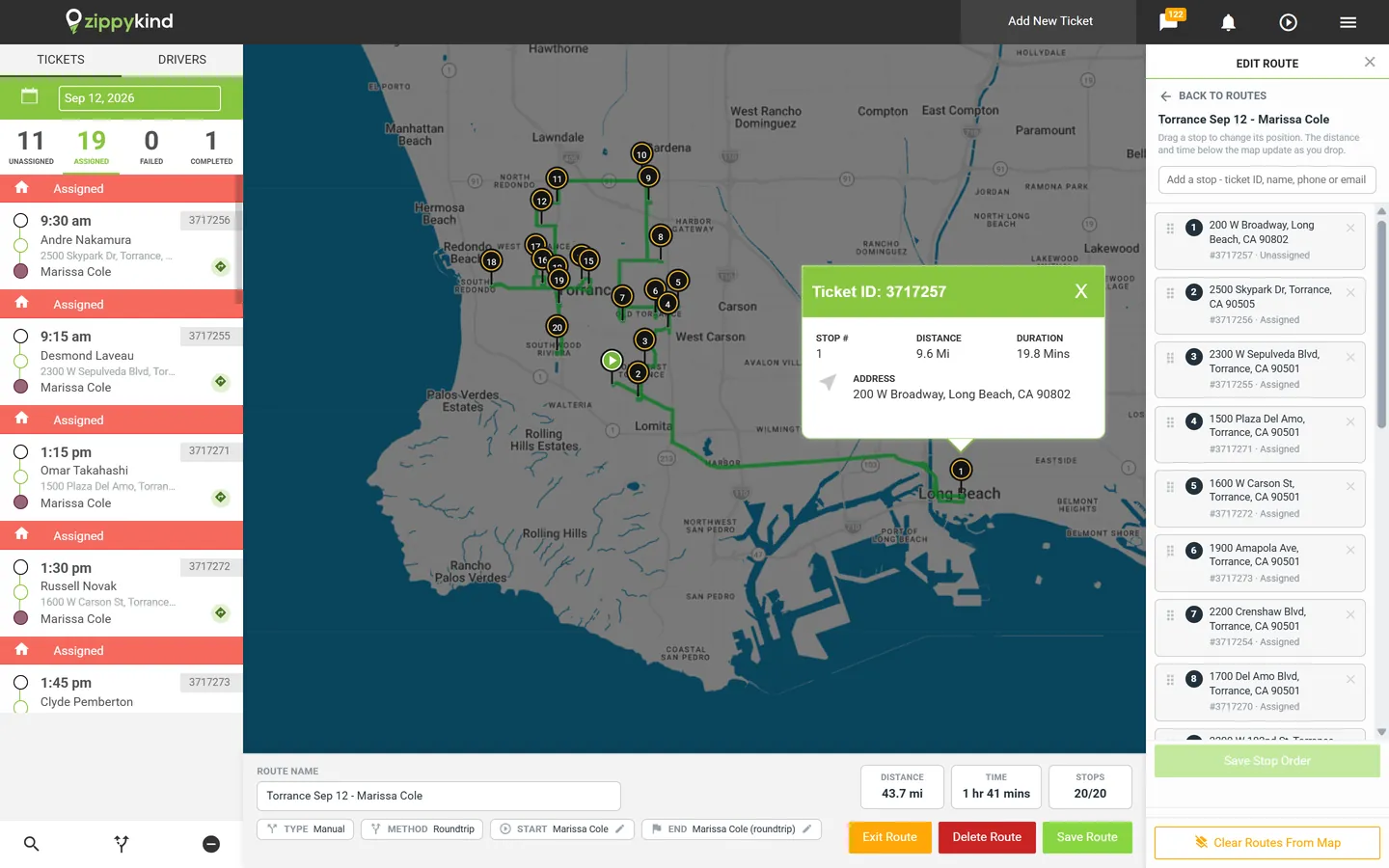
The route editor after a stop was added, totals recalculated
The added stop is priced on its own too — 9.6 miles and 19.8 minutes from the one before it.
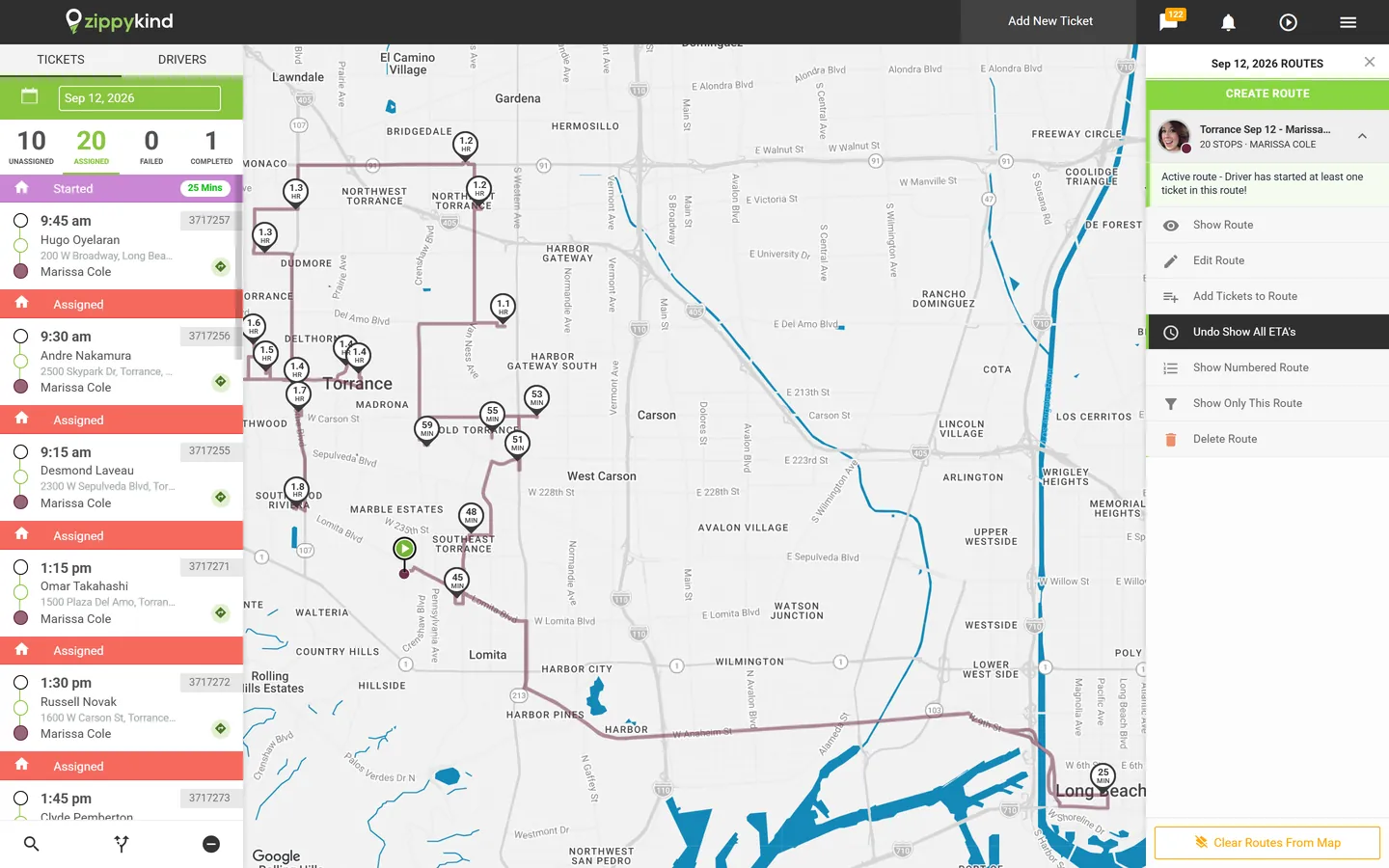
A twenty-stop route with an arrival estimate on each stop
Show all ETAs and every stop carries its own arrival estimate.
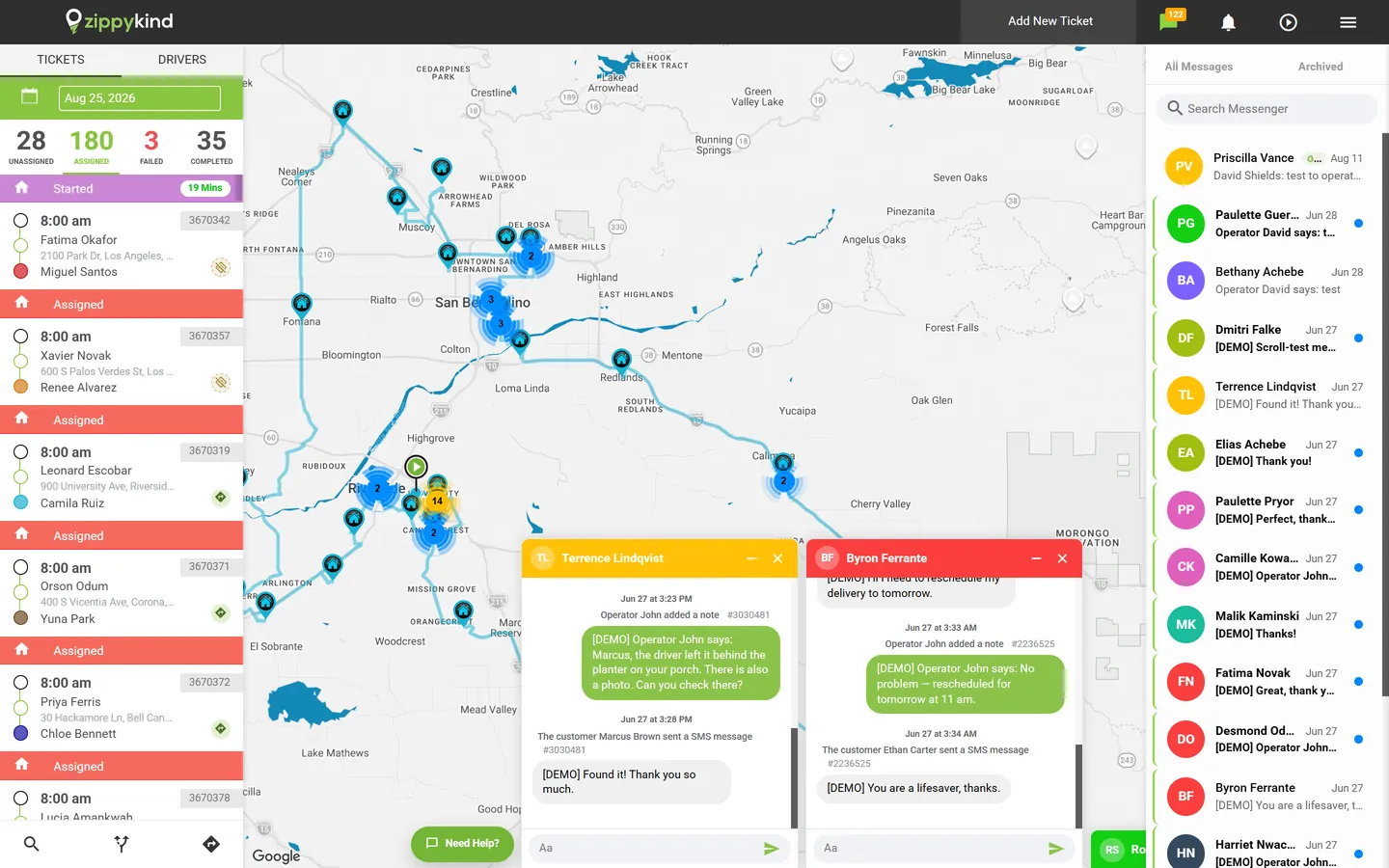
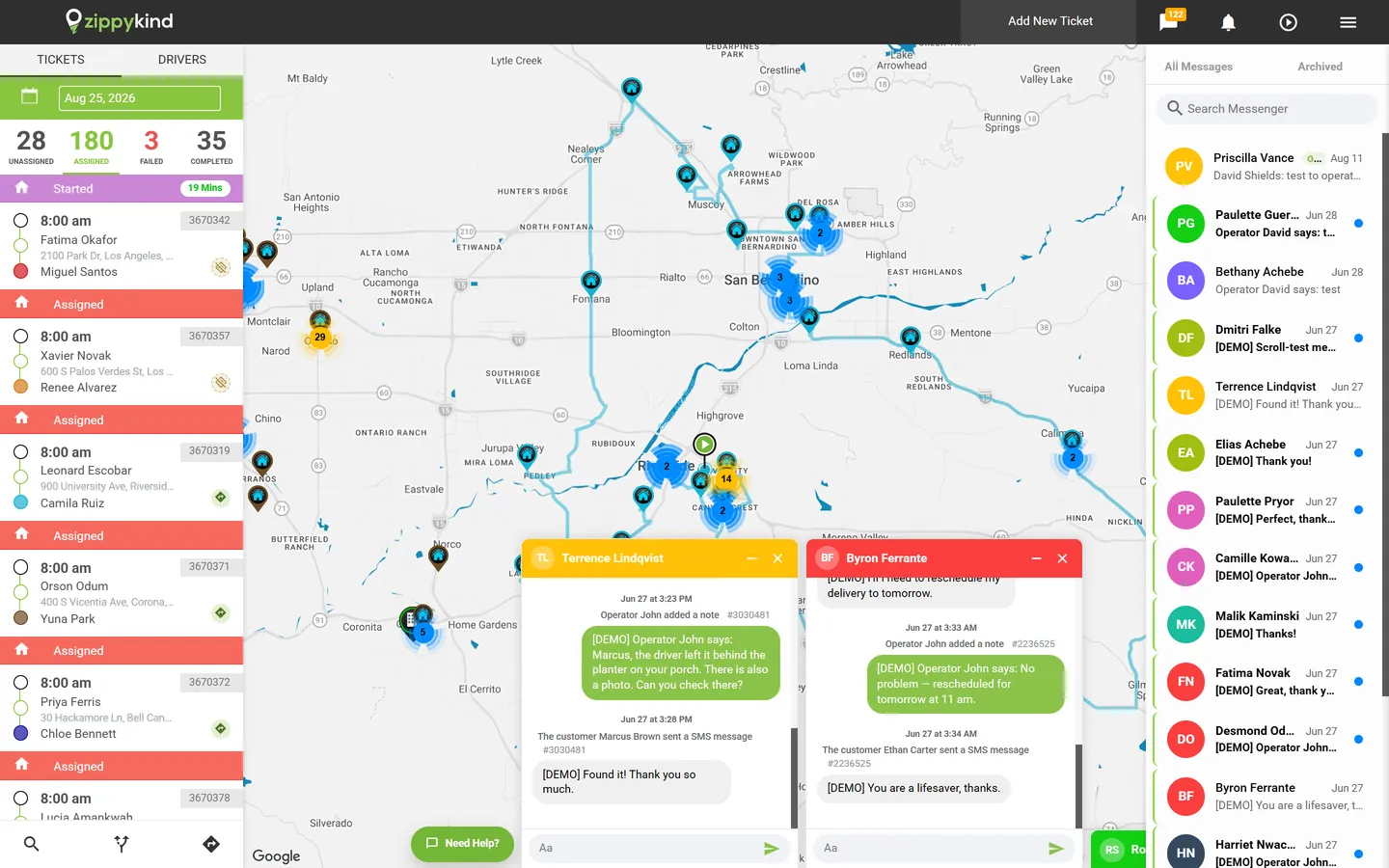
Customer chat windows docked over the live dispatch map
Customer threads dock over the map, so a question gets answered without leaving dispatch.
Docked chat windows over a zoomed-out dispatch map
The messenger list stays open beside them, so the next unanswered thread is one click away.
A mix of customer and internal operator chat windows docked over the map
Operators dock alongside customers. The amber header is an internal thread, and it never reaches a driver or a recipient.
A driver payroll zone drawn on the map with a pay rate and assigned driver
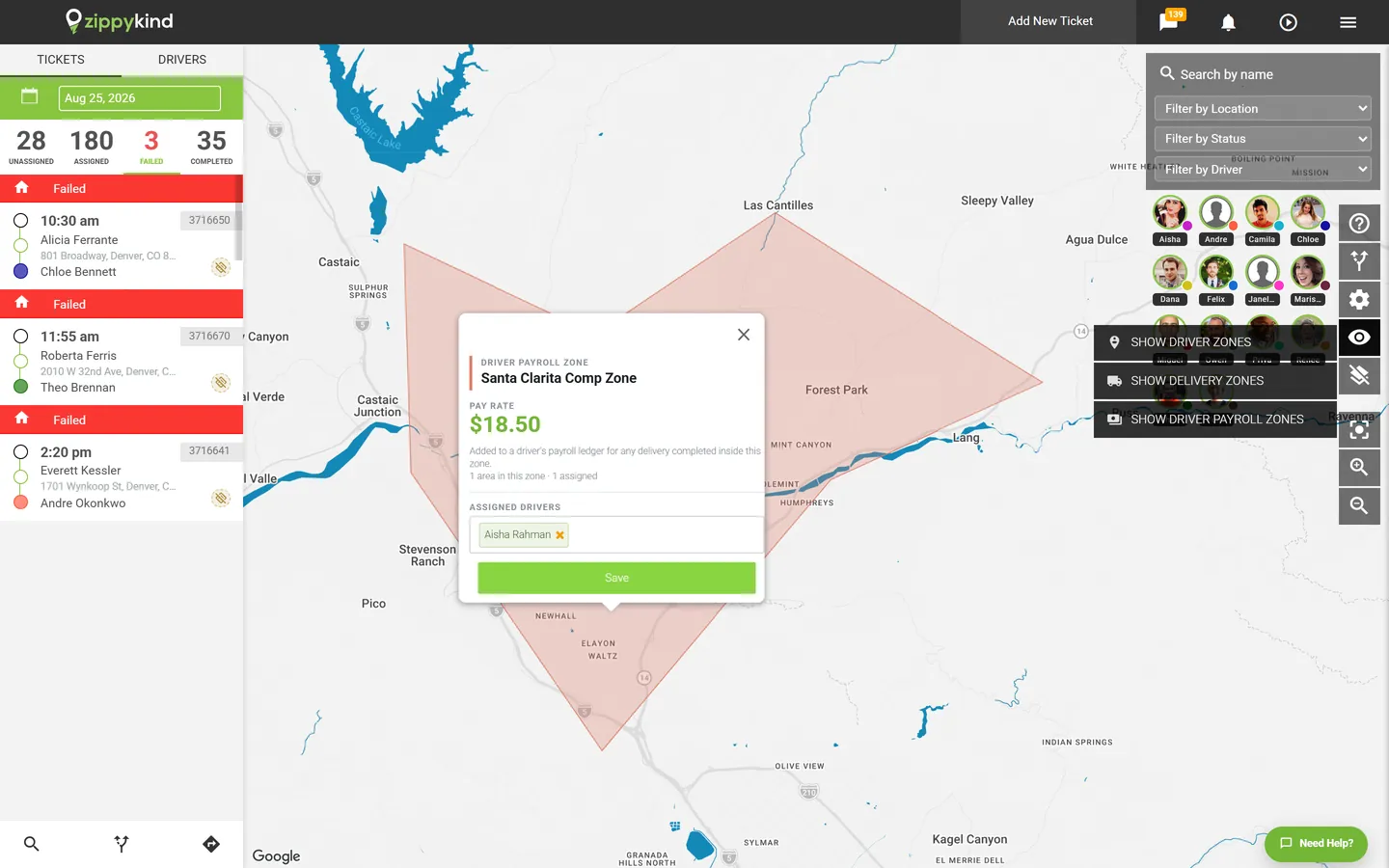
Payroll zones put a pay rate on an area — $18.50 here — added to a driver’s ledger for any delivery completed inside it.

Tickets

Every delivery, and the paperwork that proves it

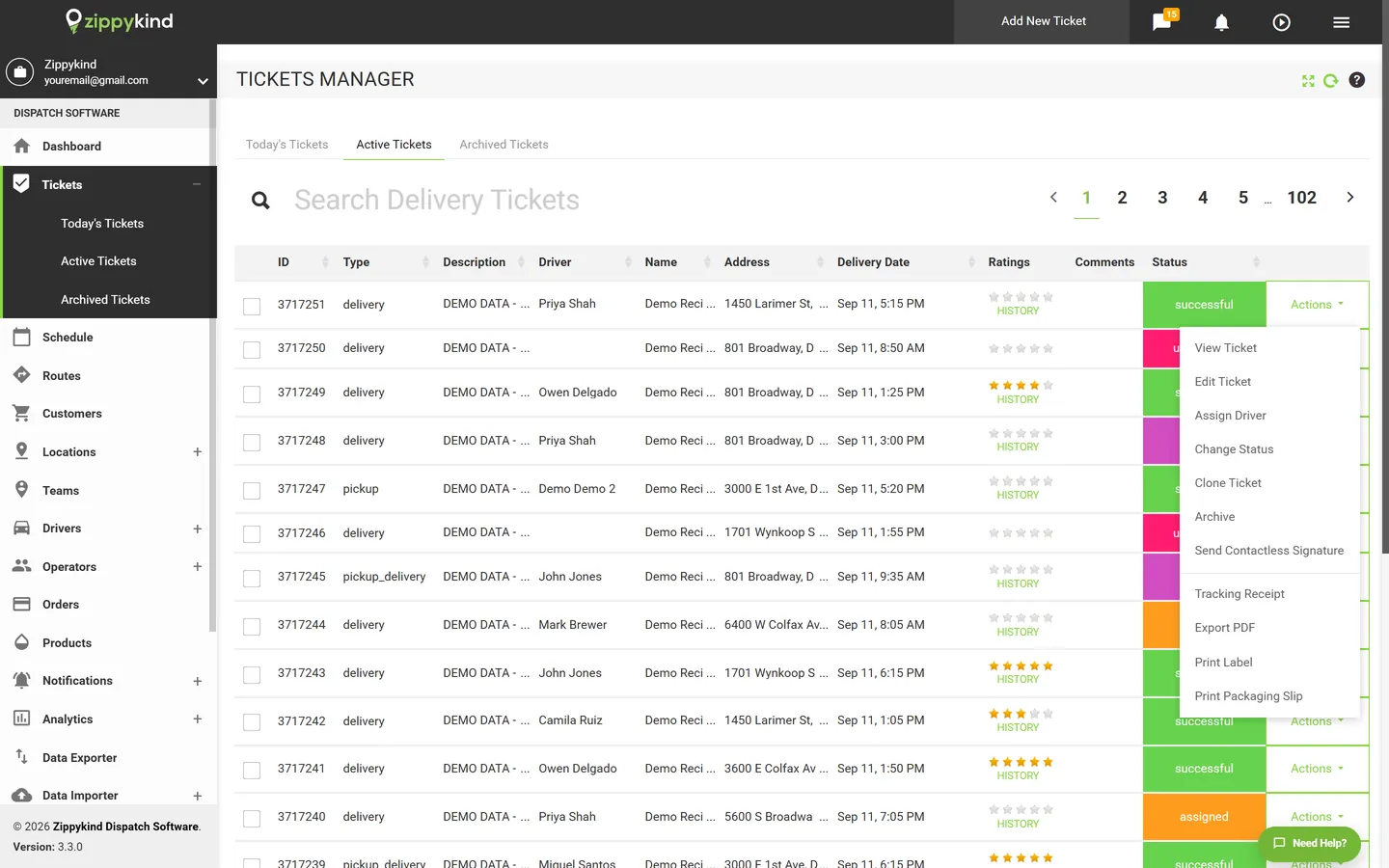
The Tickets Manager holds today’s, active and archived deliveries. What makes it more than a list is what a row can produce: a printed label, a packing slip, a signed PDF, a tracking link the customer can open.

The Tickets Manager with the per-row actions menu open
Search, sort and page the whole history. Any row opens the actions a dispatcher reaches for — assign, change status, clone, request a contactless signature, print, export.
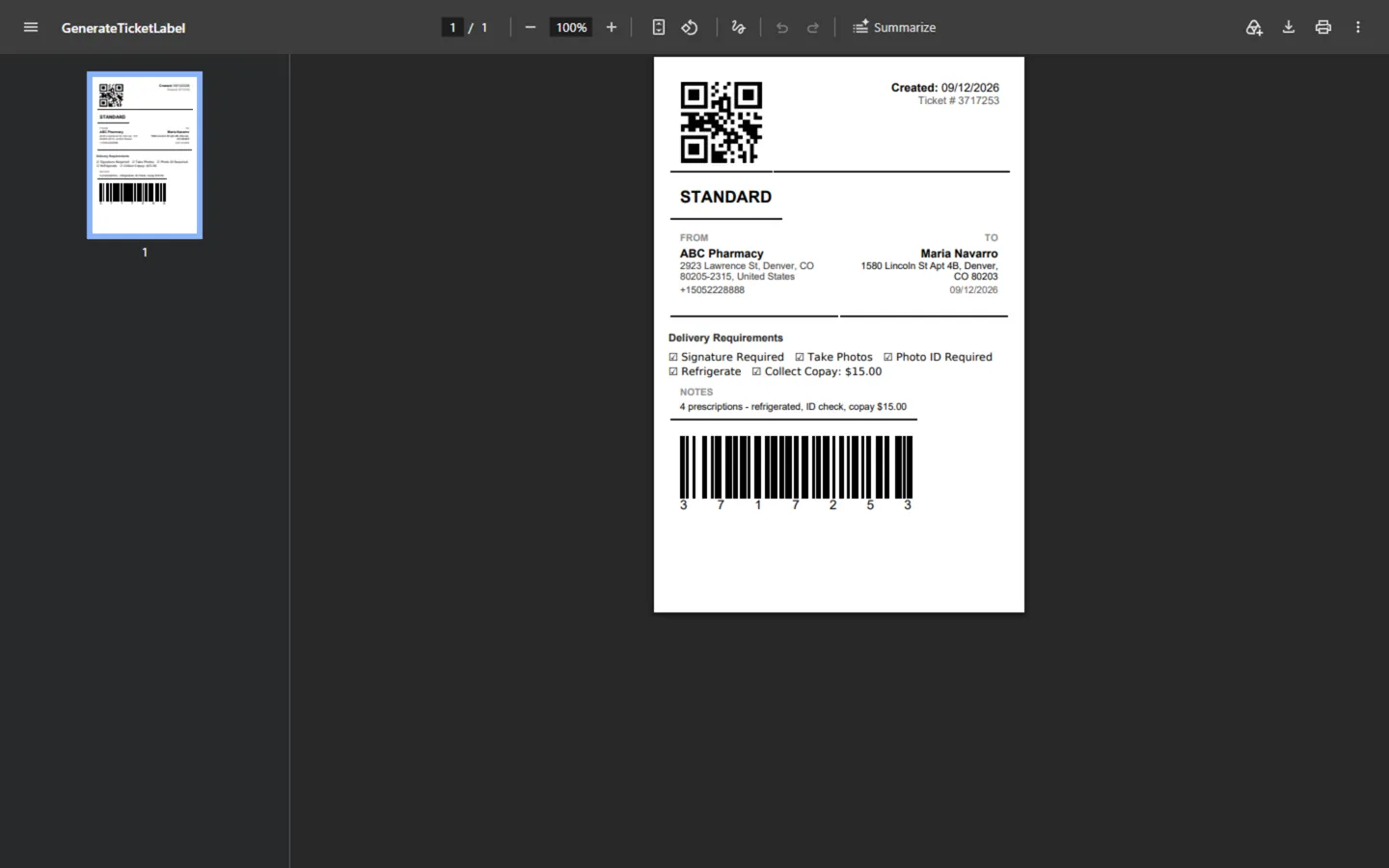
A printed delivery label with QR code, addresses and delivery requirements
The printed label carries the QR, both addresses, and the delivery requirements as checkboxes the driver works through.
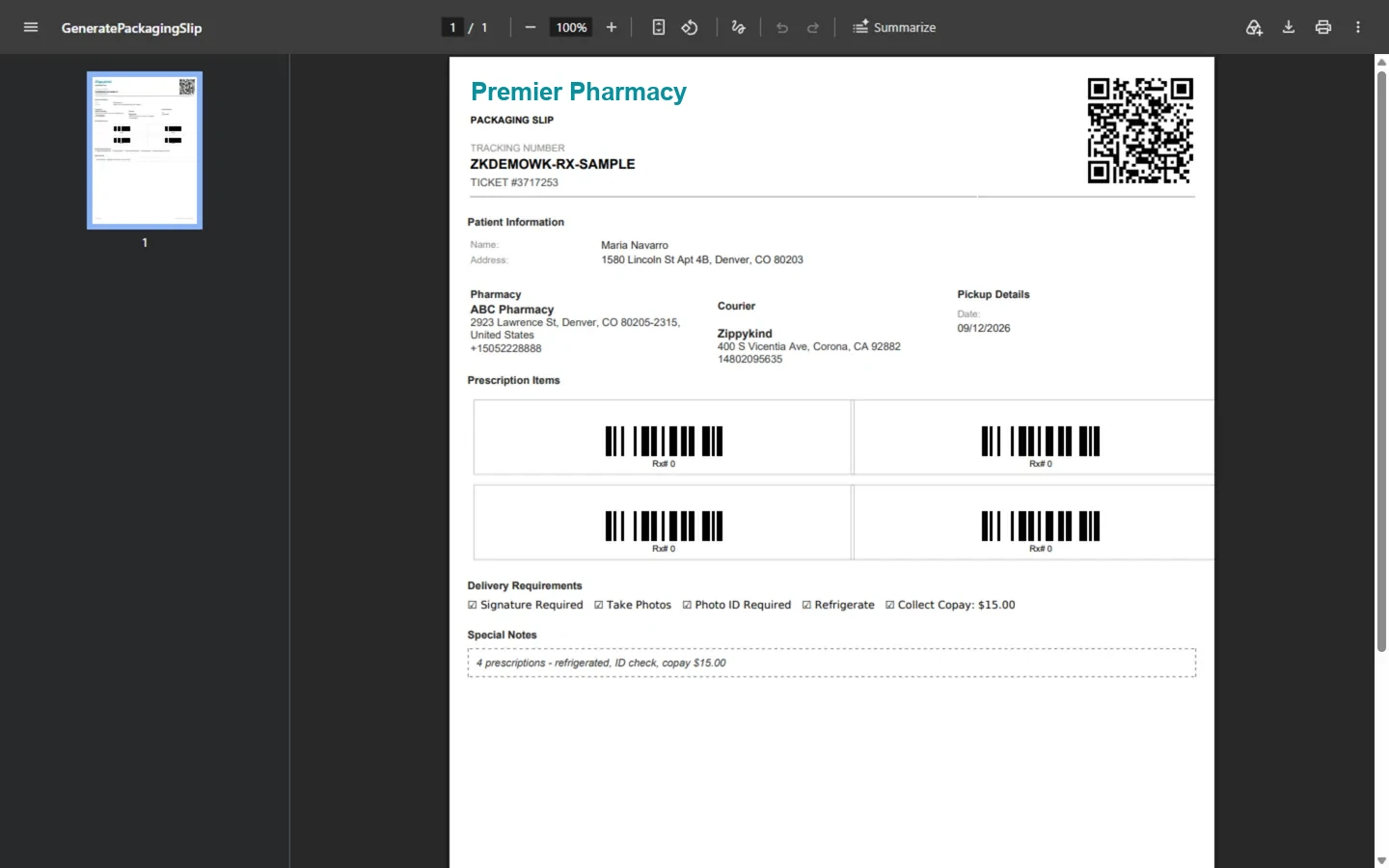
A packaging slip listing prescription items with barcodes
The packing slip adds the items, each with its own barcode, and repeats the requirements as a checklist.
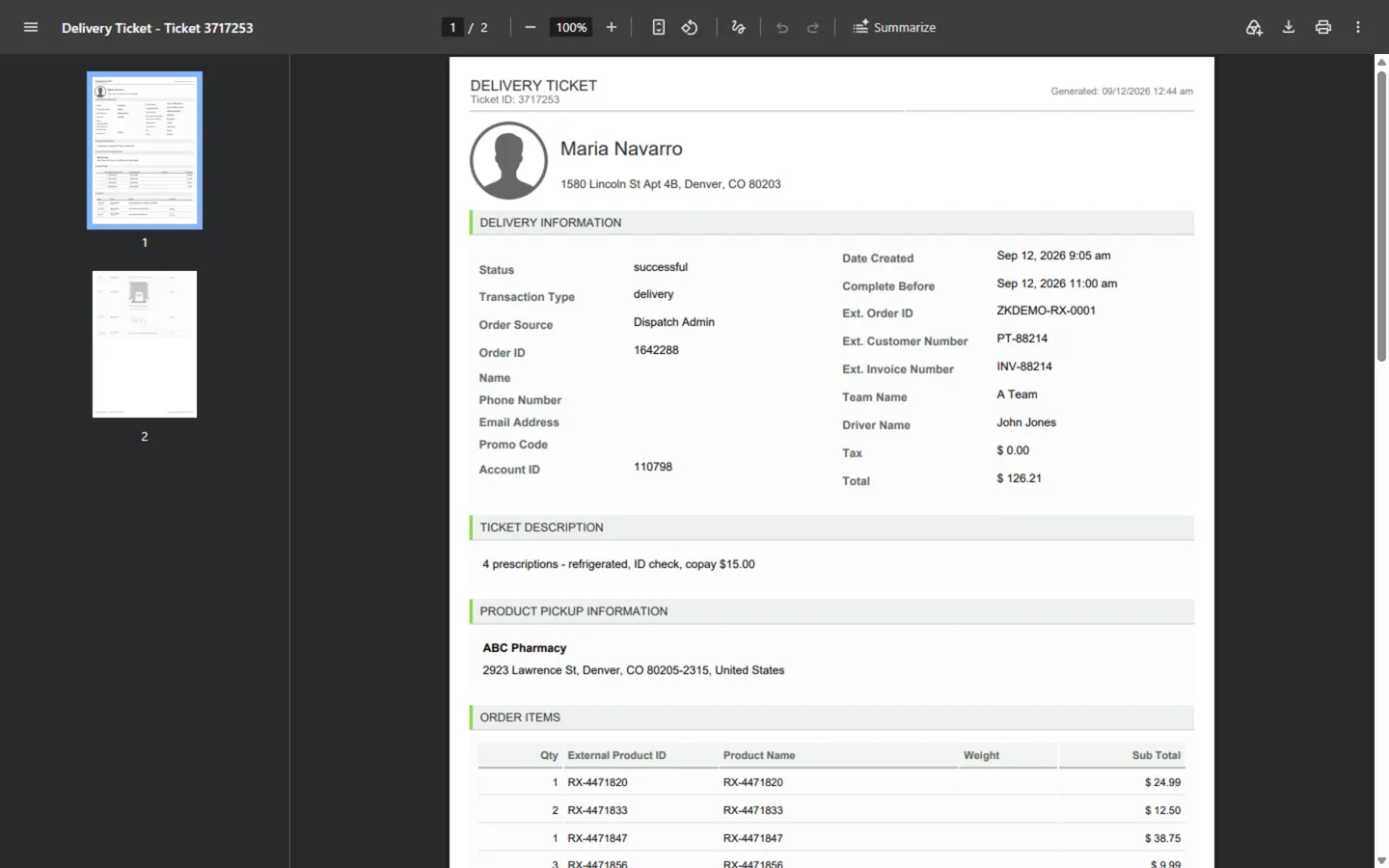
Page one of a delivery ticket PDF showing delivery and order information
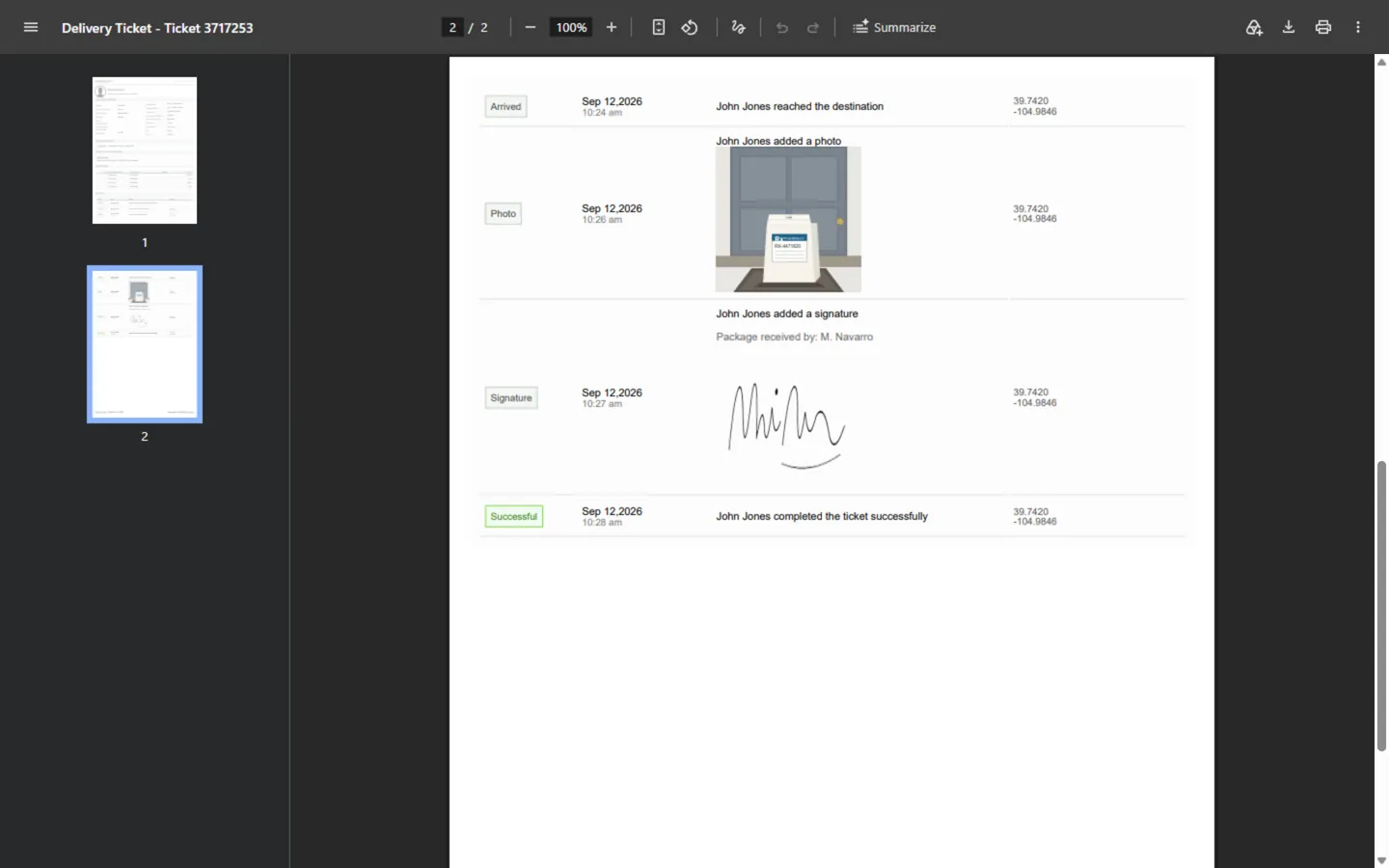
Page two of a delivery ticket PDF showing the proof of delivery timeline with photo, signature and coordinates
The delivery ticket PDF: status, timestamps, external order and invoice numbers, line items and totals. Page two is the chain of custody — arrived, photo, signature, completed — each stamped with a time and a GPS fix.
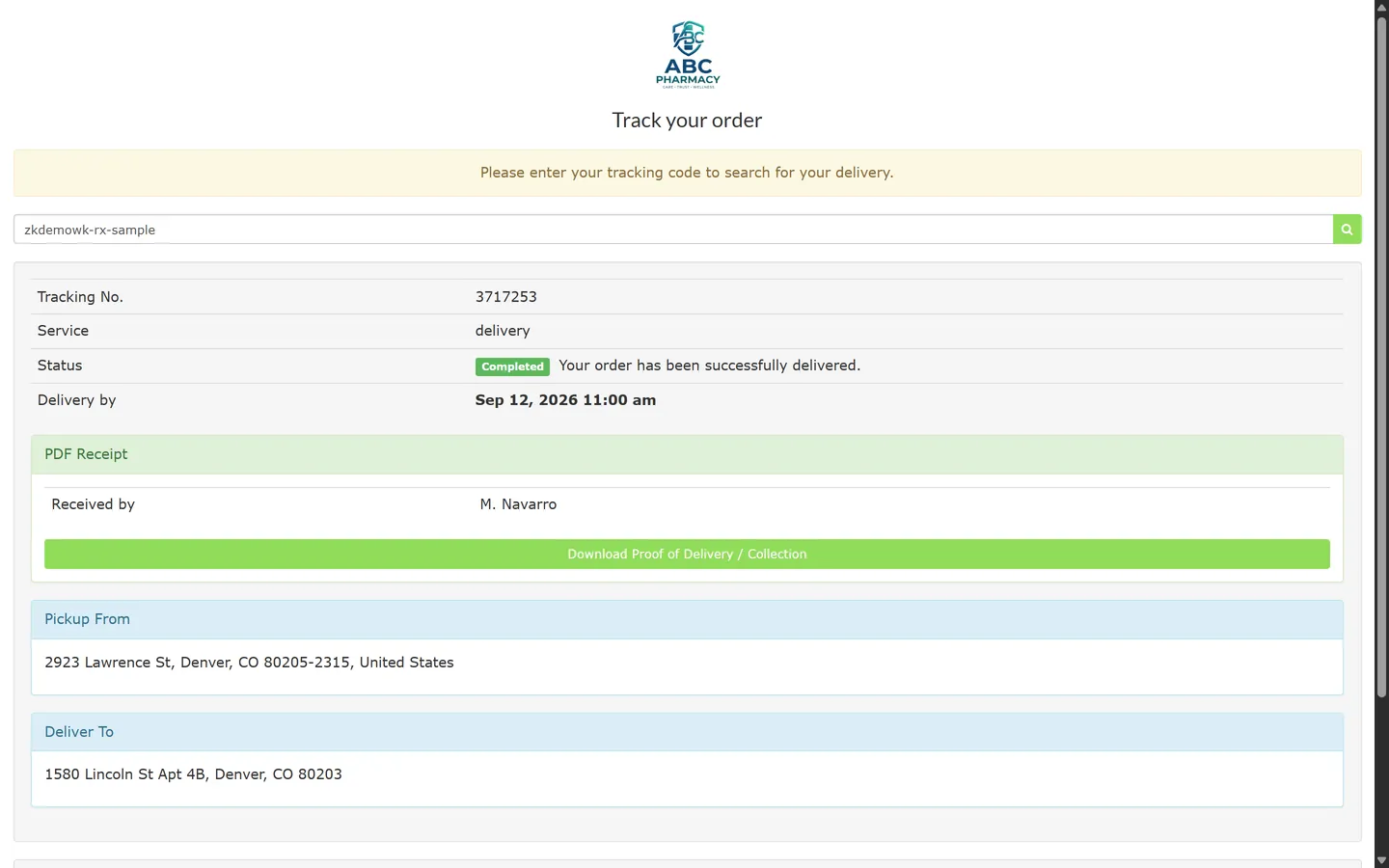
A branded track-your-order page showing a completed delivery and a proof of delivery download
What the recipient sees when they look it up afterwards: your branding, the outcome, and the proof to download.

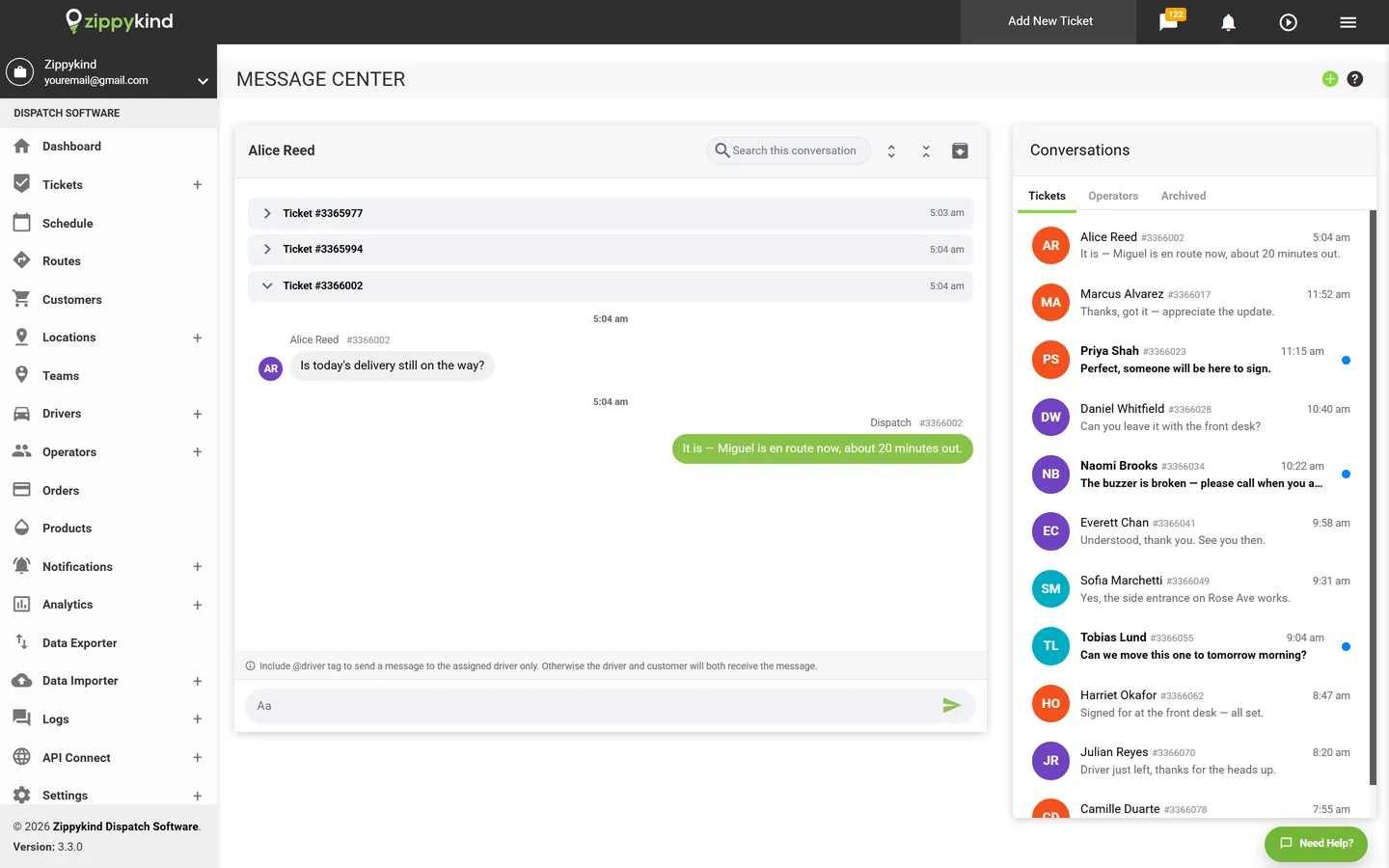
Message Center

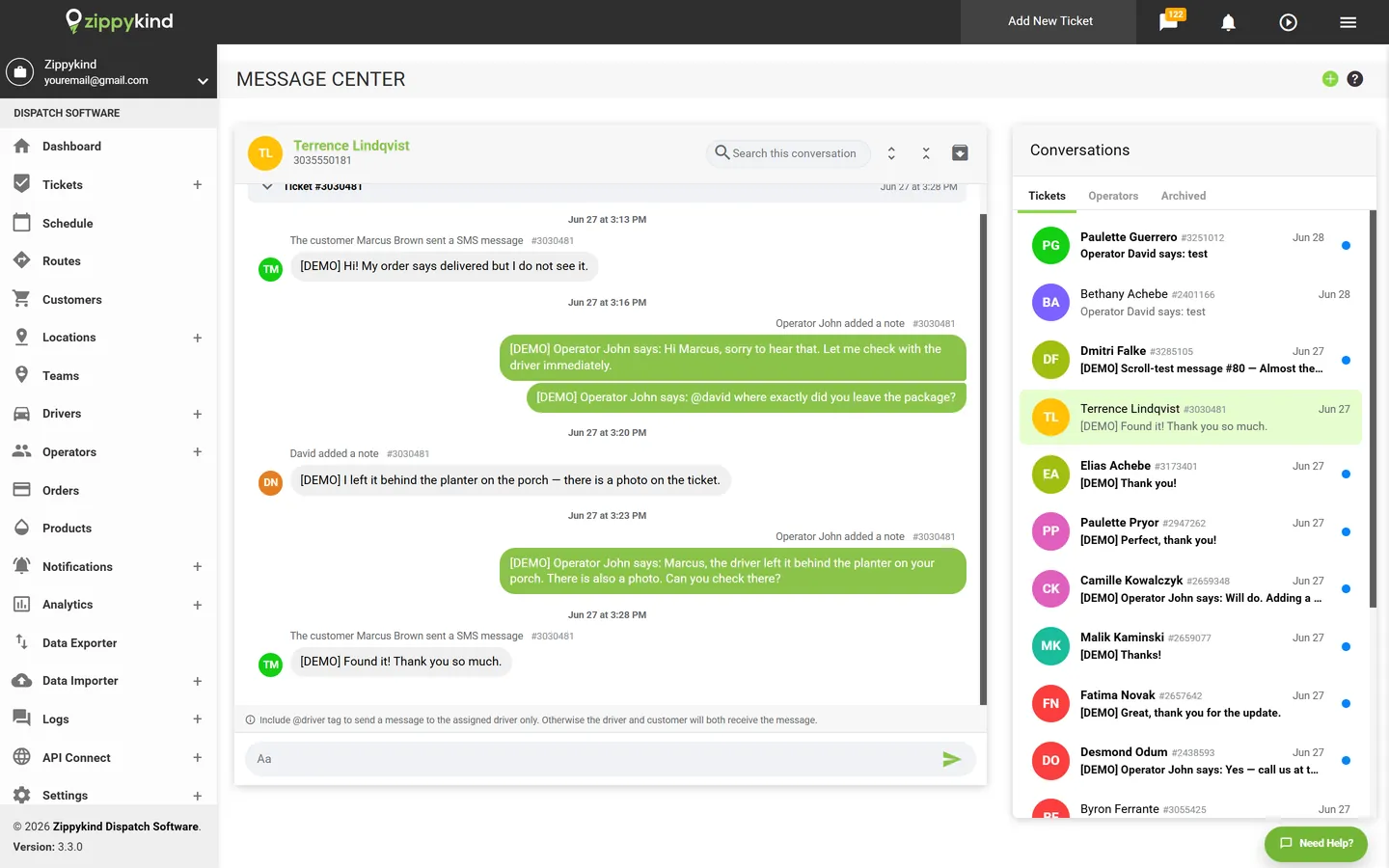
One thread per customer, and the driver in it

Conversations stay attached to their tickets, so the next operator picks one up with the whole history in front of them. Tag the driver and only the driver sees it. Leave the tag off and the customer is in the thread too.

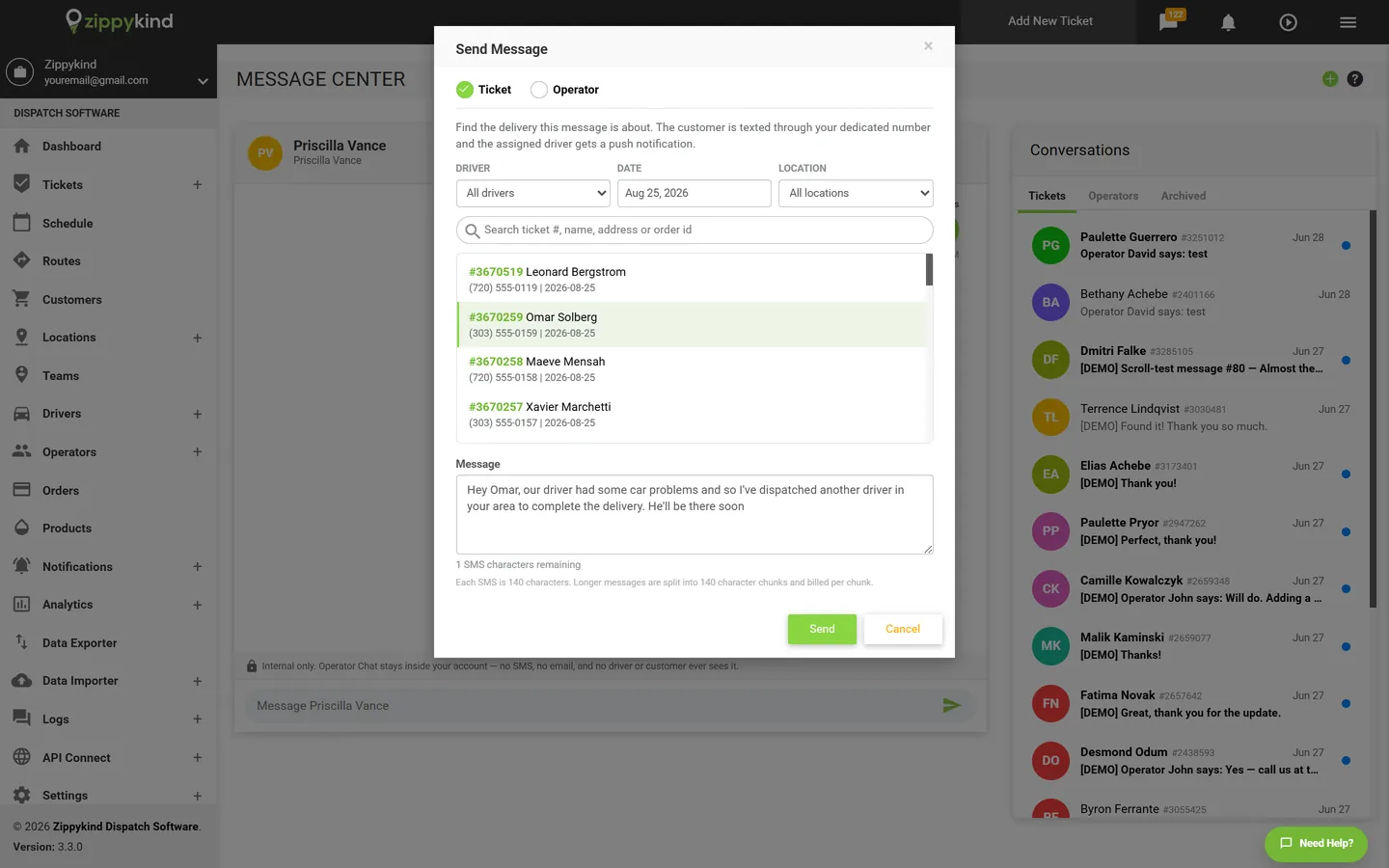
140 characters one SMS. Longer messages split into 140-character chunks and bill per chunk, and the composer counts down as you type

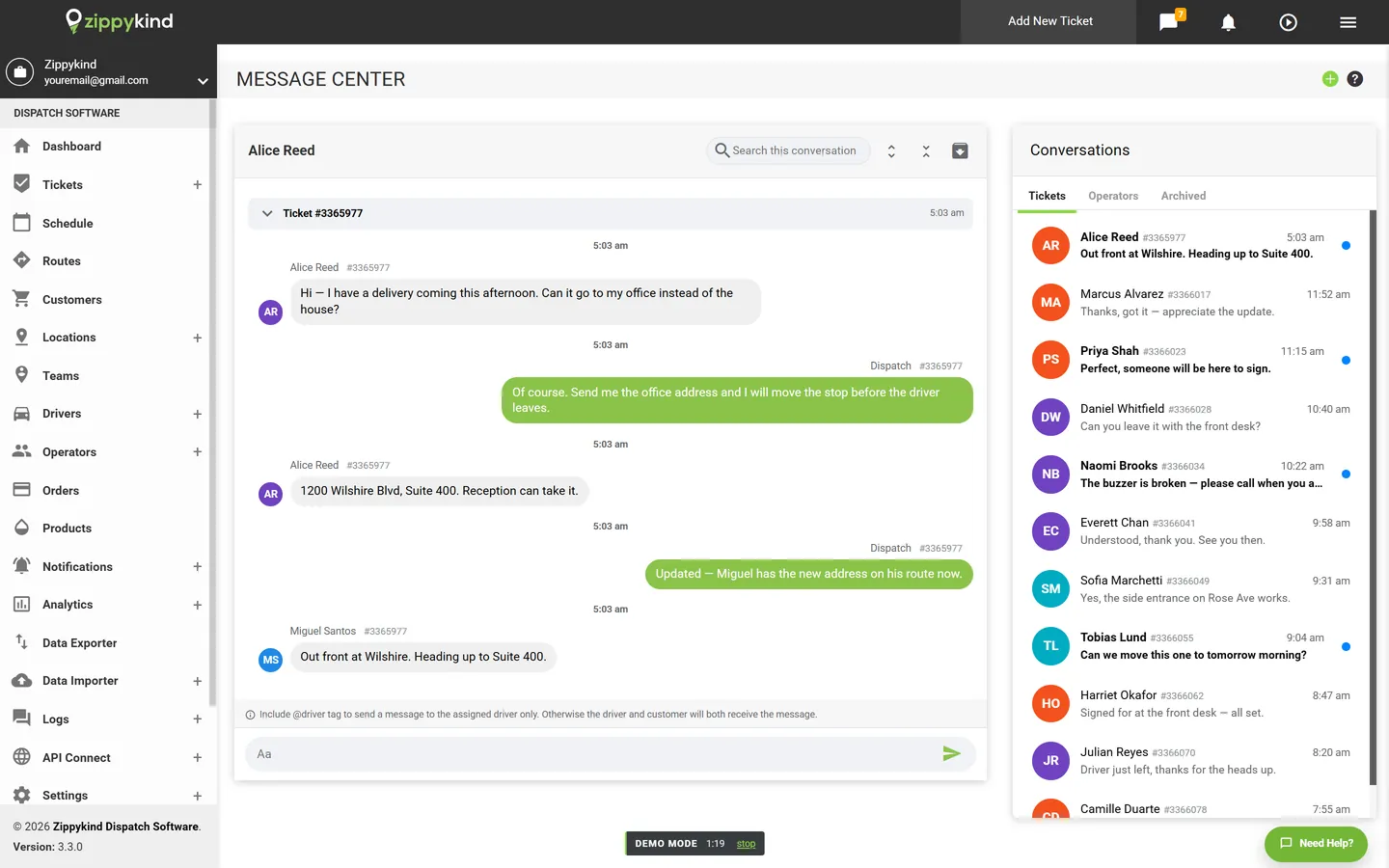
The Message Center with a customer conversation and the conversation list
A live conversation beside the queue, each row carrying its ticket number.
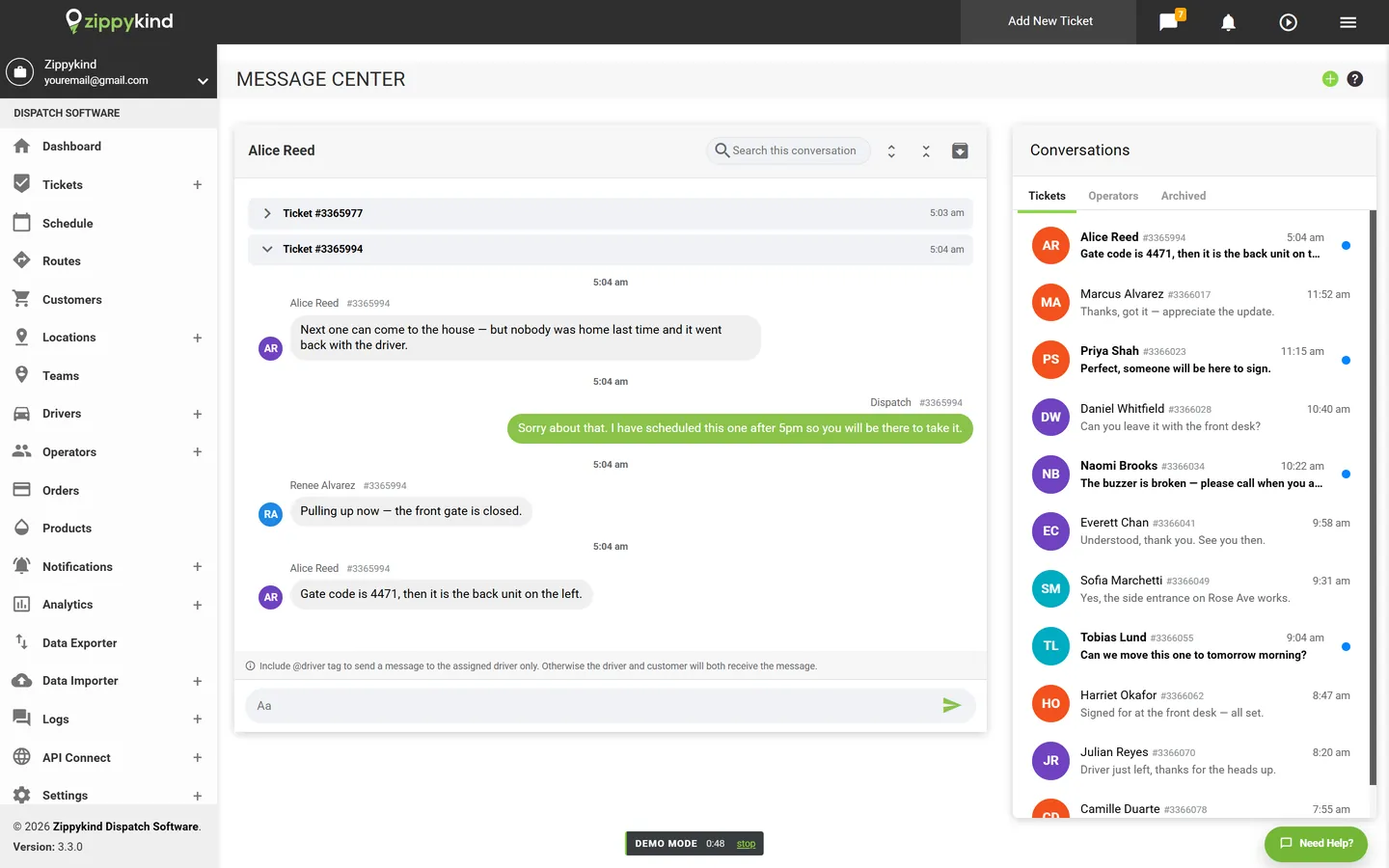
A customer thread with two delivery tickets grouped inside it
One customer, several deliveries: the tickets group inside a single thread instead of scattering.
A customer thread with earlier tickets collapsed
Collapse the older tickets and the current one stays in view.
A conversation where an operator tags a driver to locate a delivered package
A missing parcel resolved in one thread: the customer asks, the operator tags the driver, the driver answers, the customer confirms.
The send message dialog searching for a delivery ticket
Start one from scratch: find the delivery, and the customer is texted through your own number while the driver gets a push.
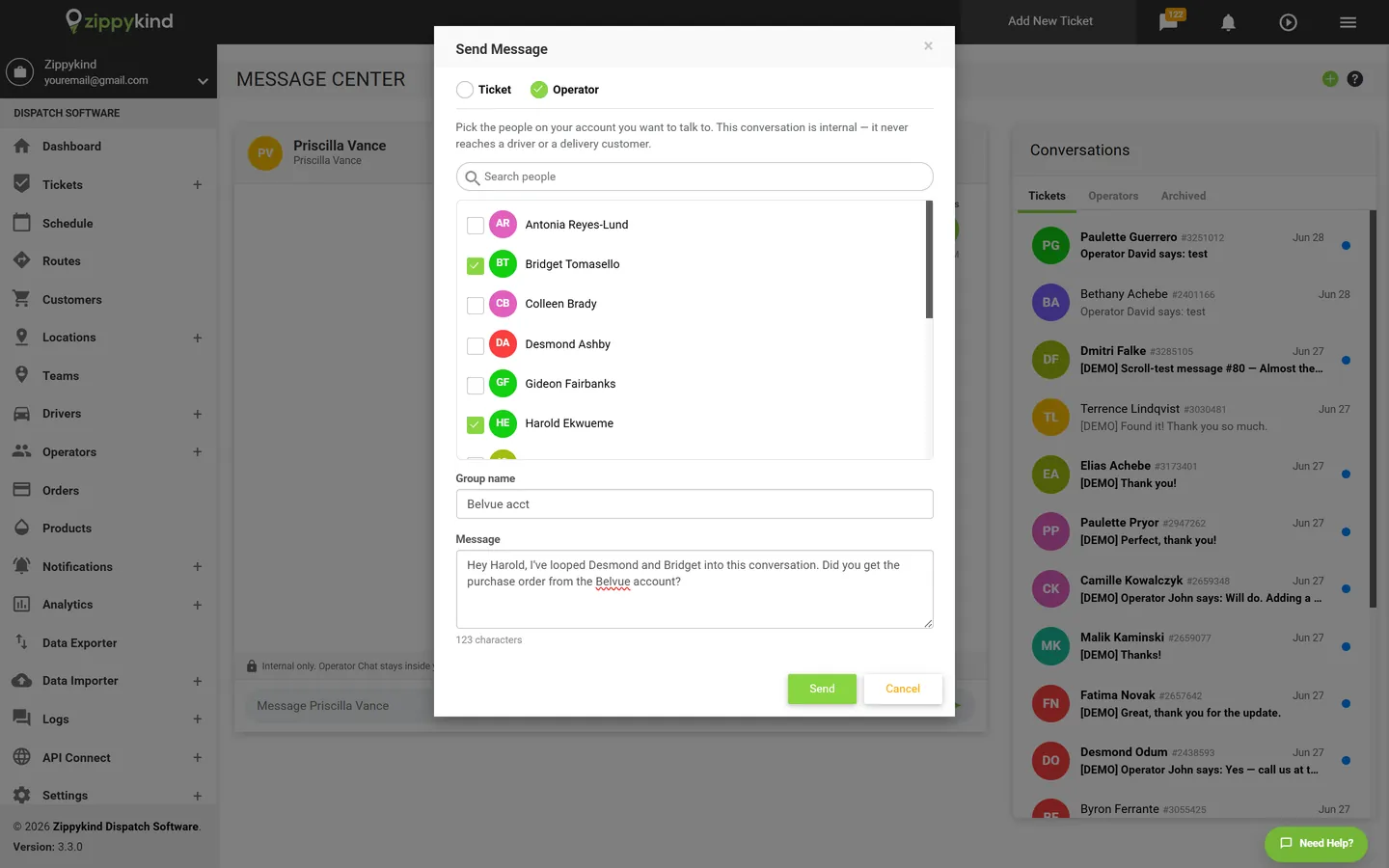
The operator group message dialog with staff selected
Operator chat is separate and internal — pick the people, name the group, and it never reaches a driver or a customer.

Dispatch tools

Everything it takes to start a delivery

A ticket can start from an order feed, an import, the API, or a person typing it. The form is the same either way, and it loads the requirements set on the pickup location so nobody has to remember them.

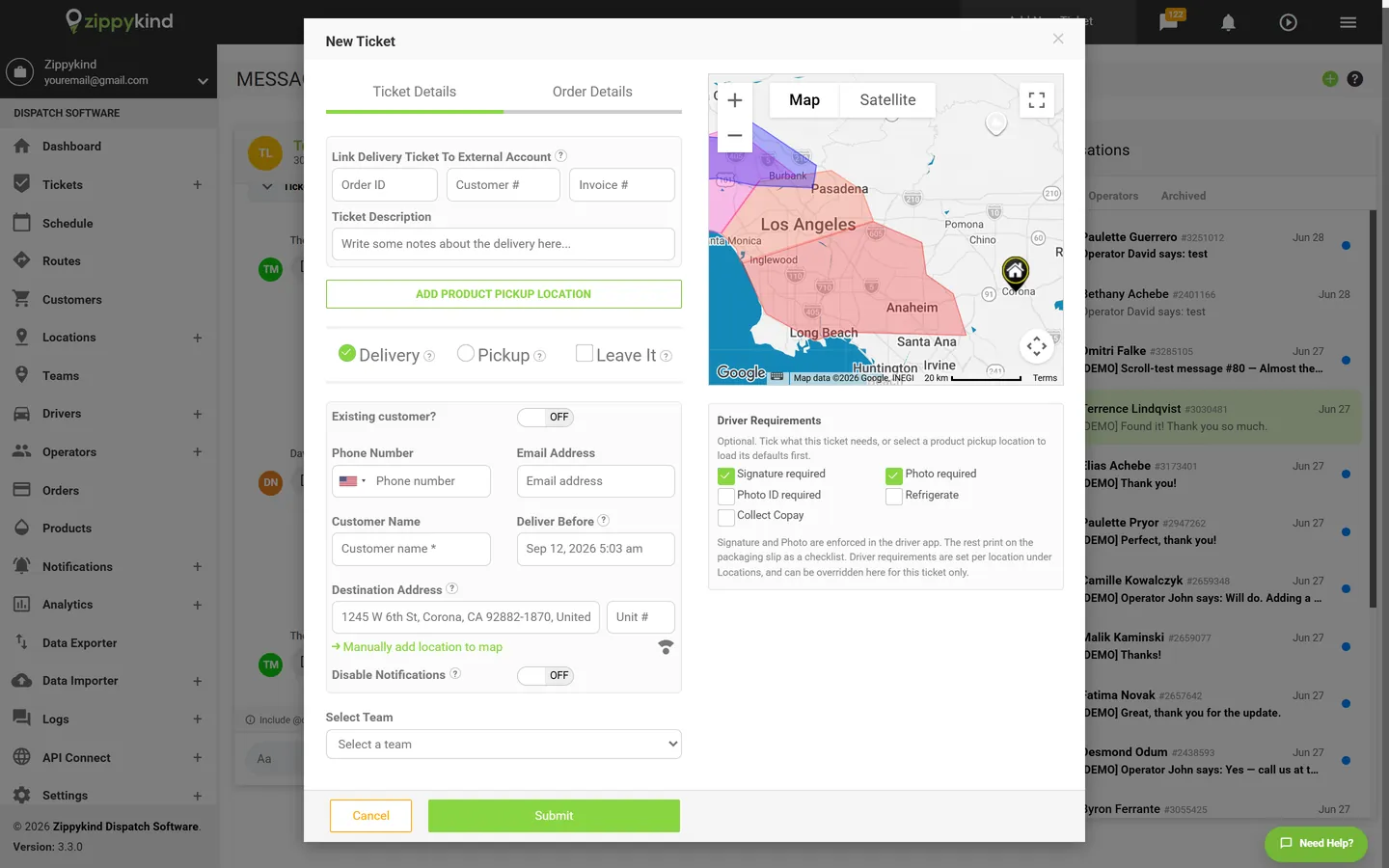
The new ticket form with a map of delivery zones
A new ticket, with the delivery zones drawn beside the address so you can see which one it falls in.
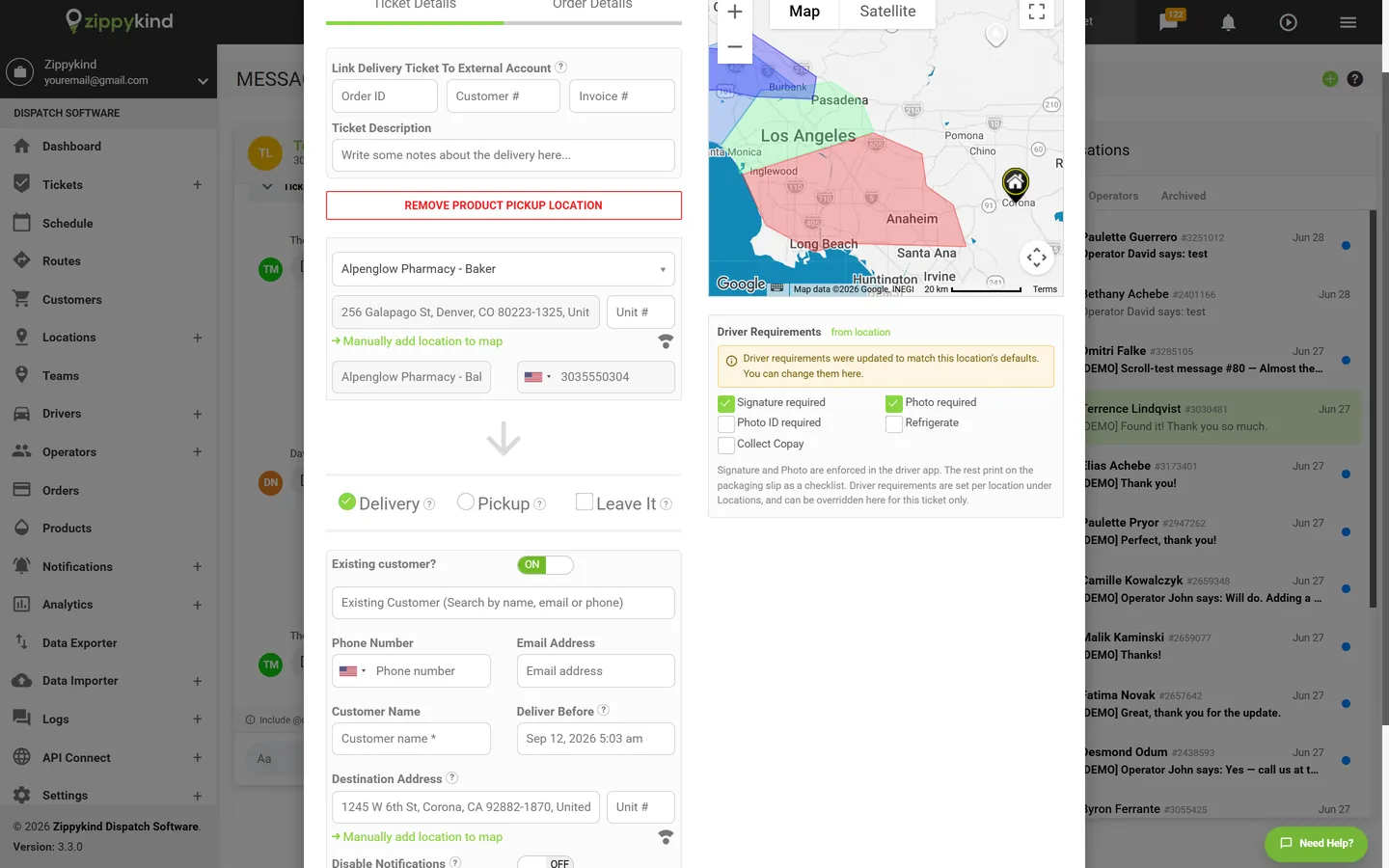
The new ticket form with a pickup location selected and its requirements filled in
Pick a pickup location and its driver requirements load themselves — signature, photo, ID, refrigeration, copay — still editable for this one ticket.
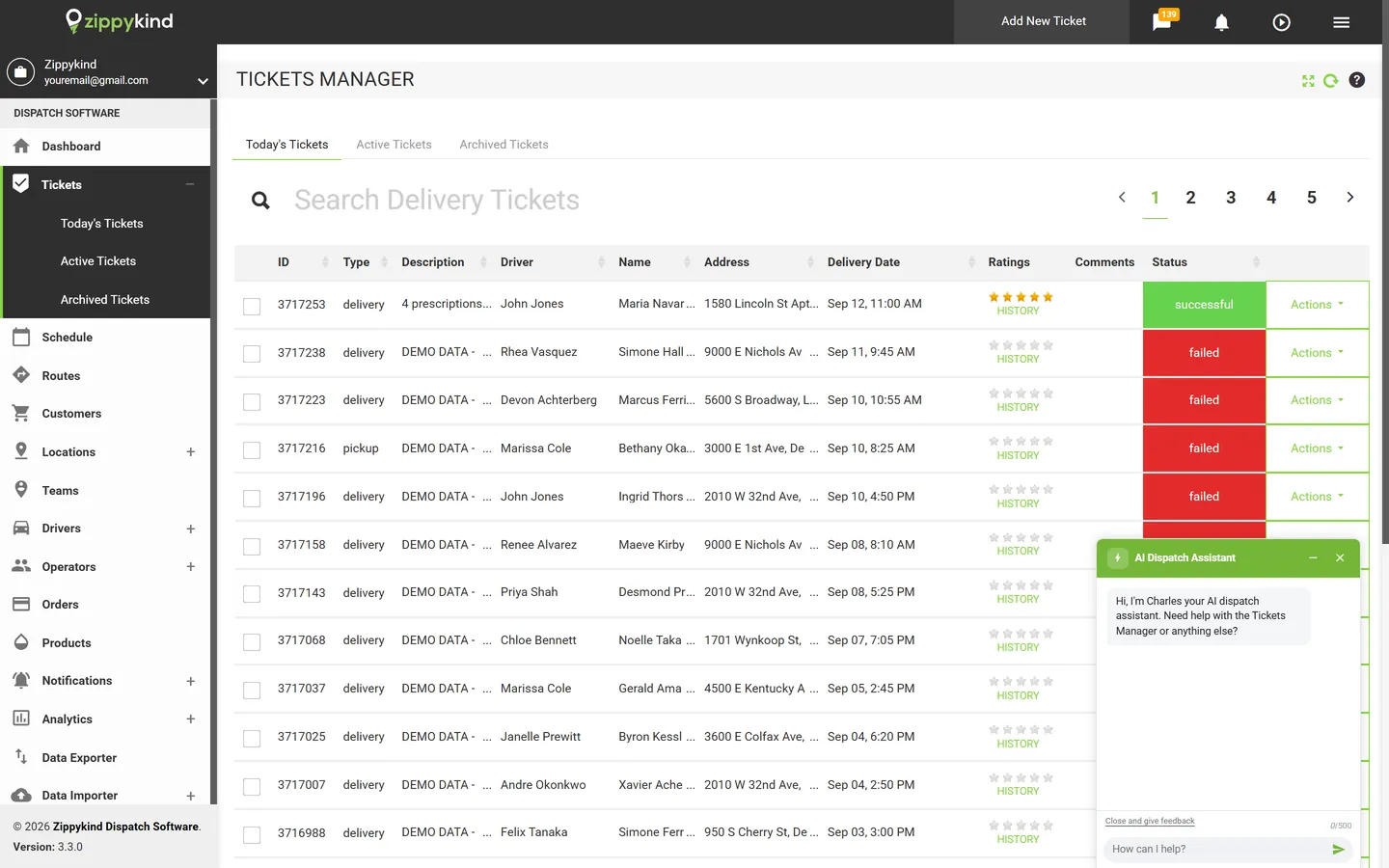
The Charles AI dispatch assistant panel open beside the Tickets Manager
Charles sits inside the software and knows which screen you are on. He answers questions about Zippykind, and deliberately nothing more: no access to your account, your tickets or your drivers.
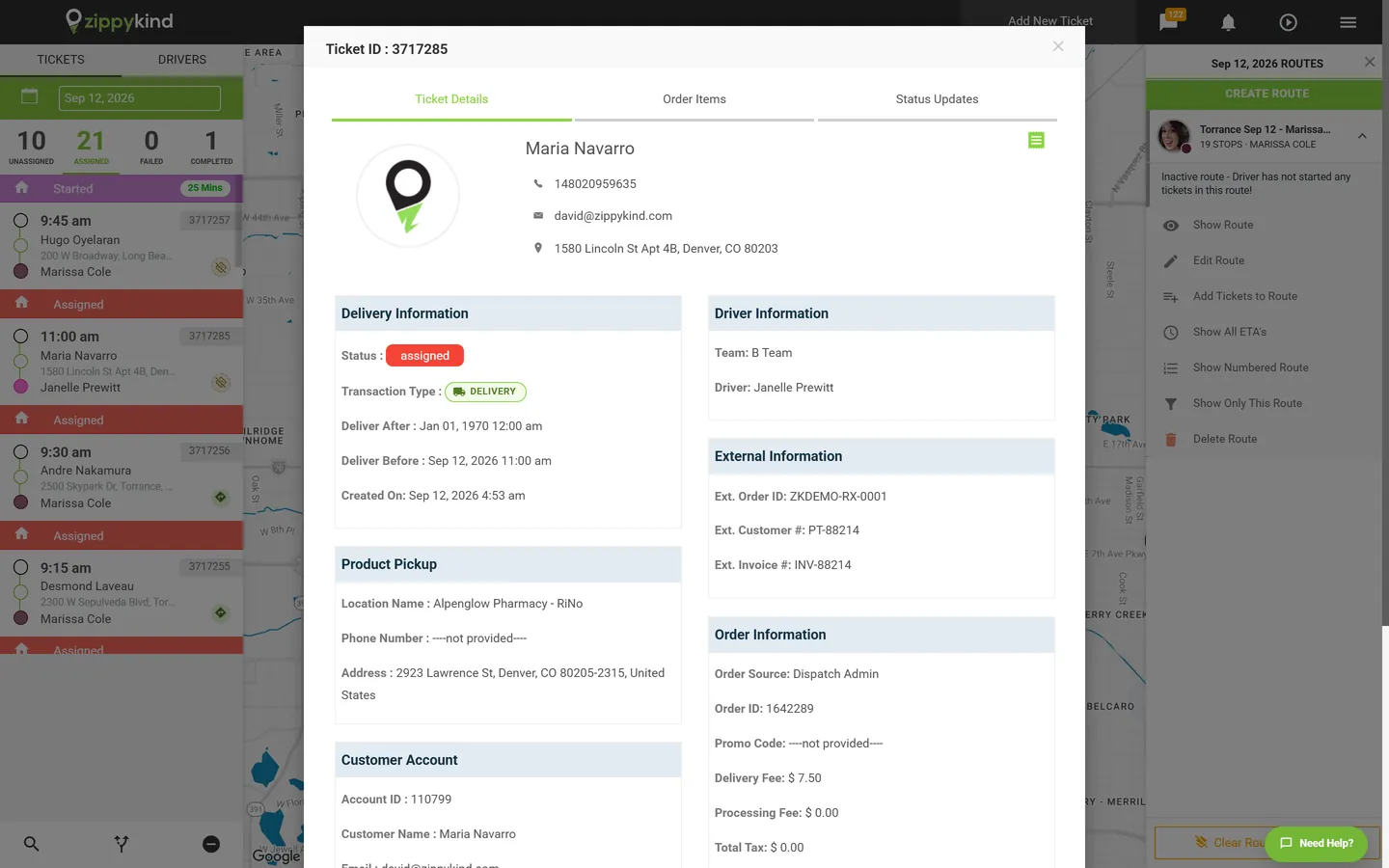
The full ticket detail panel showing delivery, driver, external and order information
The ticket itself — delivery window, driver and team, pickup location, external order and invoice numbers, fees and tax — with order items and status updates on their own tabs.

Analytics

Five questions, five tabs

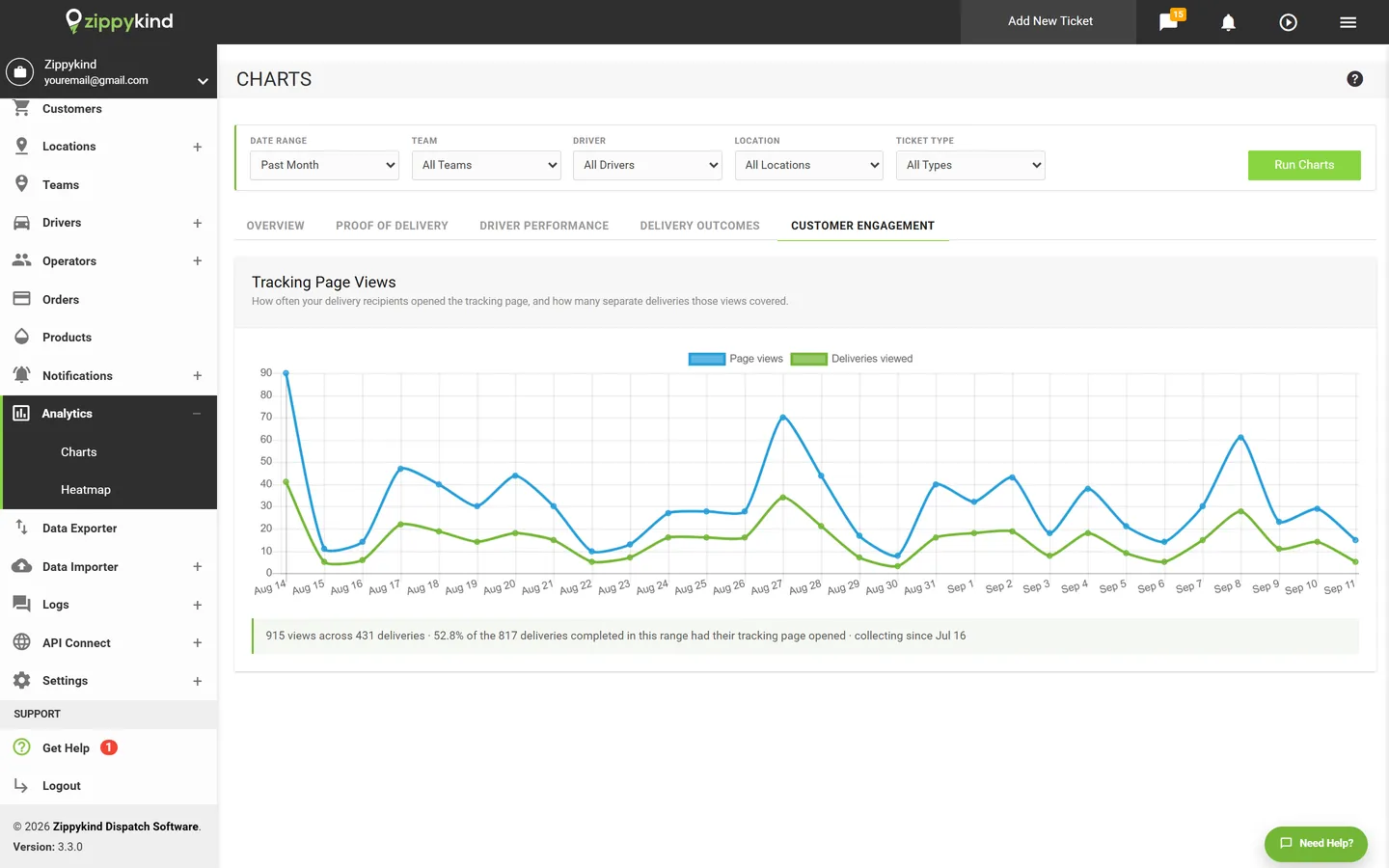
Filter by date range, team, driver, location and ticket type, then read the operation five ways. The charts explain their own method underneath, because a number nobody can check is not worth showing.

52.8% of completed deliveries had their tracking page opened — measured, not estimated

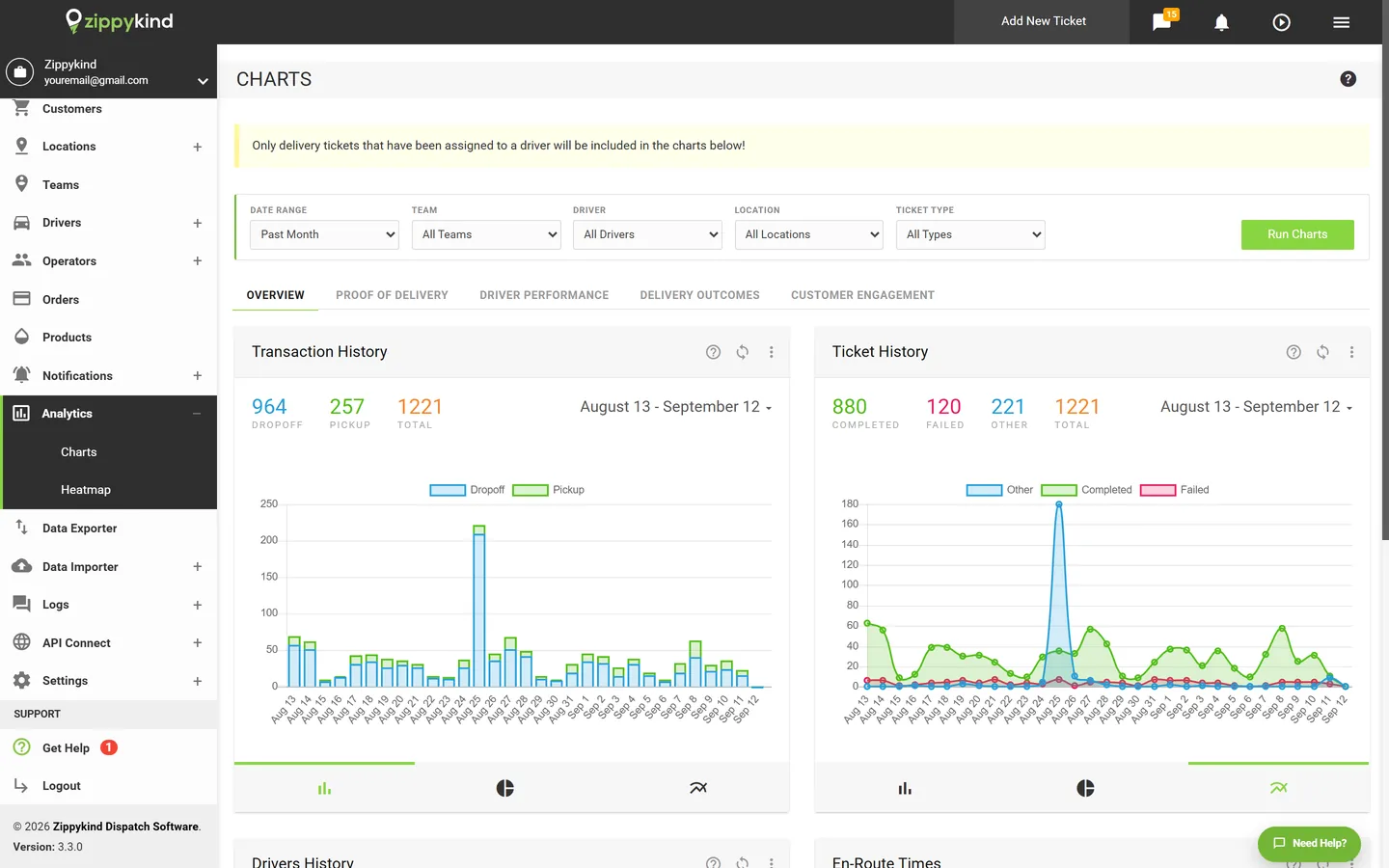
The analytics overview tab with transaction and ticket history charts
Overview: transactions and ticket outcomes over the range, with drivers and en-route times below.
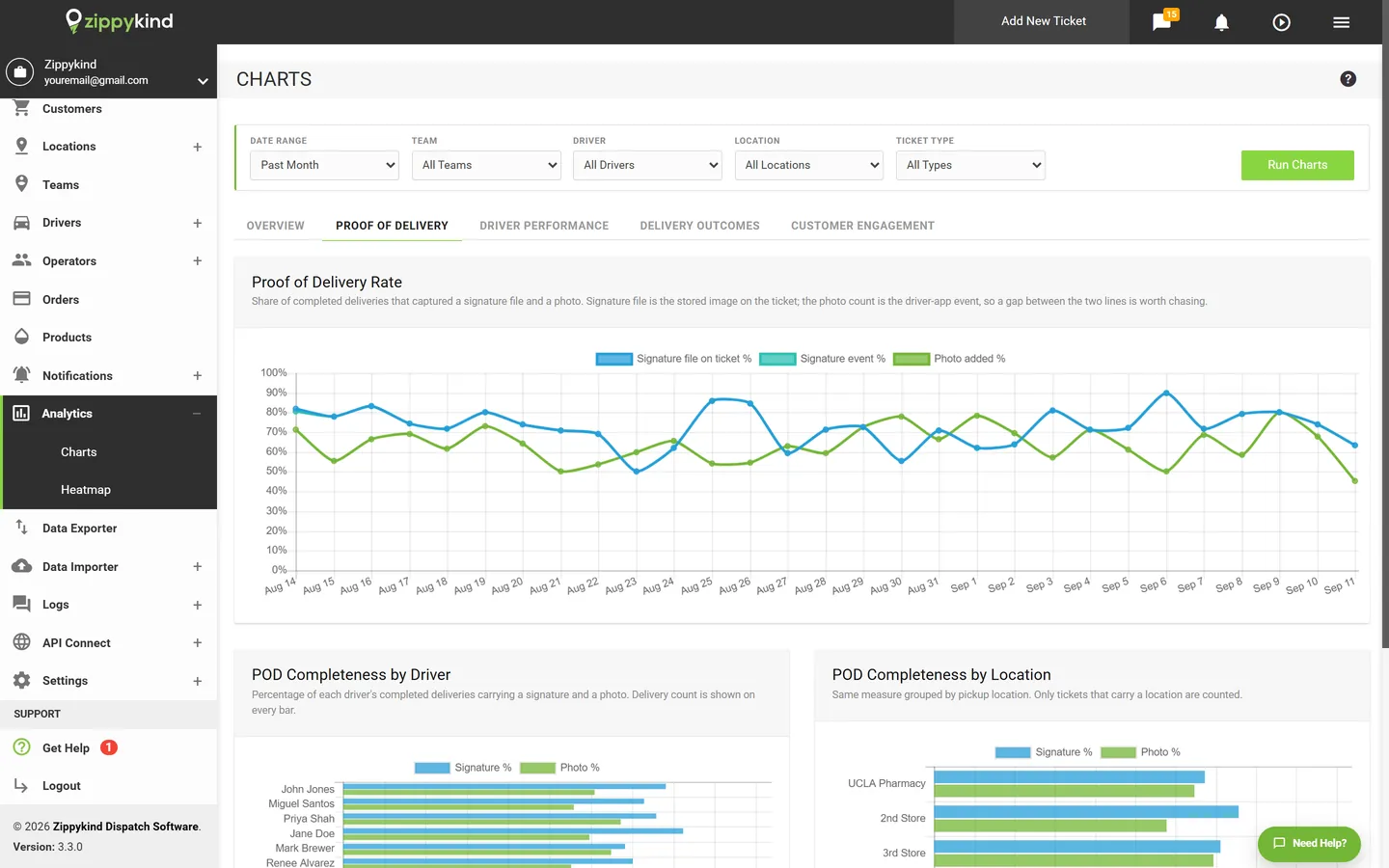
The proof of delivery tab showing capture rates by driver and location
Proof of delivery: the share of completed deliveries carrying a signature and a photo, then the same measure per driver and per location.
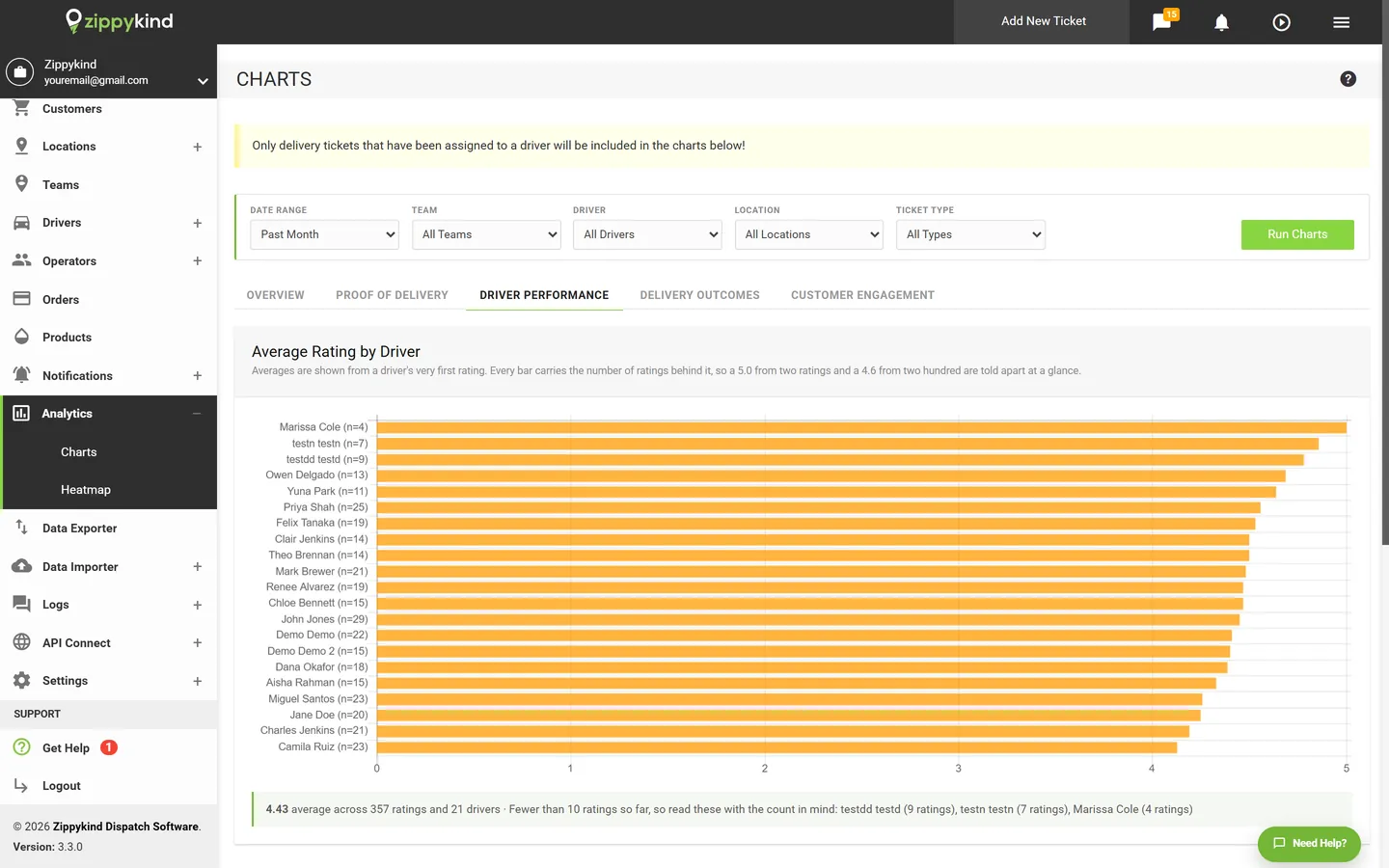
Average rating by driver, each bar labelled with its number of ratings
Driver performance carries the rating count on every bar, so a 5.0 from two ratings and a 4.6 from two hundred are told apart at a glance.
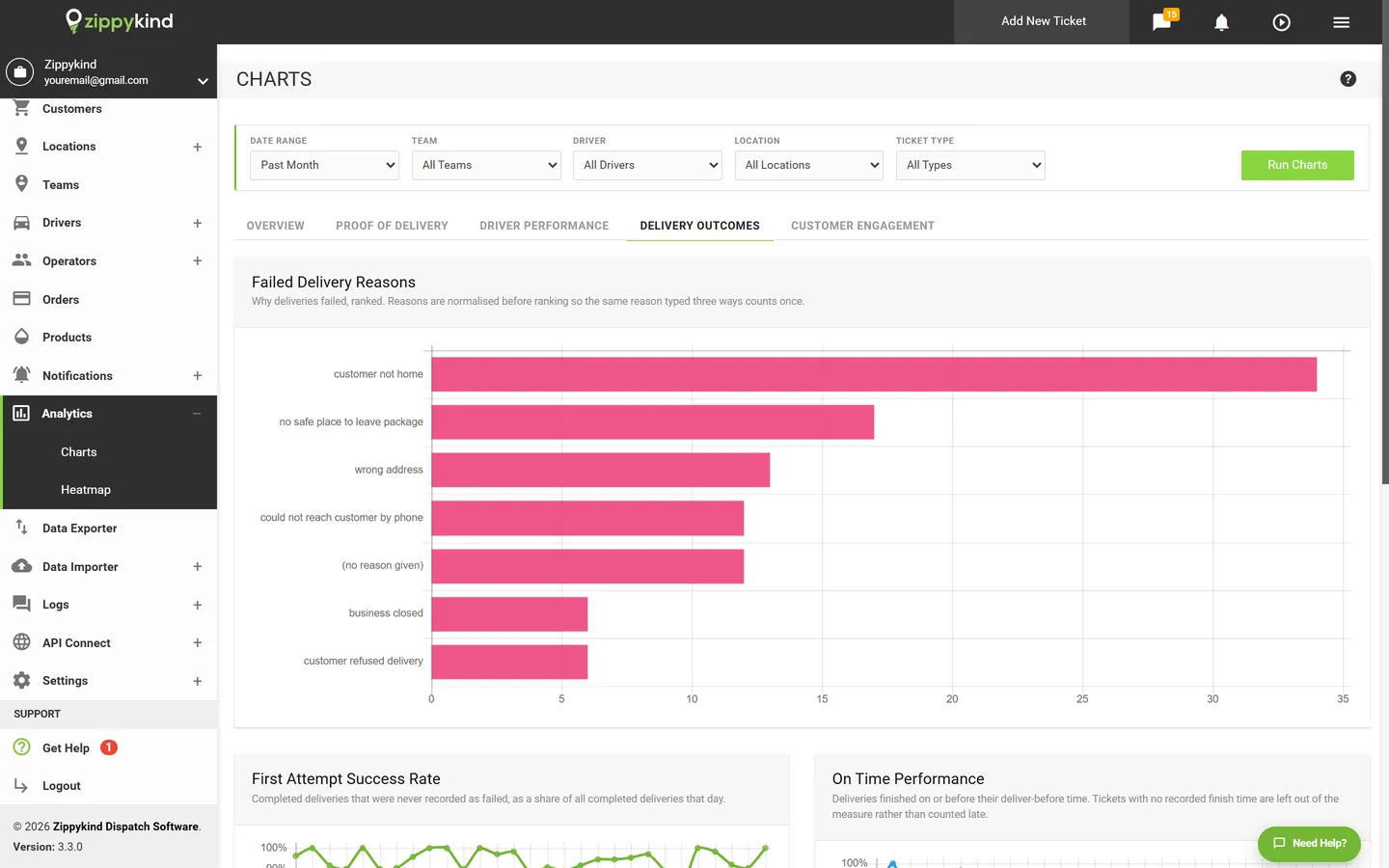
Failed delivery reasons ranked, with first attempt success and on time performance below
Failed deliveries ranked by reason, normalised first so the same reason typed three ways counts once.
Tracking page views charted against deliveries viewed
Customer engagement: how often recipients opened the tracking page, and how many deliveries those opens covered.

Notifications

The messages that go out without anyone typing

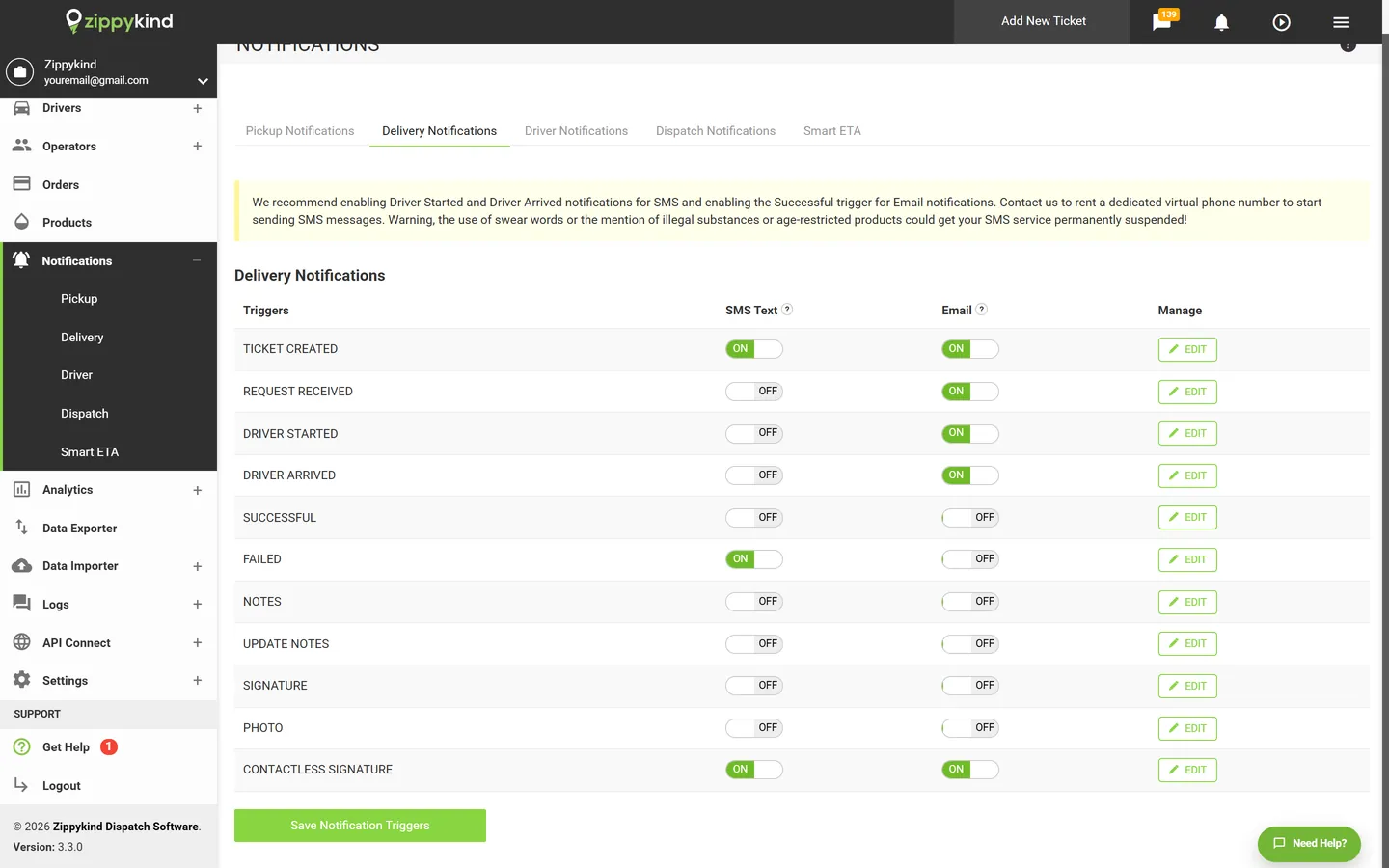
Eleven delivery triggers, each with an SMS switch and an email switch, and a default message already written for every one of them. Edit the wording to sound like your business; the tags fill in the customer, the ticket and the tracking link.

The delivery notification triggers with SMS and email toggles
Delivery triggers, from ticket created through to contactless signature, SMS and email switched independently.
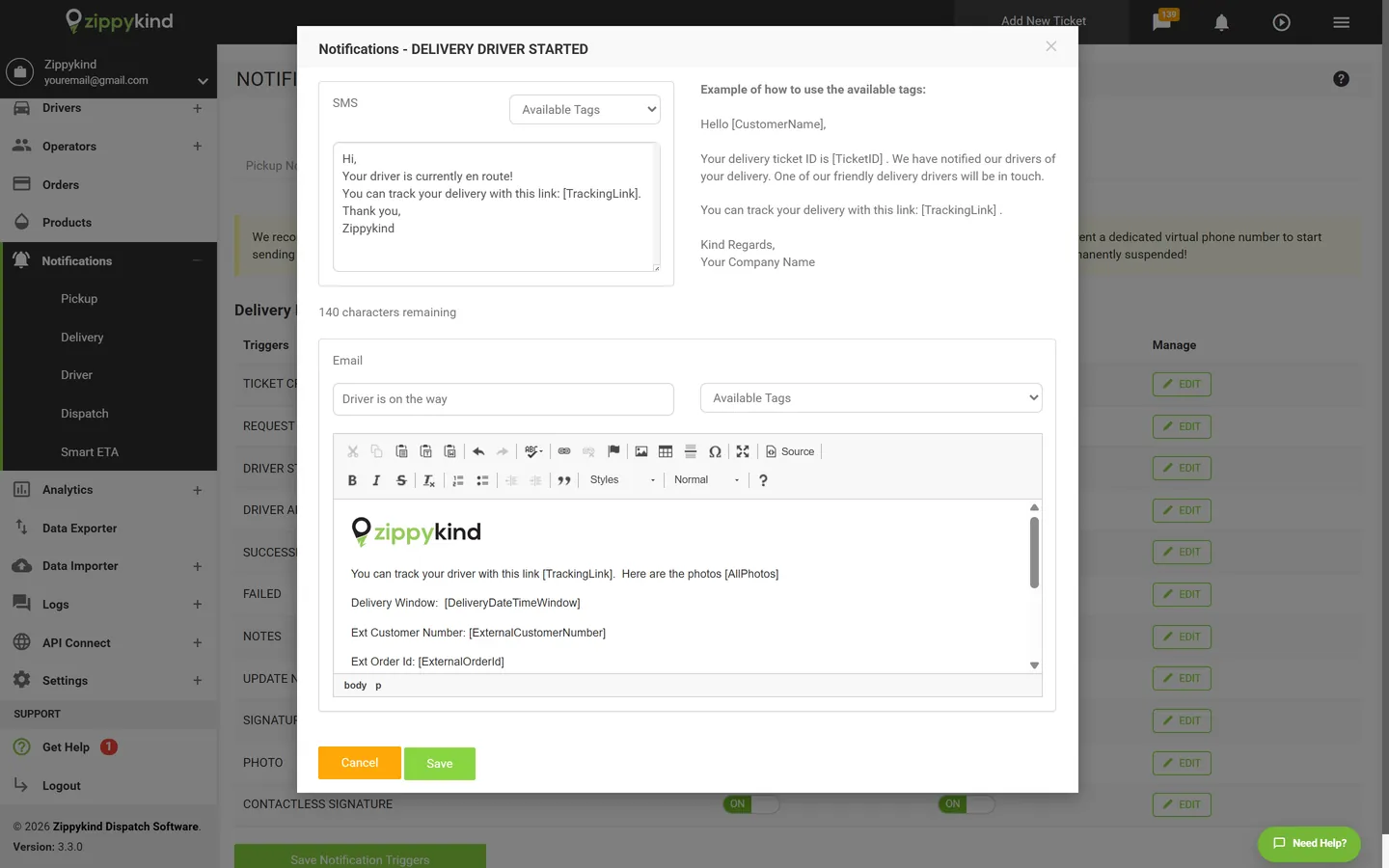
The notification editor for driver started, with SMS and email bodies
Editing one: the SMS on the left with its character count, the full email on the right, and the available tags listed beside both.
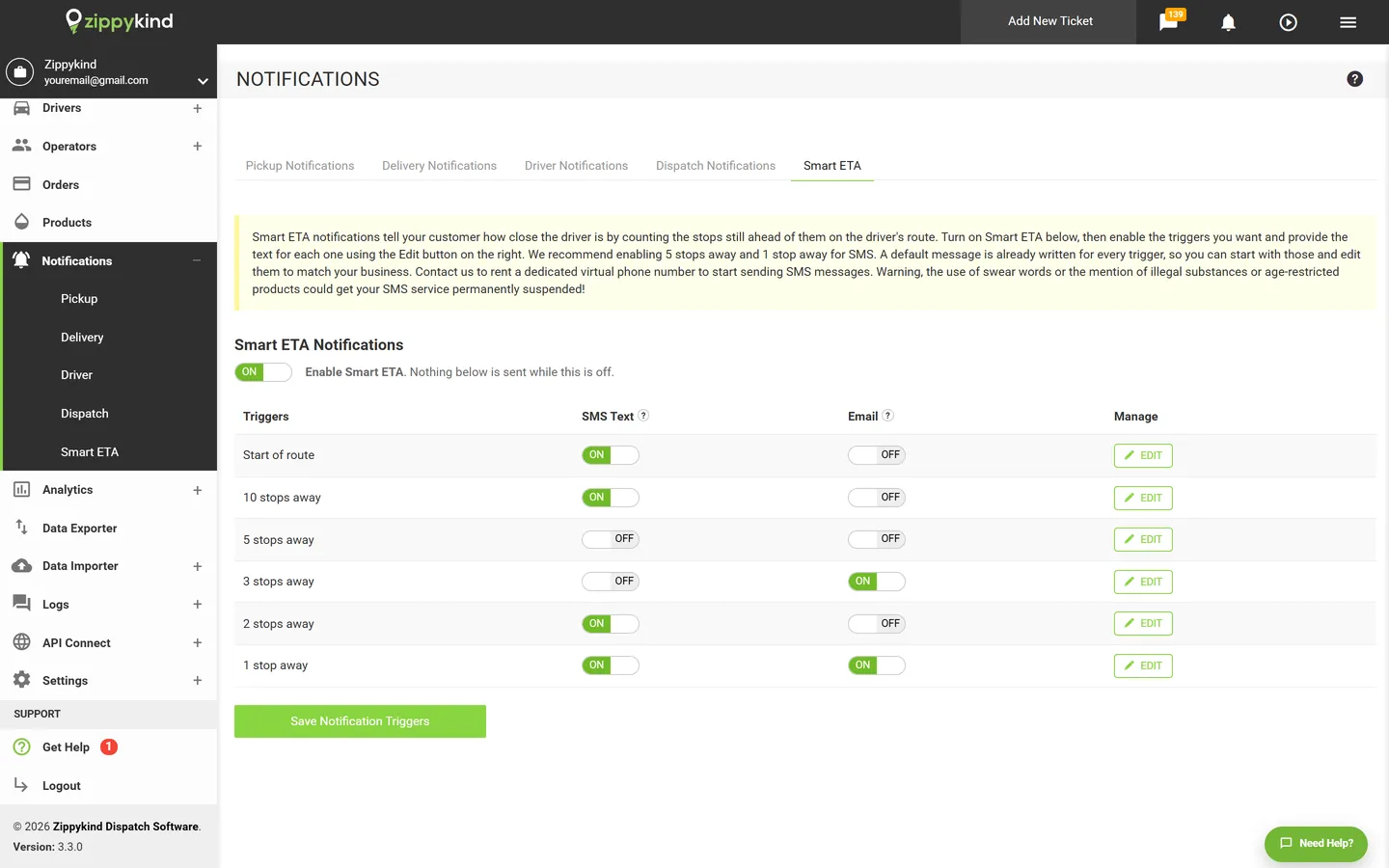
Smart ETA triggers with SMS and email switches per distance
Smart ETA counts the stops still ahead of a delivery and fires at the distance you choose — start of route, ten away, one away.

Customers

The account behind the address

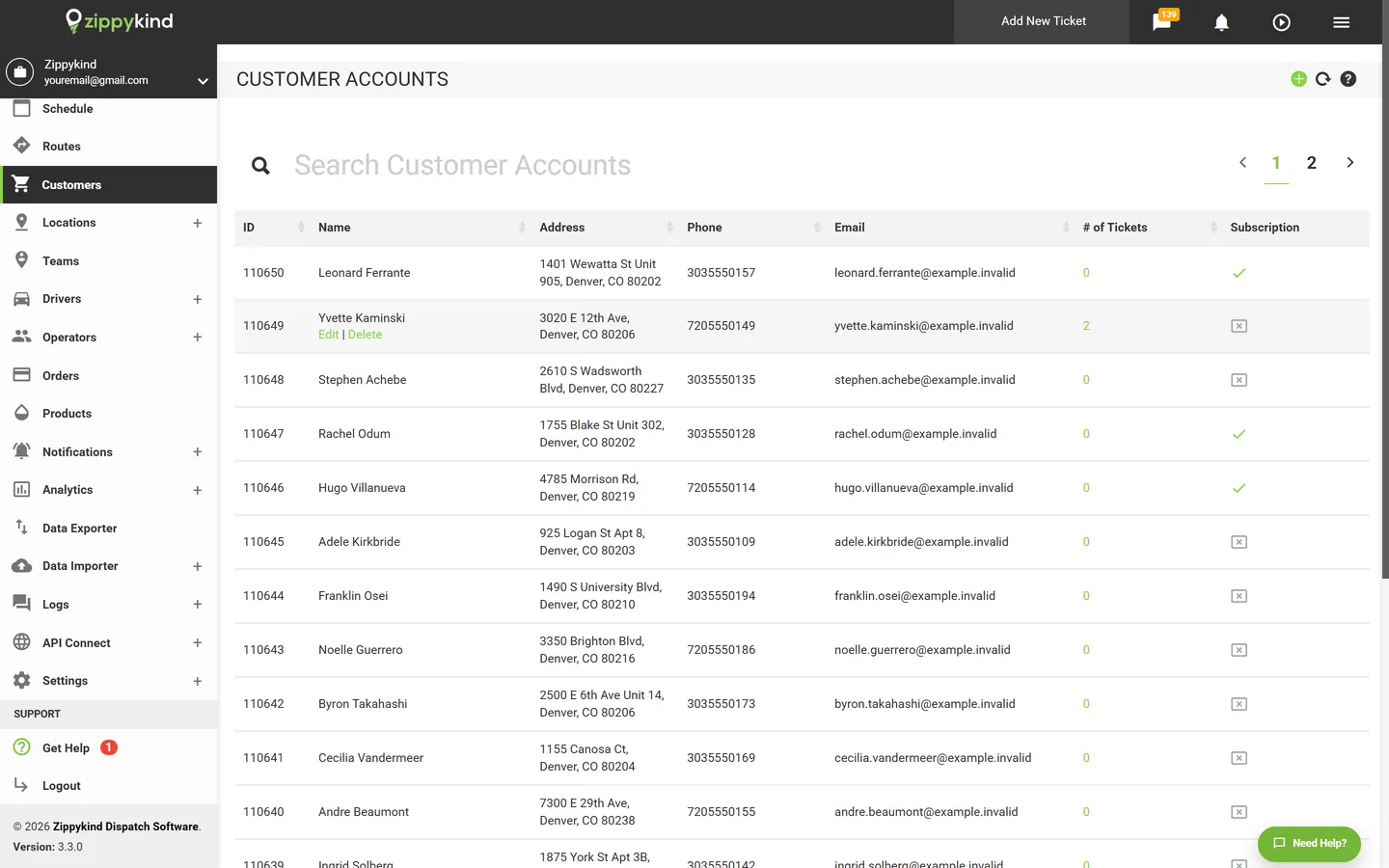
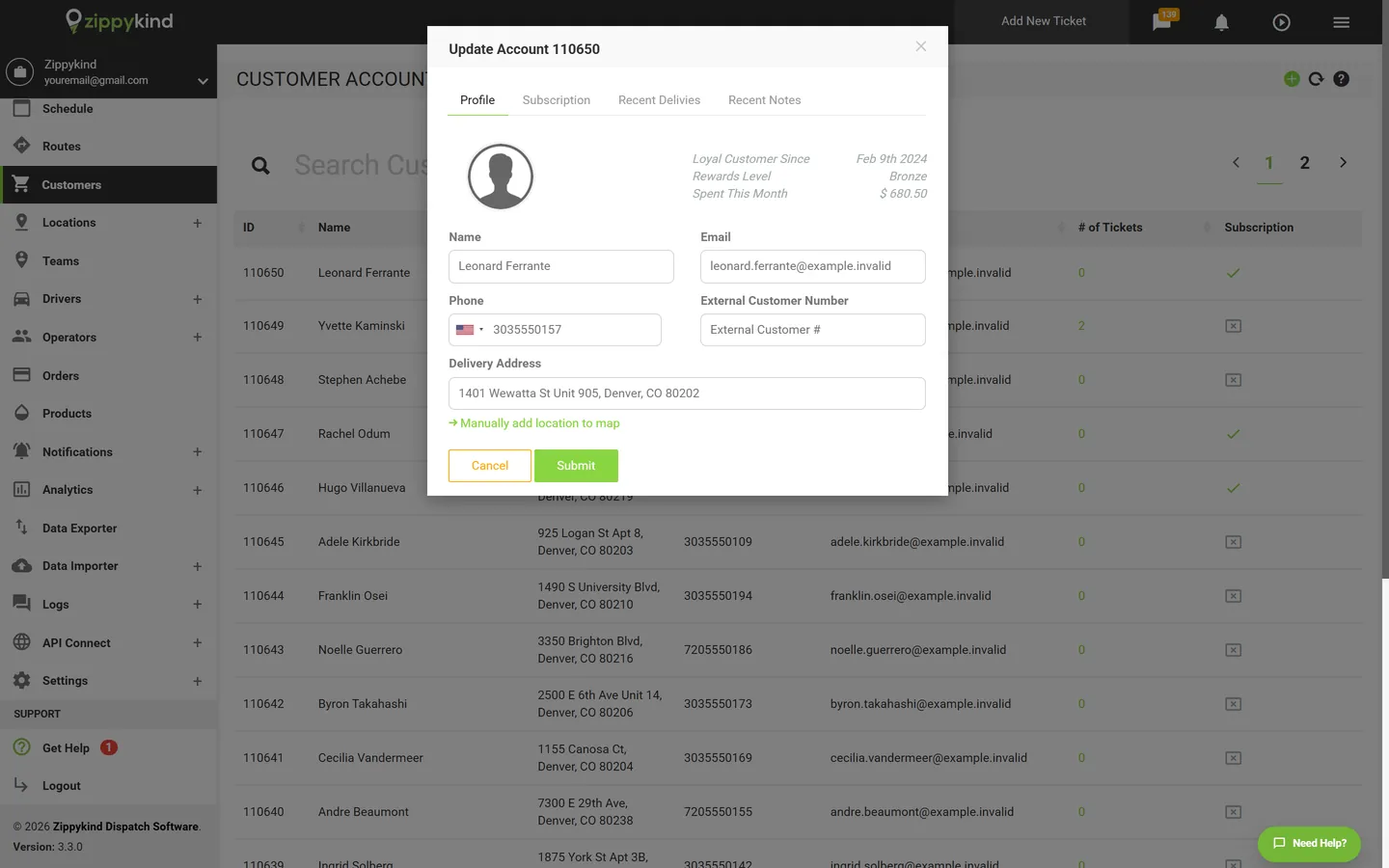
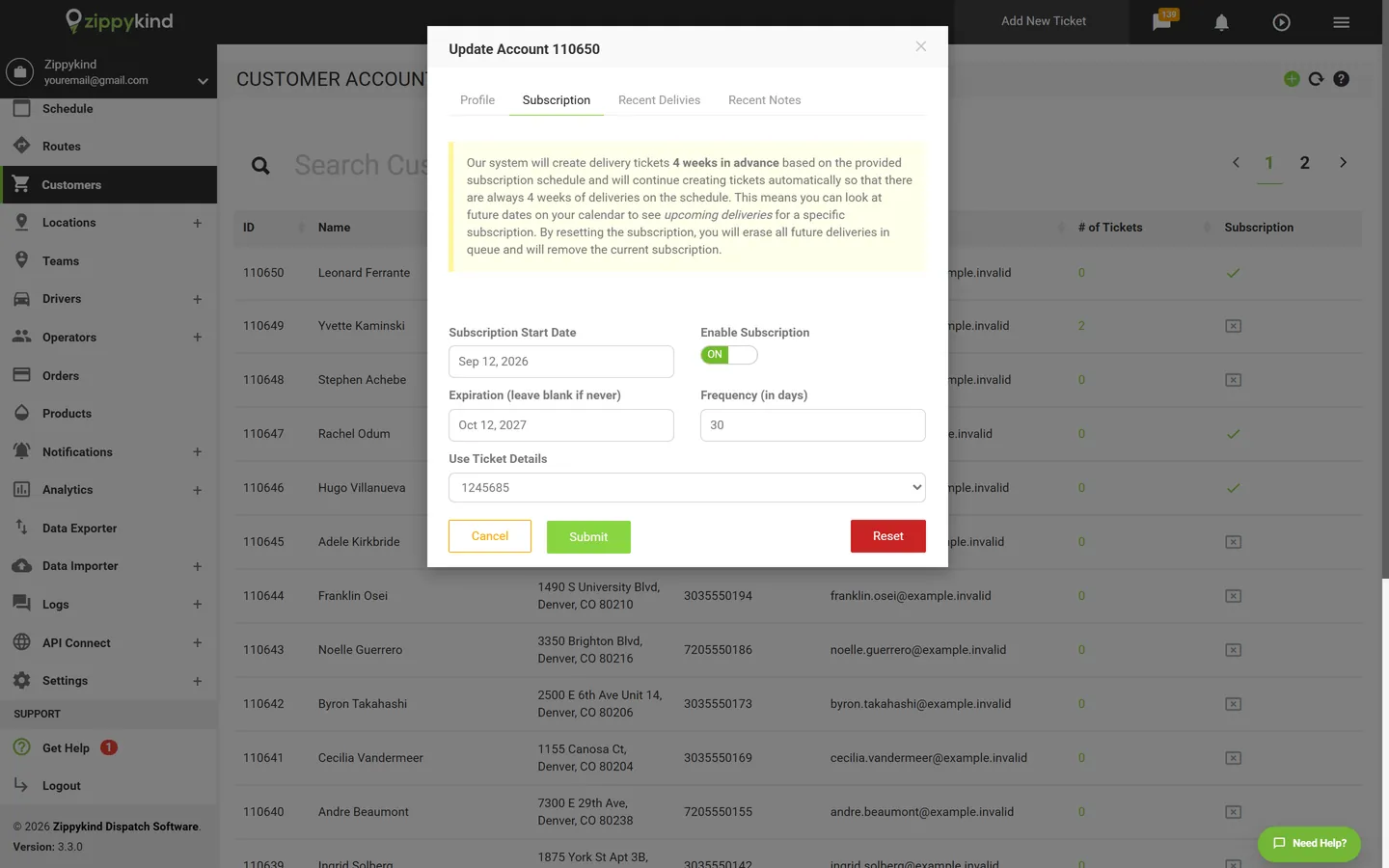
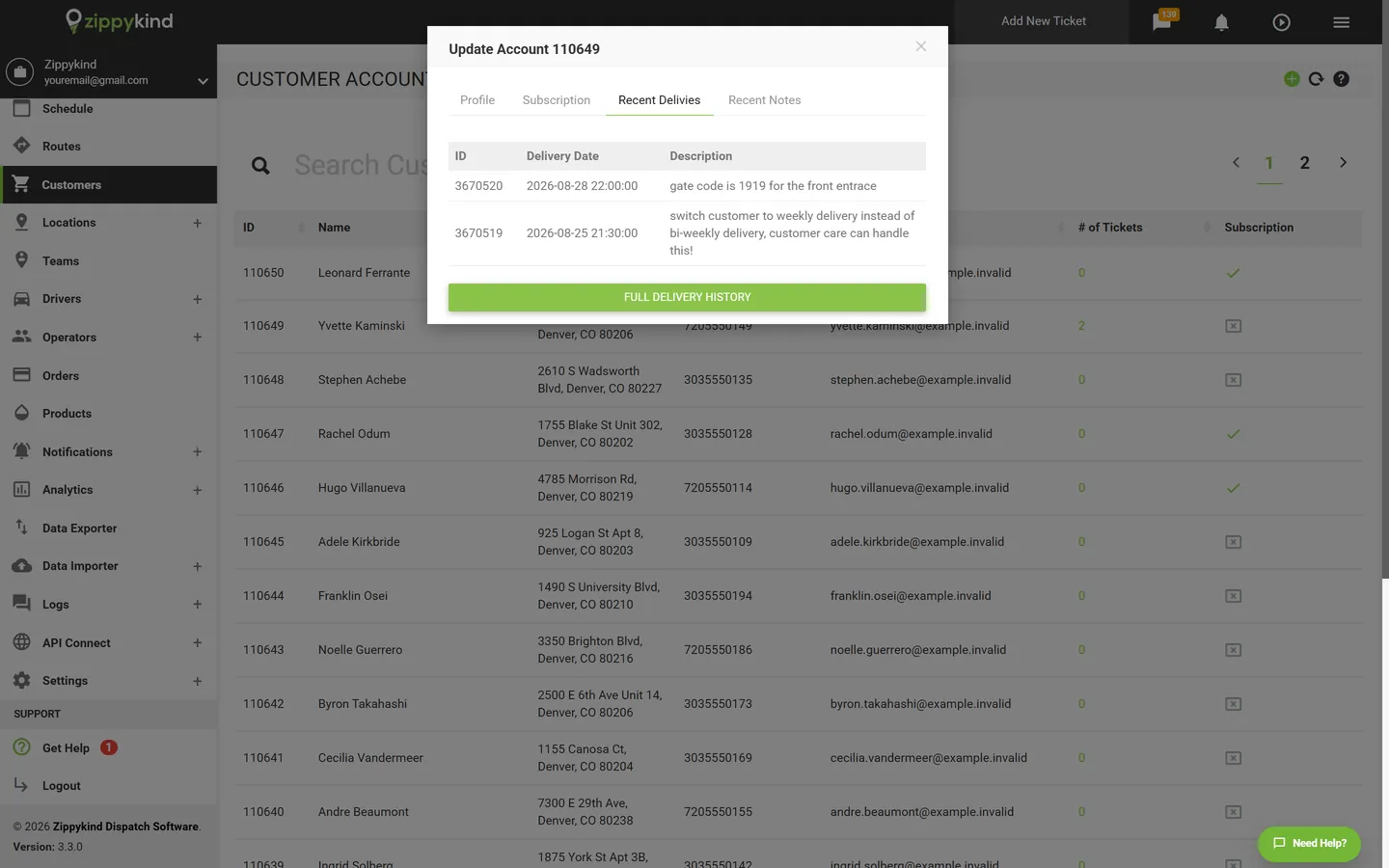
A customer is more than a delivery address. Each account carries its history, its standing instructions, and a recurring schedule if it has one.

The customer accounts list with ticket counts and subscription status
The account list, with ticket counts and which accounts are on a subscription.
A customer profile showing loyalty, rewards level and monthly spend
The profile carries loyalty: customer since, rewards level, spend this month.
The subscription tab with start date, expiry and frequency in days
A subscription writes its own tickets, four weeks ahead, on the frequency you set.
The recent deliveries tab listing past tickets and their notes
Recent deliveries sit on the account, so the last conversation is one click from the next one.
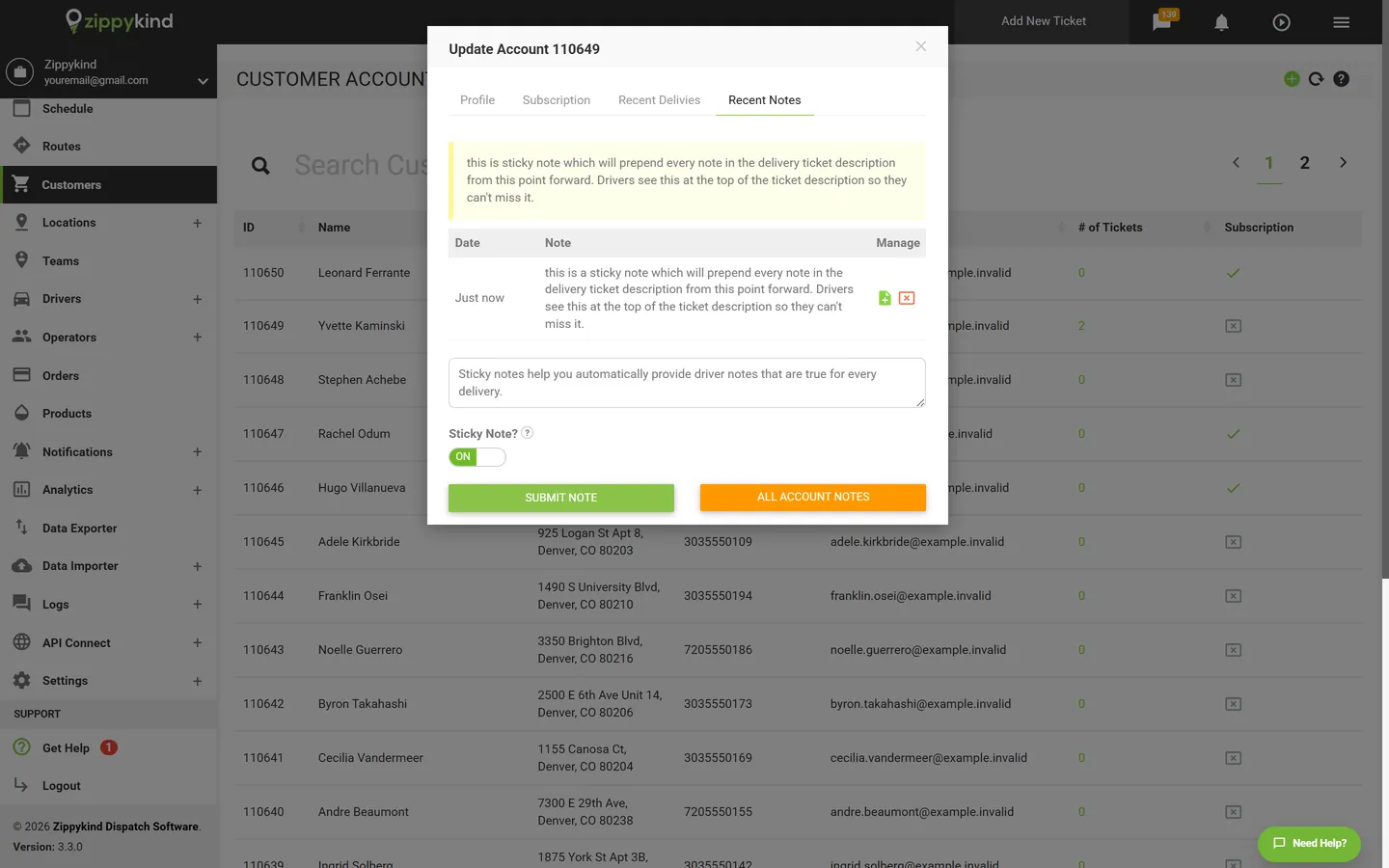
The account notes tab with a sticky note that prepends to every delivery
A sticky note prepends itself to every future ticket description, so the gate code reaches the driver without anyone retyping it.

Locations

Each branch, with its own rules

Run more than one store and they stop being interchangeable. A location carries its own branding, its own driver requirements, its own signing disclaimer — and its own integration status.

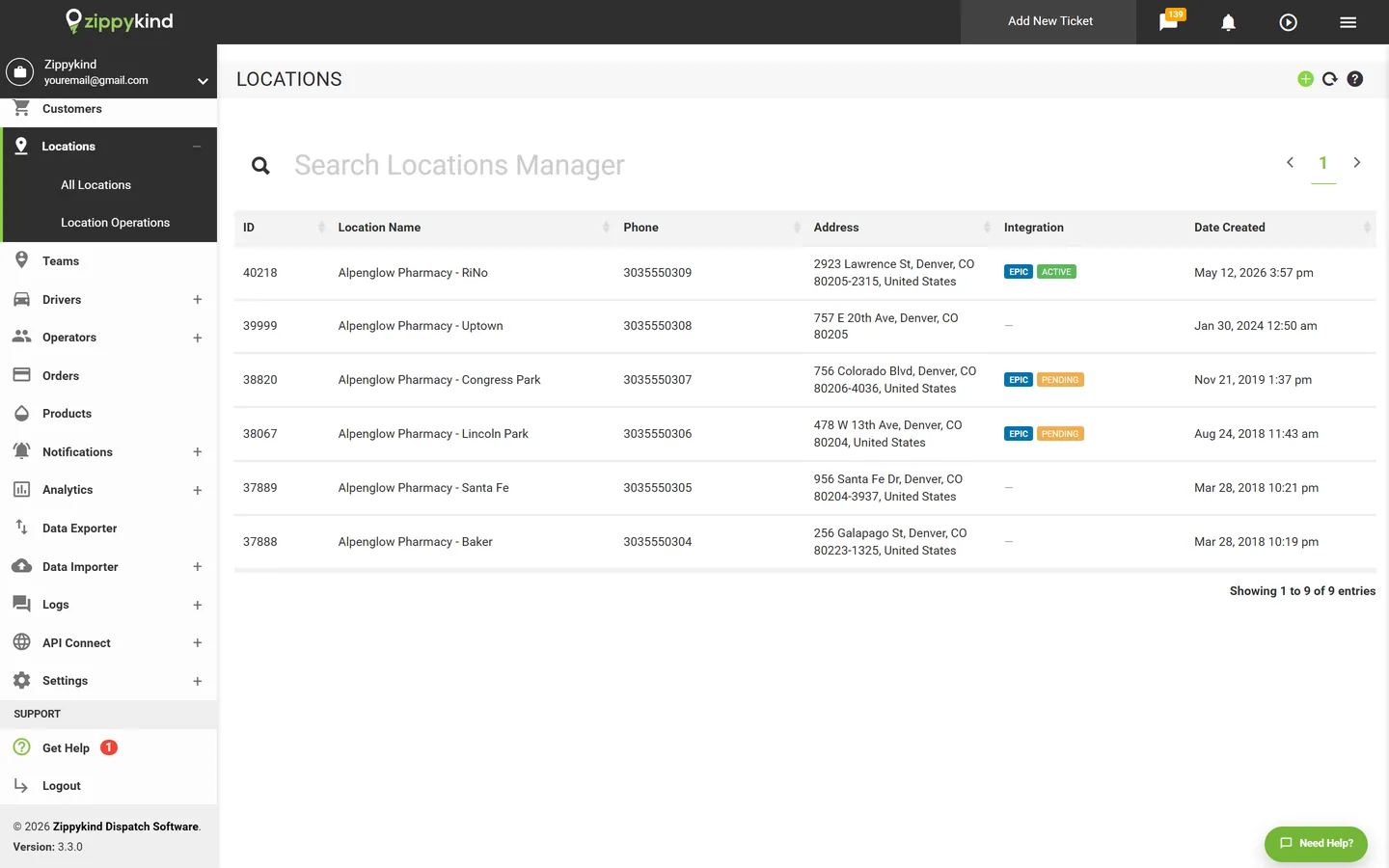
The locations list with per-location integration status badges
Nine branches, each showing whether its integration is active or still pending.
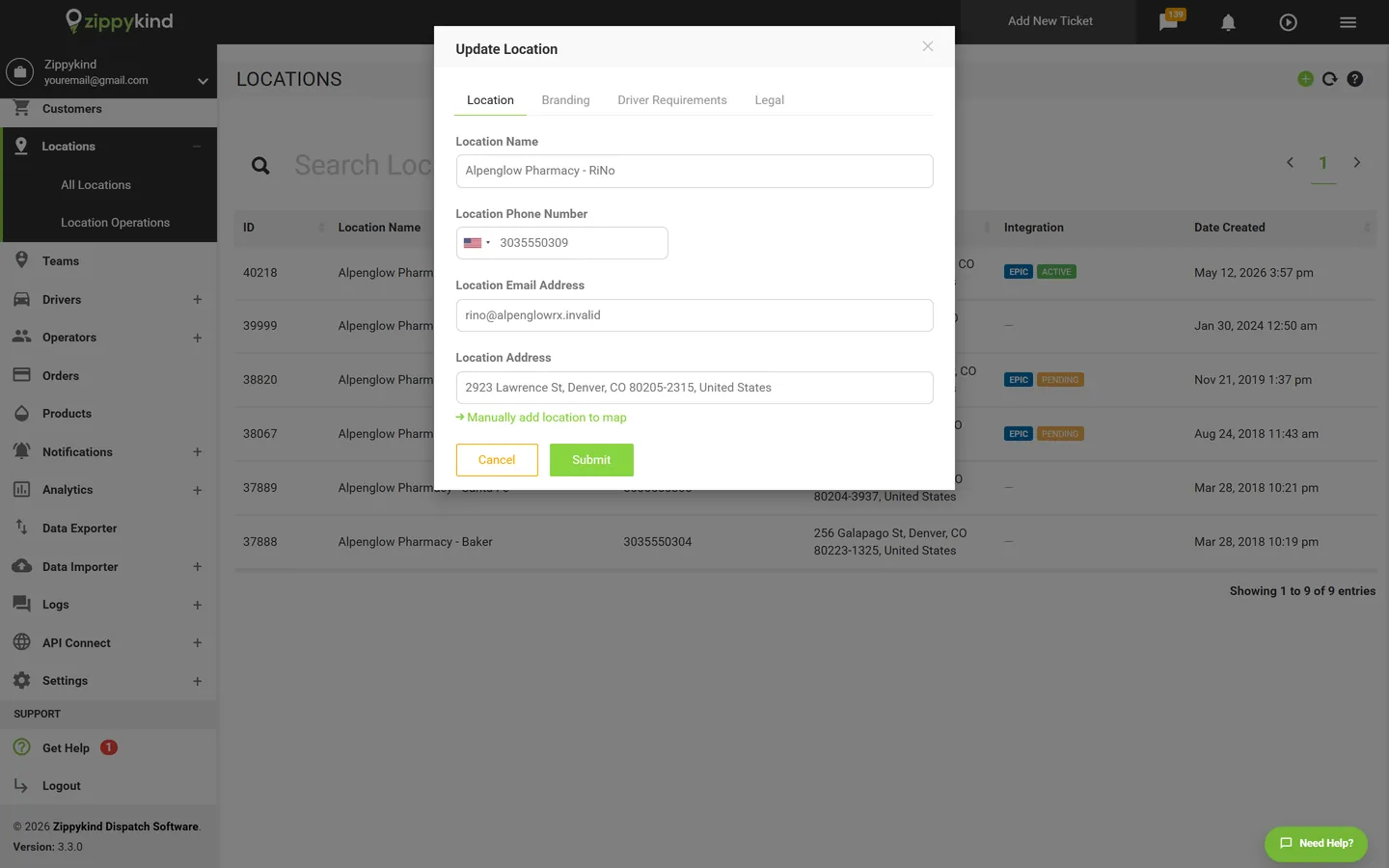
The location edit form with name, phone, email and address
The basics: name, phone, email and the address the map geocodes.
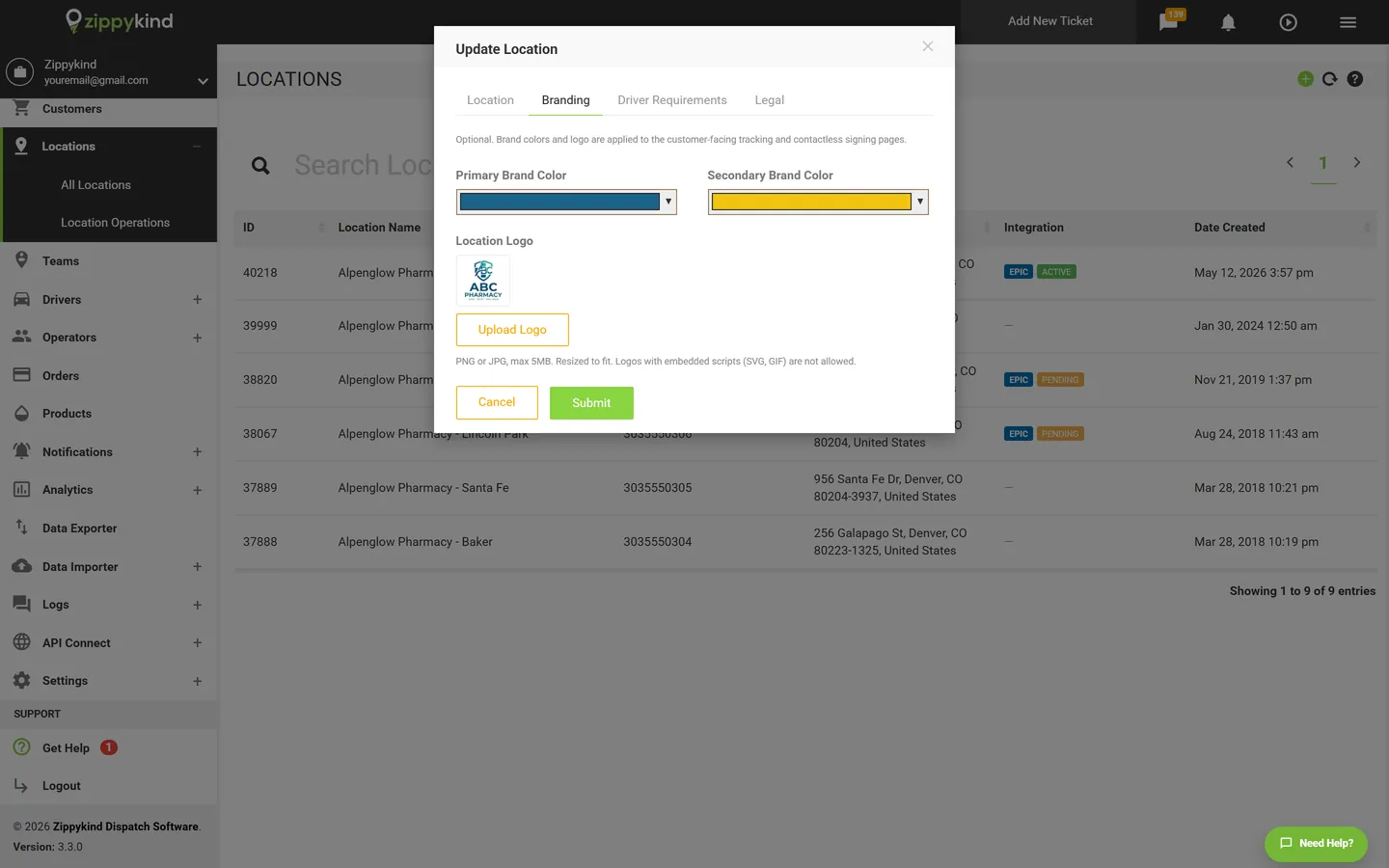
The location branding tab with primary and secondary colours and a logo
Branding is per location, and it is what the customer sees on the tracking and signing pages.
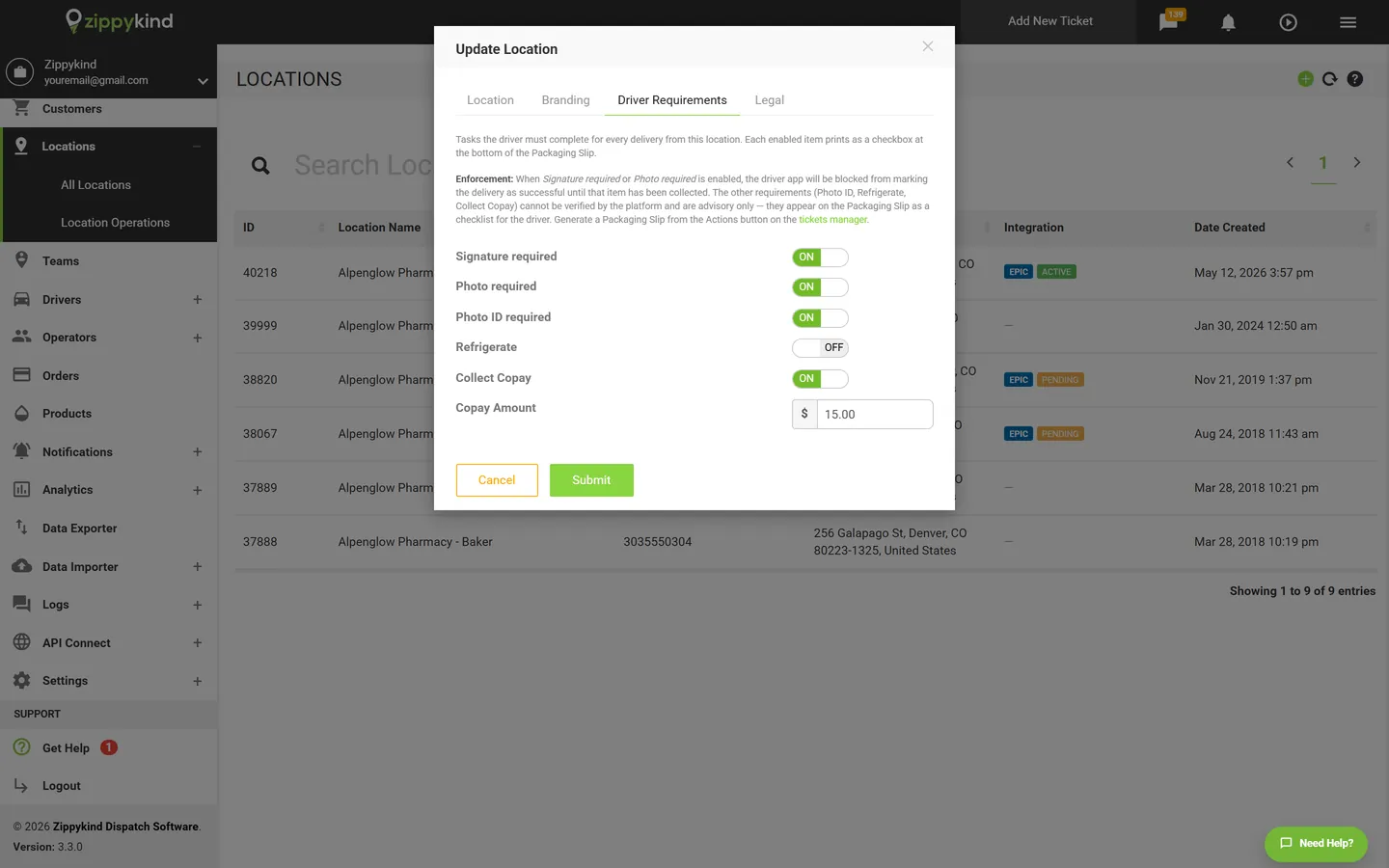
The driver requirements tab with signature, photo, ID, refrigeration and copay switches
Driver requirements set here become the defaults on every ticket from this branch. Signature and photo are enforced in the driver app; the rest print on the packing slip.
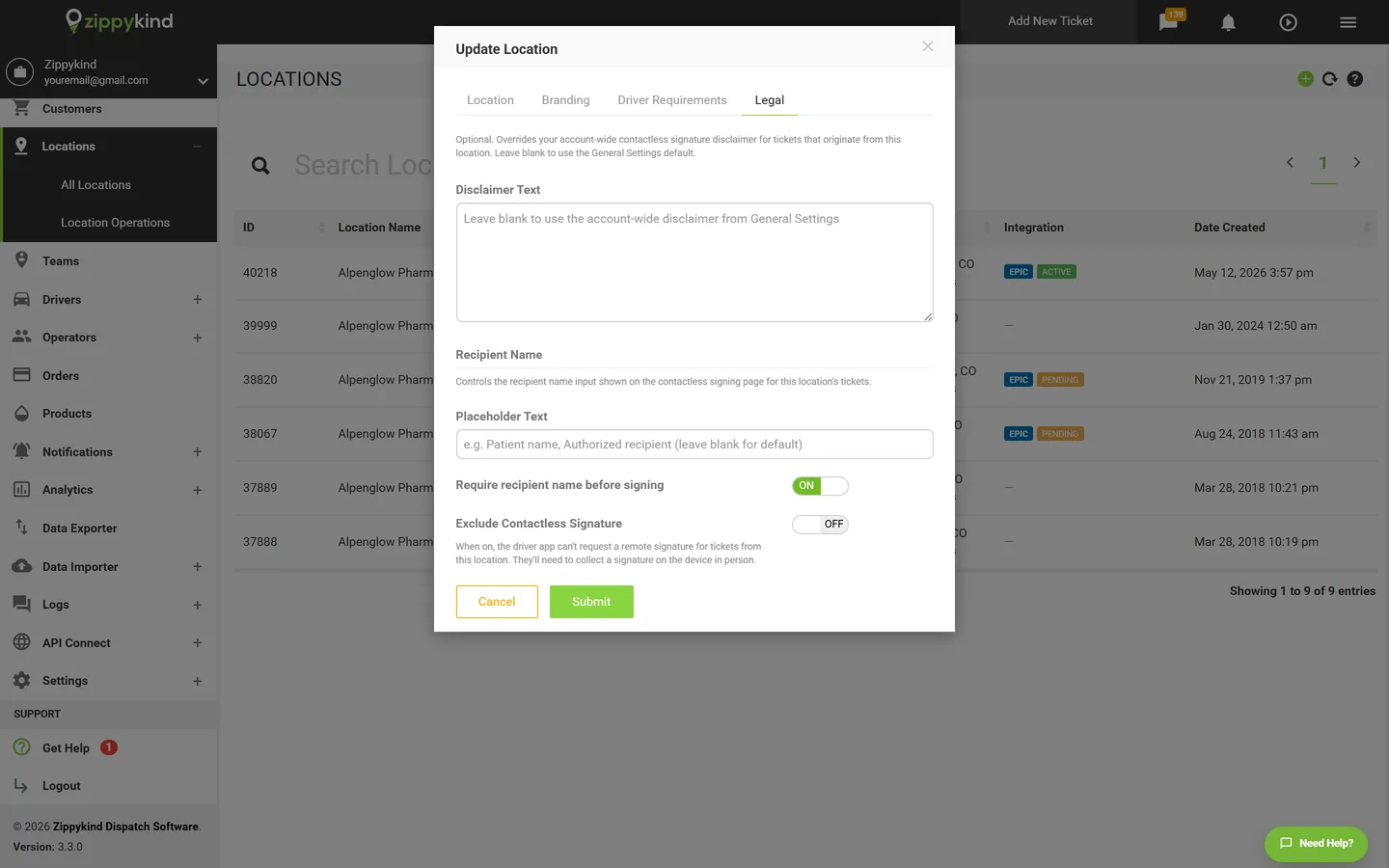
The legal tab with disclaimer text and recipient name settings
The legal tab overrides the account-wide signing disclaimer for this branch, and can require a recipient name before anyone signs.

Operators

Who can see which branch location

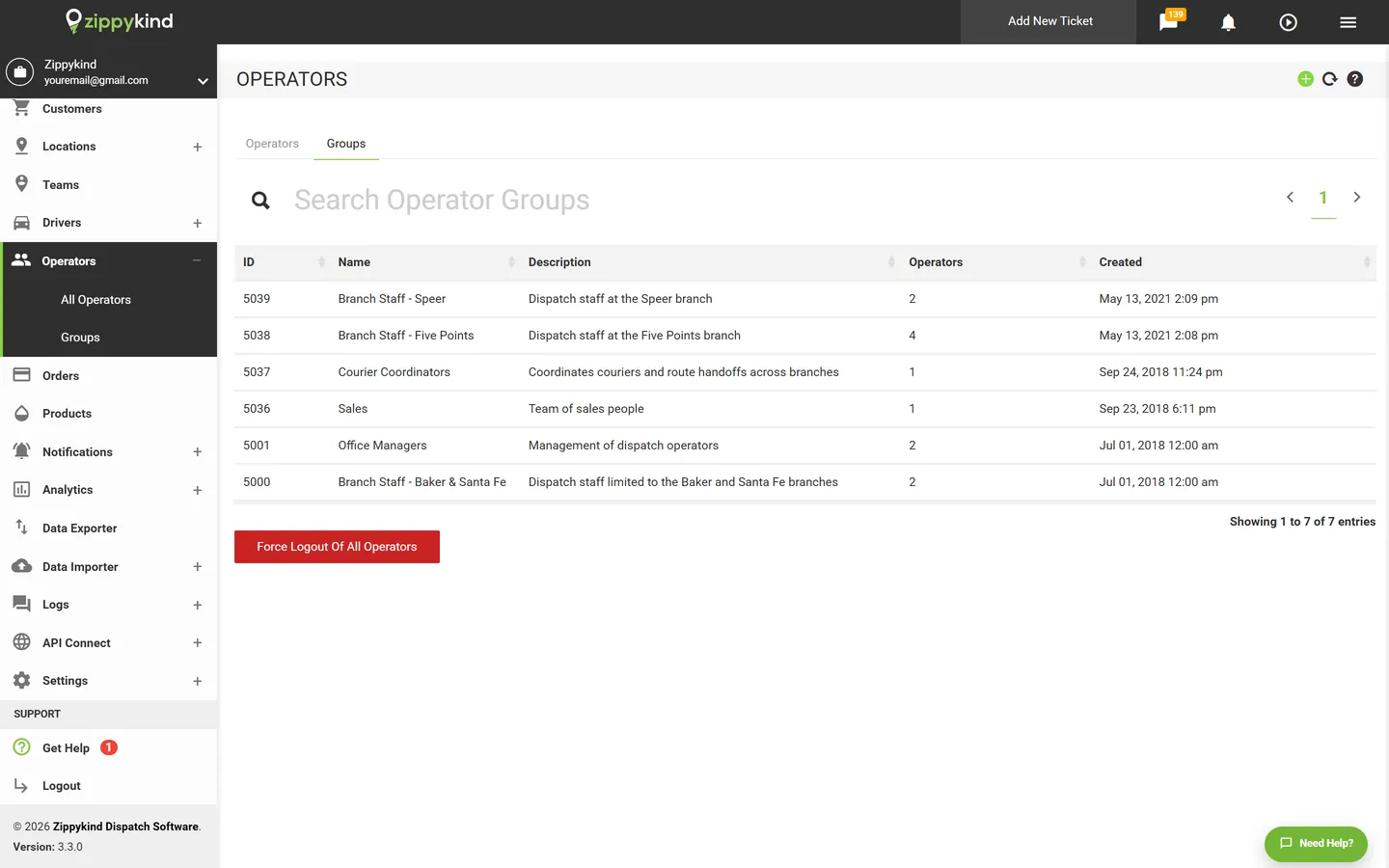
Operators are your staff logins. Groups are how a business with several branch locations keeps the Speer team out of the Five Points dashboard without running two accounts.

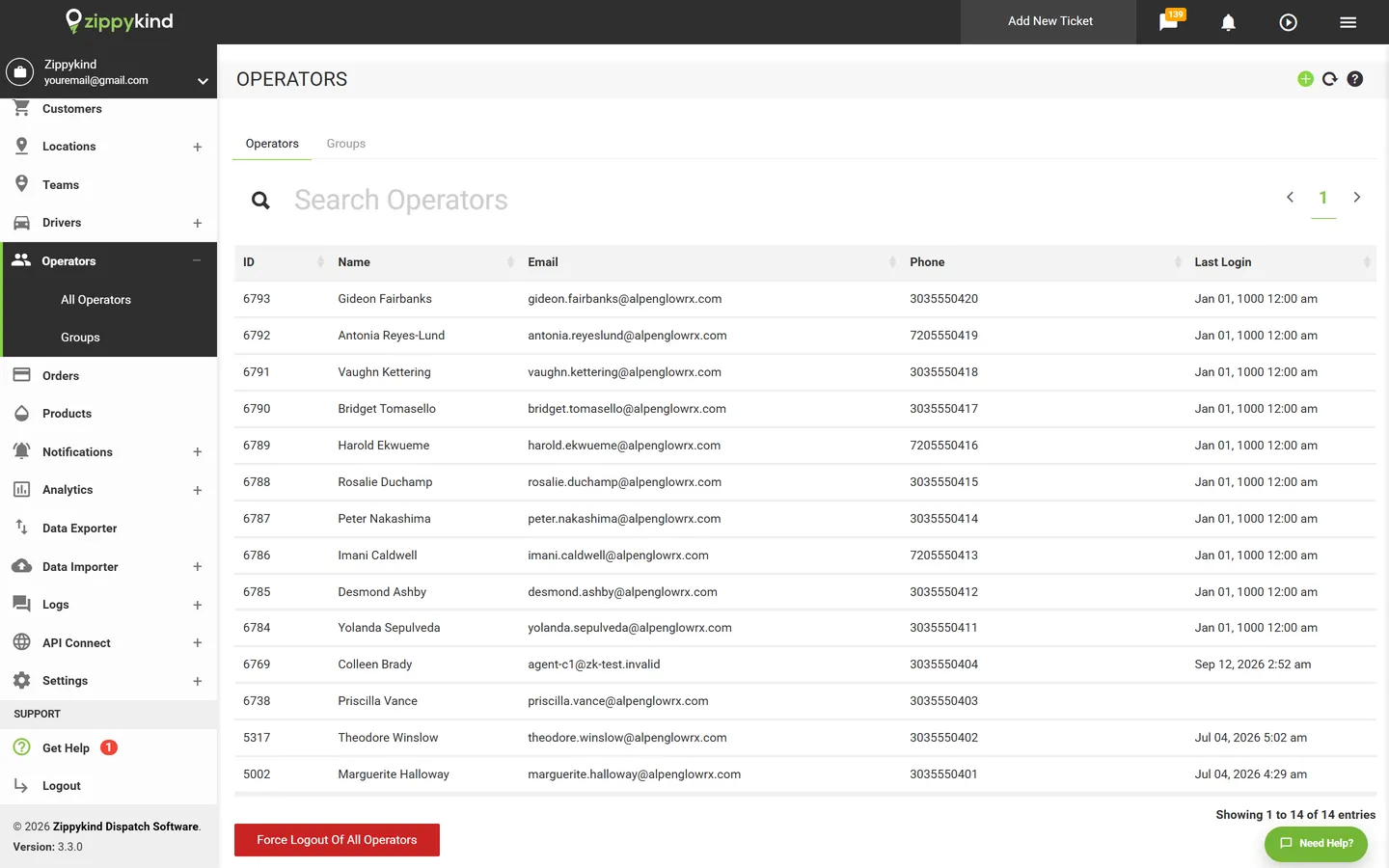
The operators list with last login times
Every login with its last-seen time, and one button to sign all of them out.
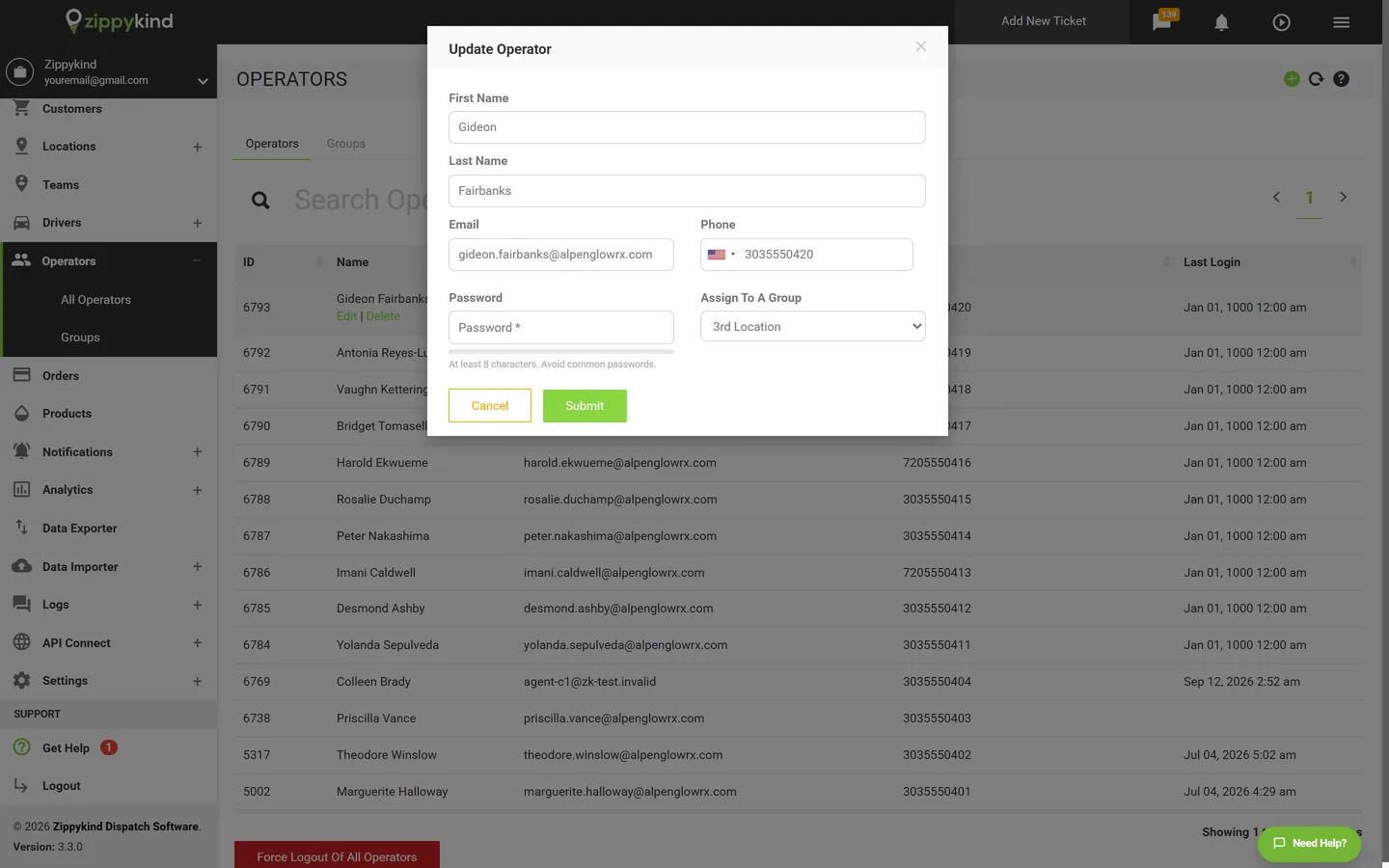
The operator edit dialog with name, contact and group assignment
Adding one is four fields and a group.
The operator groups list with descriptions and operator counts
Groups describe themselves — branch staff, courier coordinators, office managers — and carry their own headcount.

API Connect

Build on it, without creating real deliveries

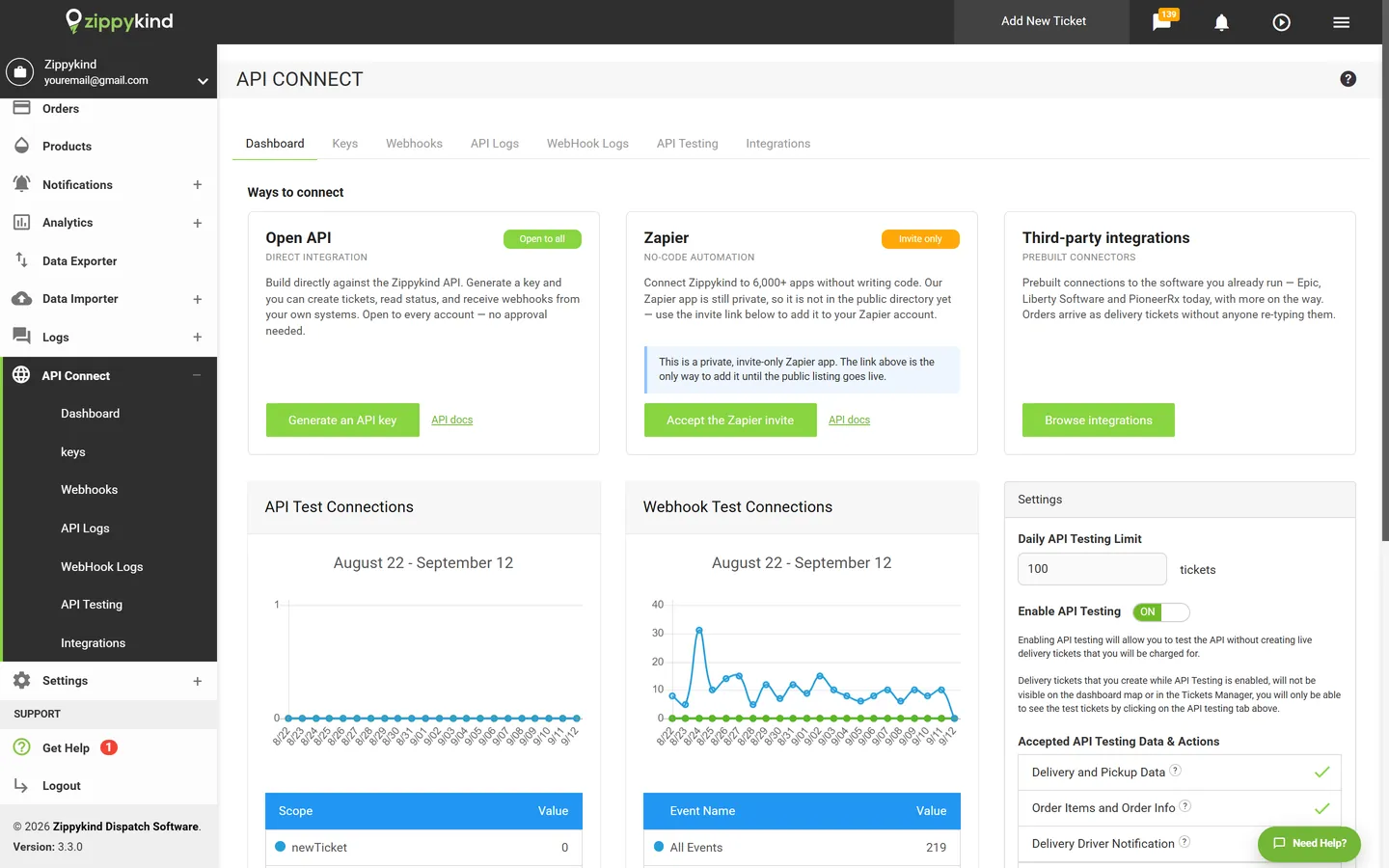
Keys, webhooks and prebuilt connectors on one screen, with a test mode that writes to a separate set so you can develop against the real endpoints all day without a driver ever being dispatched.

The API Connect dashboard with ways to connect and test connection charts
Three ways in — open API, Zapier, prebuilt connectors — with API and webhook traffic charted beneath and the testing limit on the right.
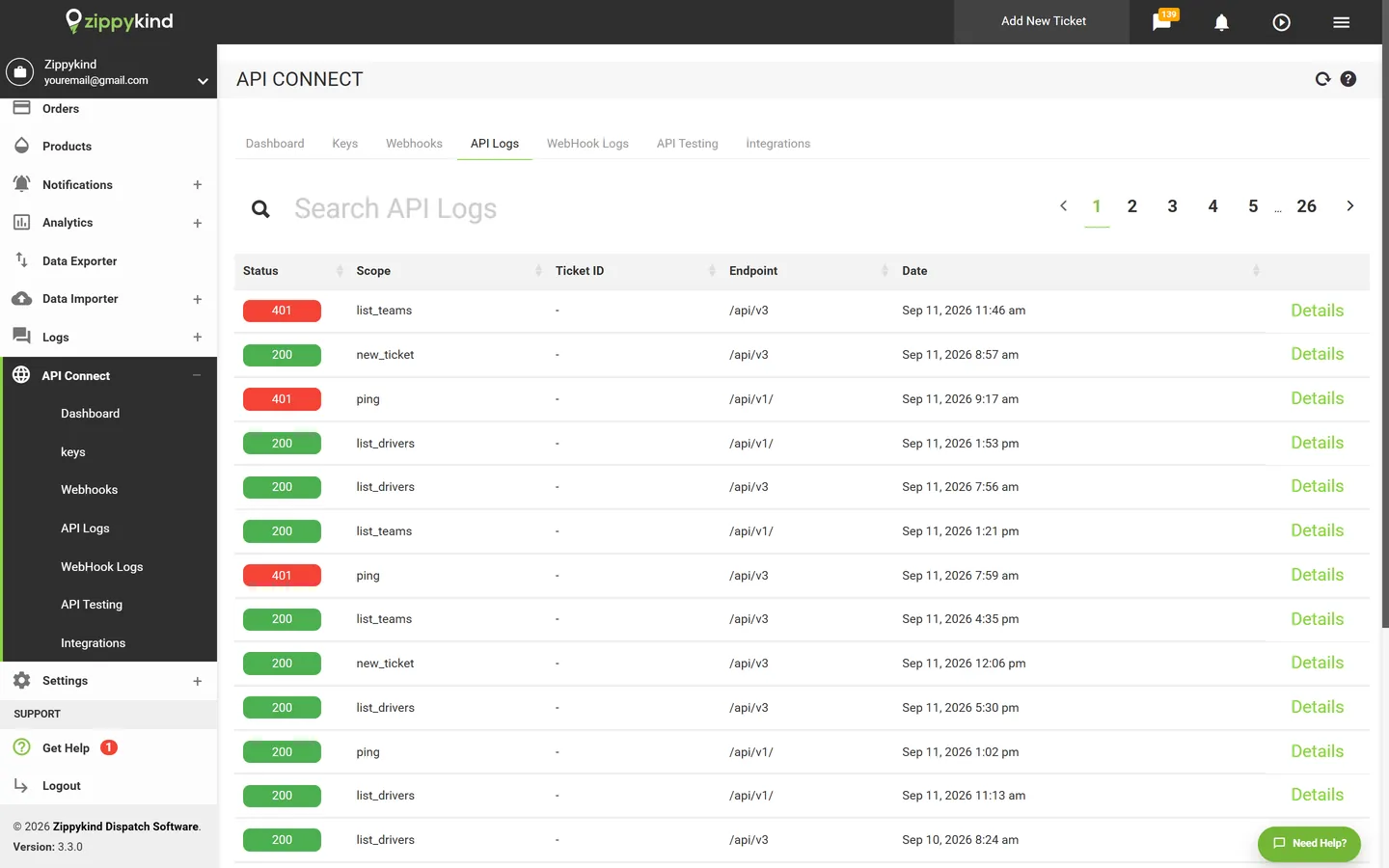
The API logs table listing requests with status codes and scopes
Every call logged as it happens: status, scope, endpoint and date, searchable and sortable.
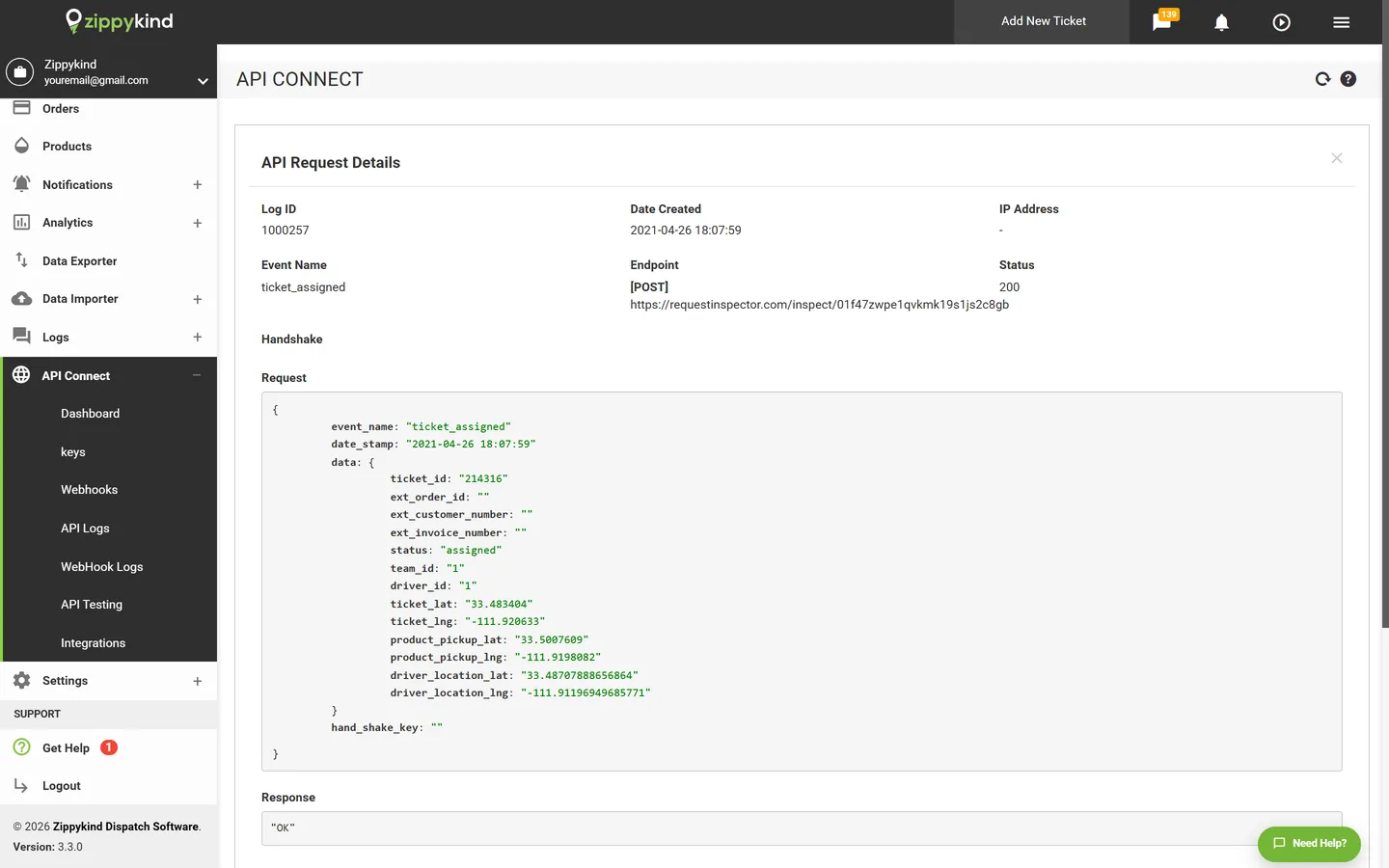
An API request detail view showing the full request payload and response
Open any row for the whole exchange — the request body we sent, the endpoint, and what came back.

Settings

The rules the software follows for you

Most of what dispatch does automatically is a decision somebody made once on these tabs. Each setting explains what it does and what it affects, in the software rather than in a manual.

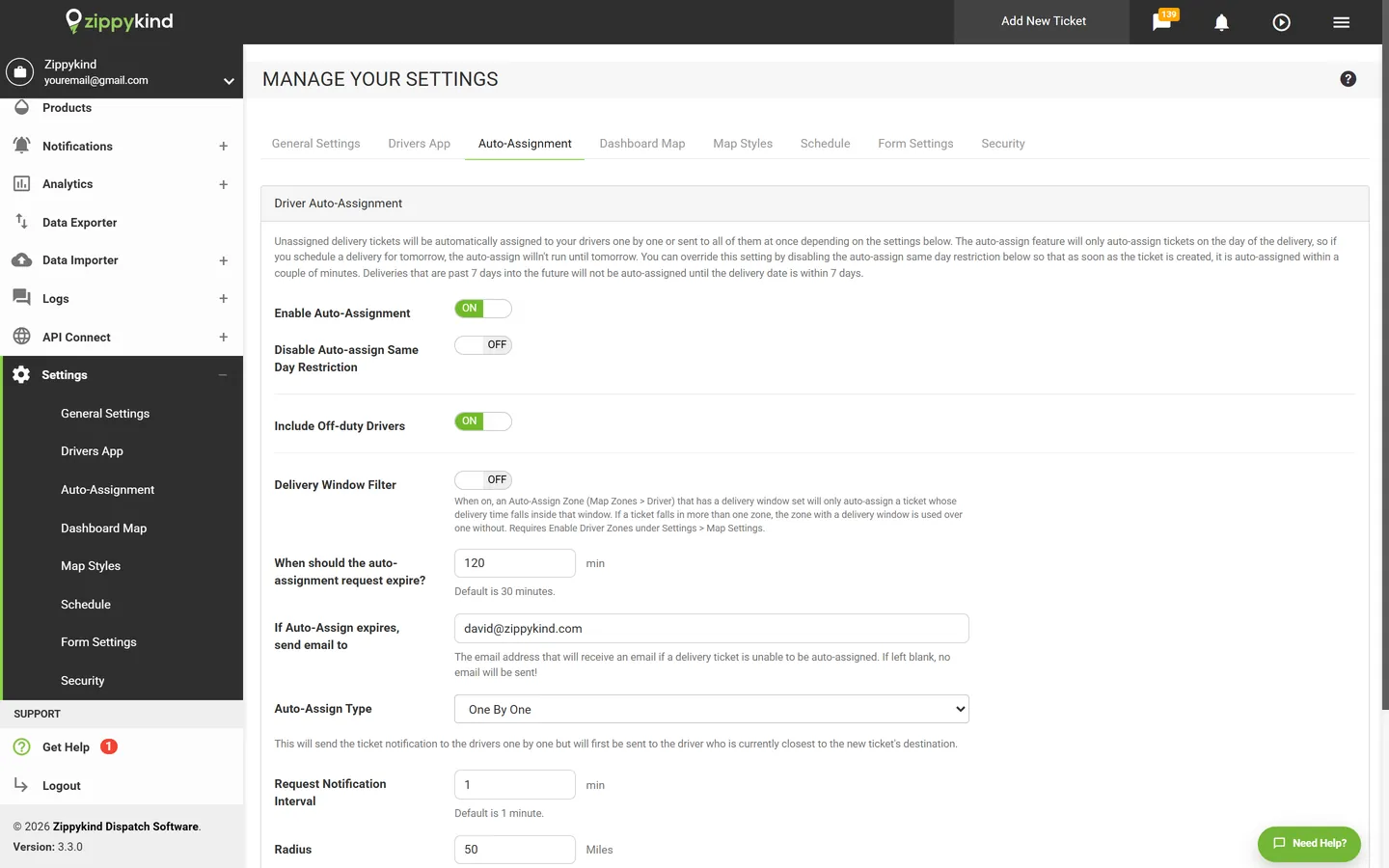
The auto-dispatch settings with driver assignment type, expiry and radius
Auto-dispatch: one driver at a time starting with the closest, or all of them at once, with an expiry, a radius, and an email if nobody takes it.
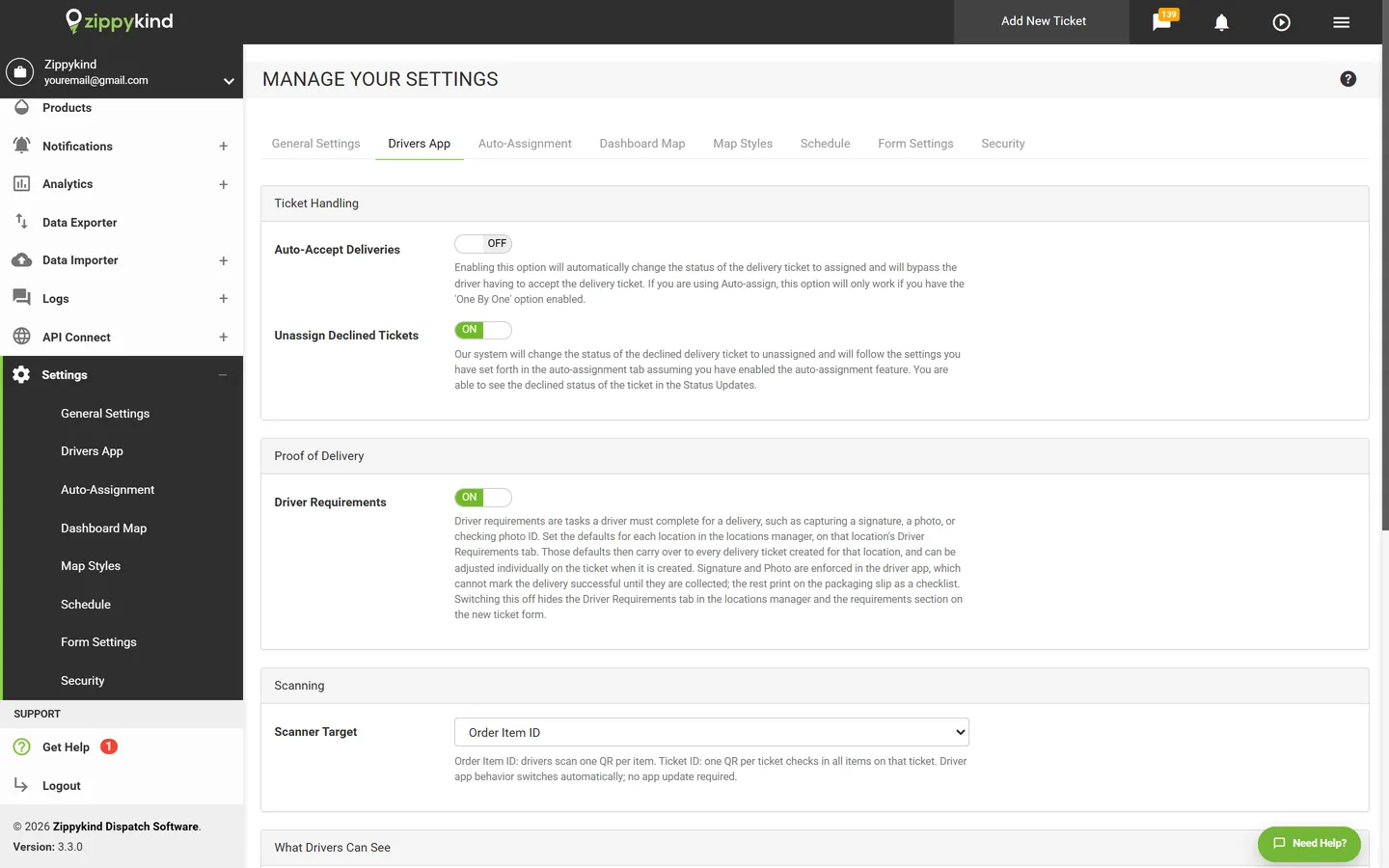
The drivers app settings covering ticket handling, proof of delivery and scanning
What the driver app does: accept automatically or not, what a decline does to the ticket, and whether the scanner reads one code per item or one per ticket.
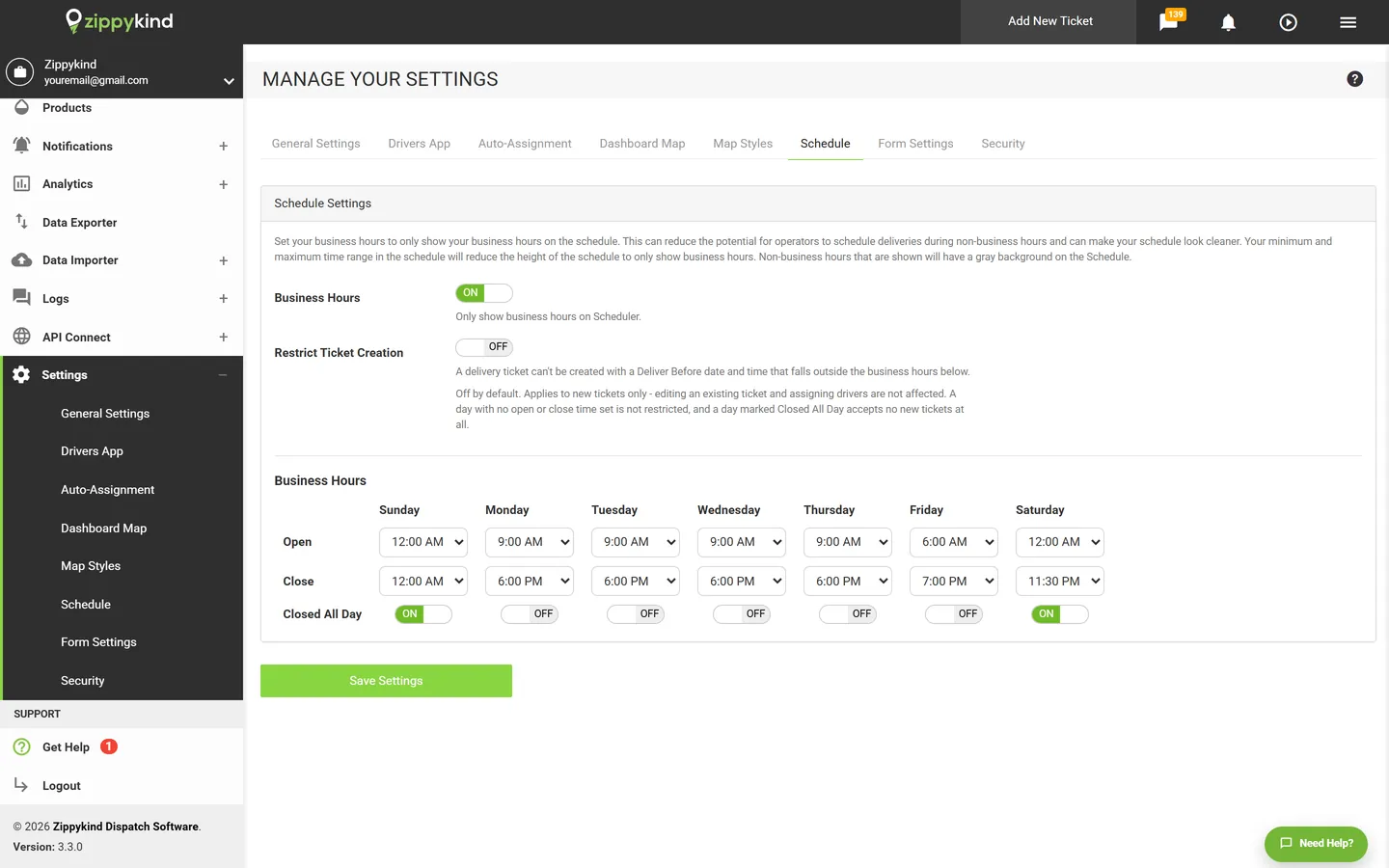
The schedule settings with open and close times for each day
Business hours per day, so the schedule shows your day rather than a blank twenty-four, and optionally refuses tickets outside it.
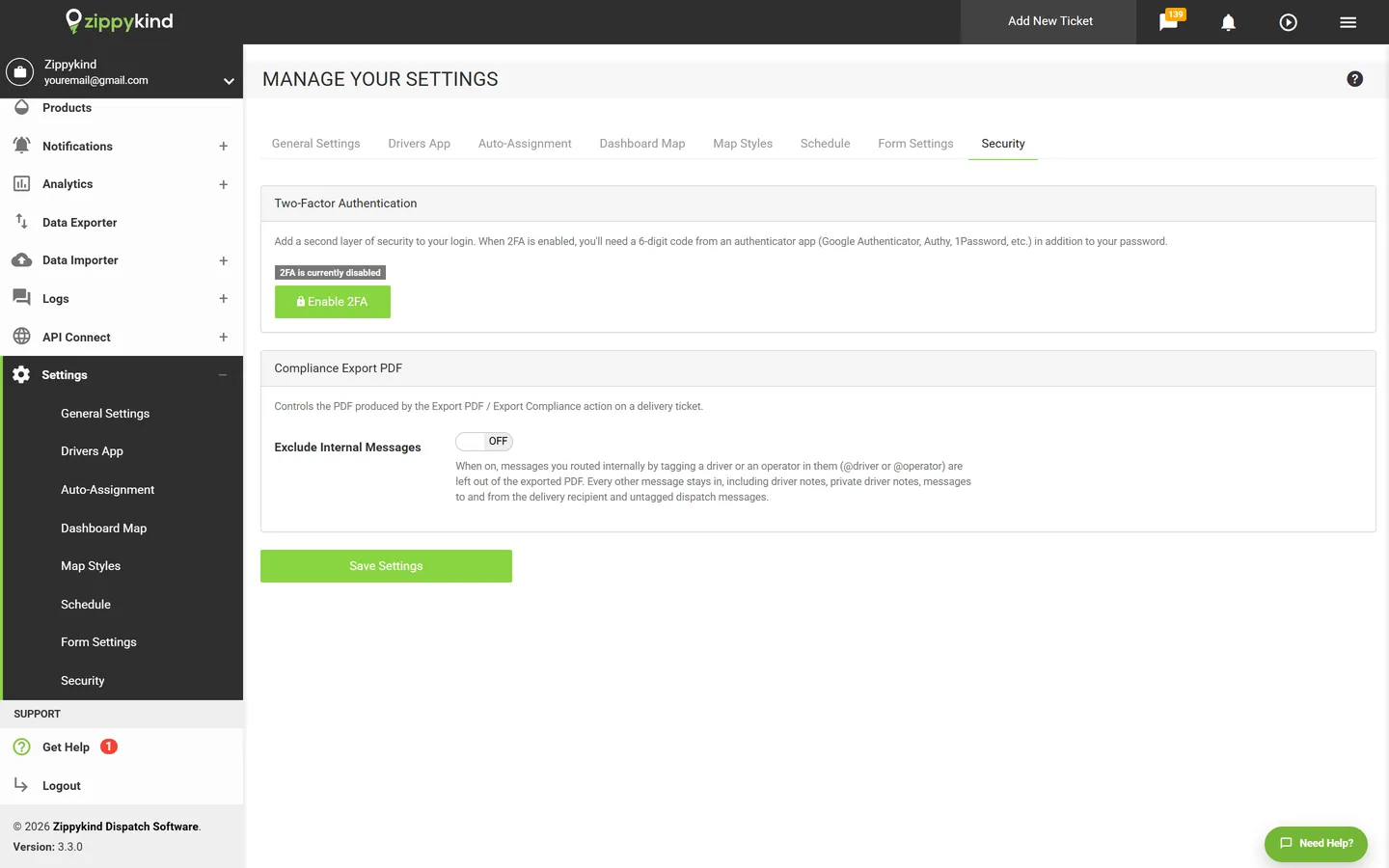
The security settings with two-factor authentication and compliance export options
Two-factor authentication, and control over whether internal messages appear in an exported compliance PDF.

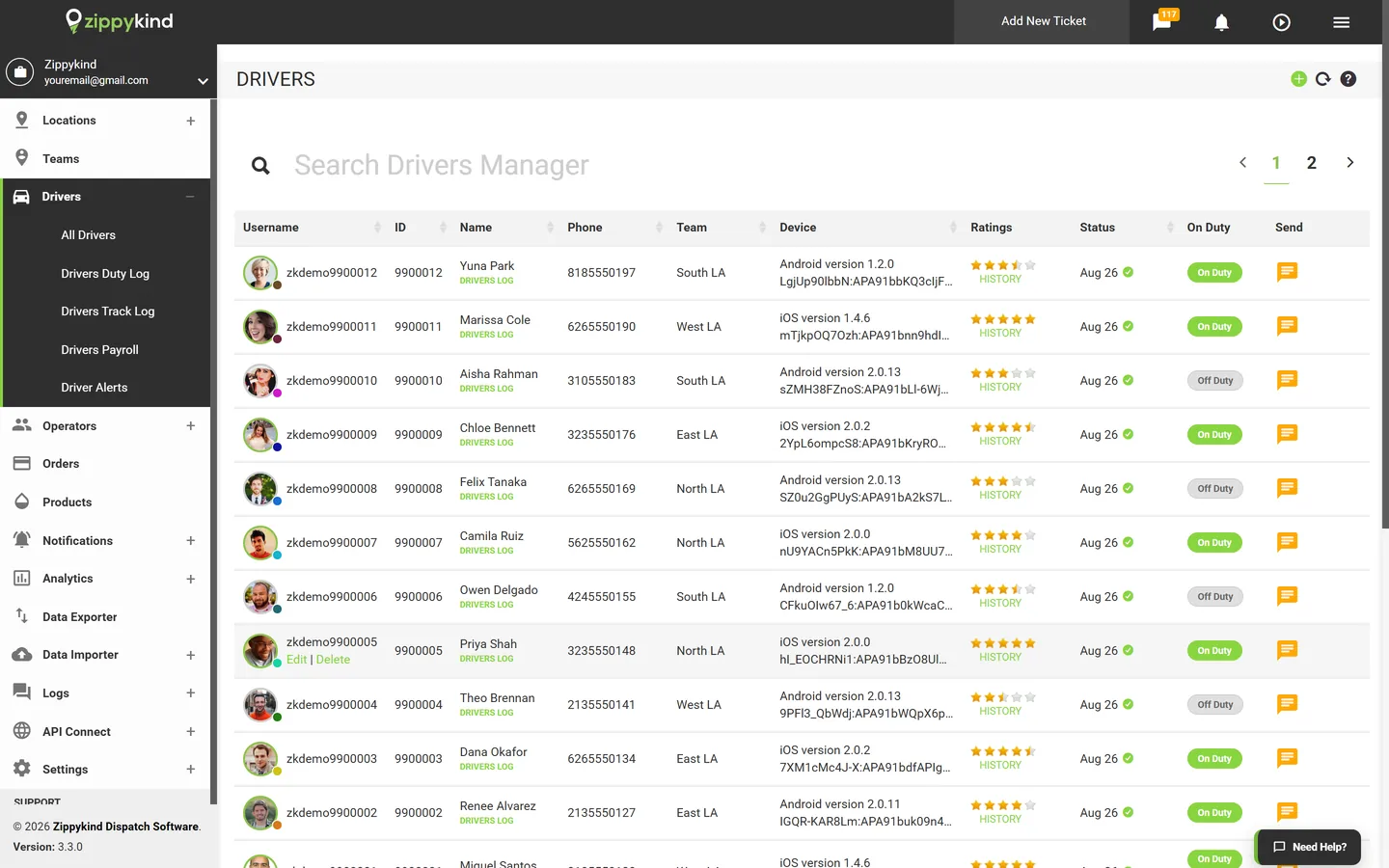
Drivers

A driver record that does more than hold a phone number

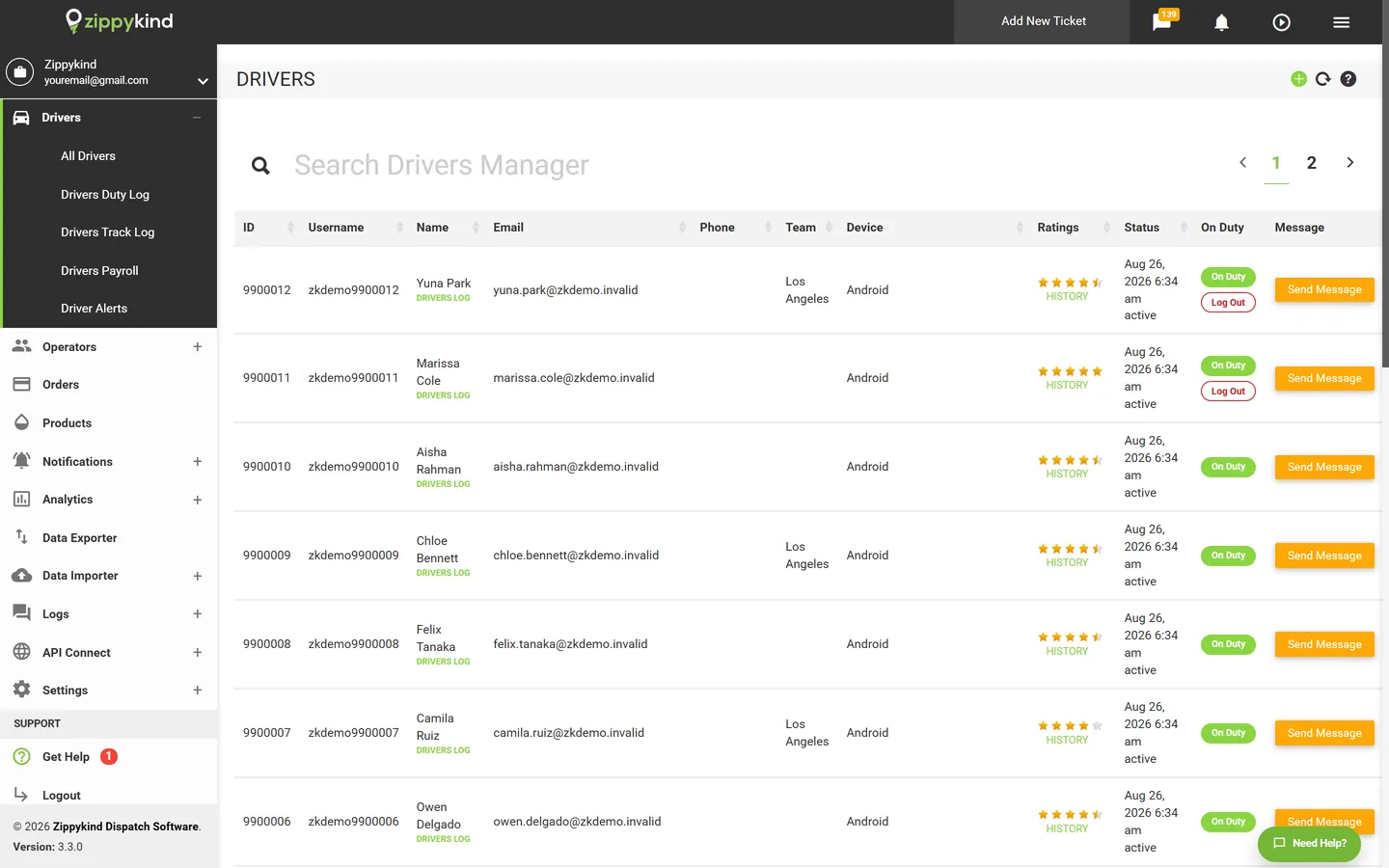
Each driver carries a duty log, a track log, payroll and alerts. Ratings and an on-duty switch sit on the list itself, so putting someone back on the road is one click, not a form.

The drivers manager listing drivers with ratings, device and on-duty status
The roster: device, team, rating, on duty or off, and a message button on every row.
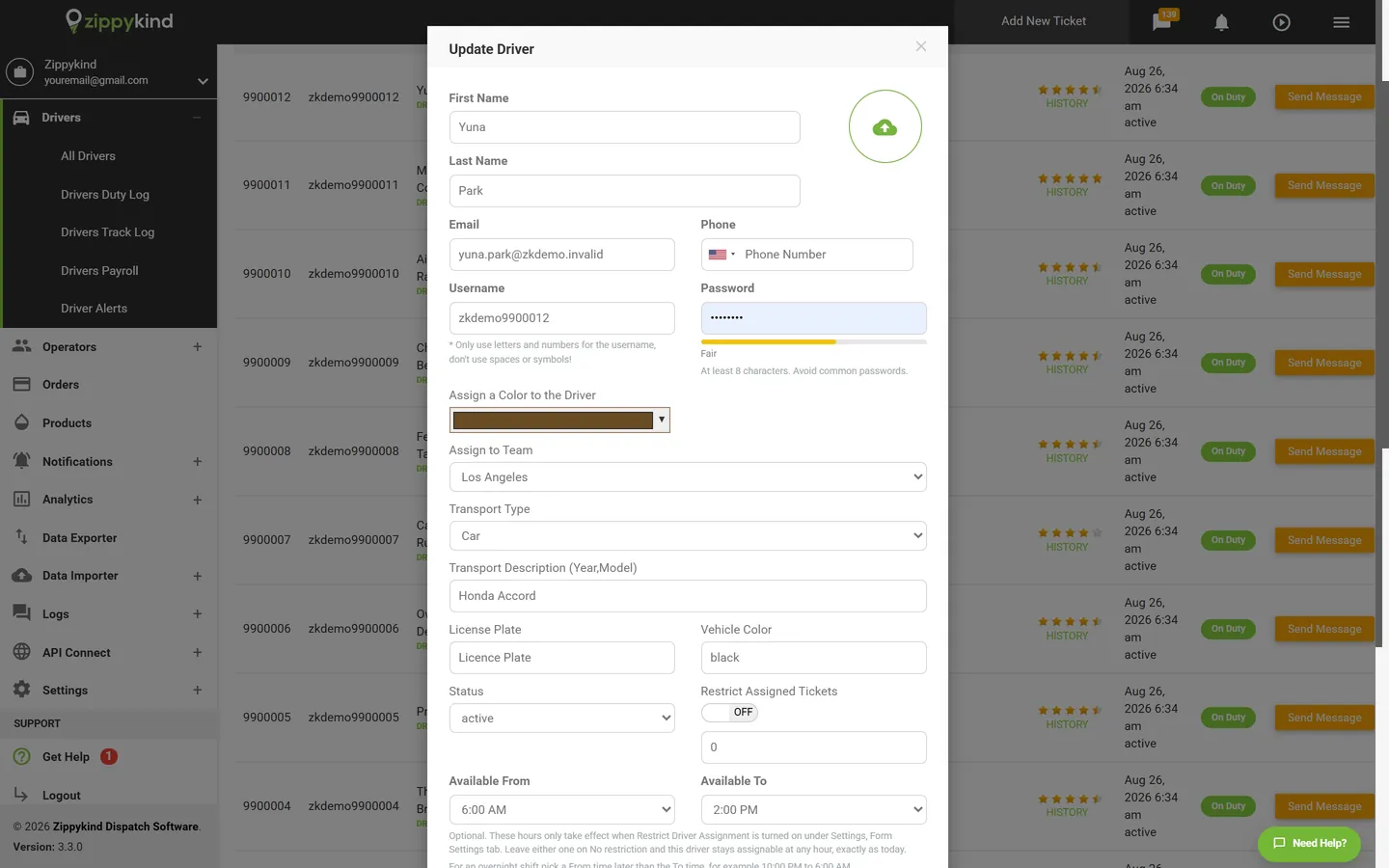
The driver edit form with vehicle, team, colour and availability hours
The record holds the vehicle, a colour that identifies them on the map, a team, and shift hours that can restrict what they are assigned.

Schedule

A month of deliveries at a glance

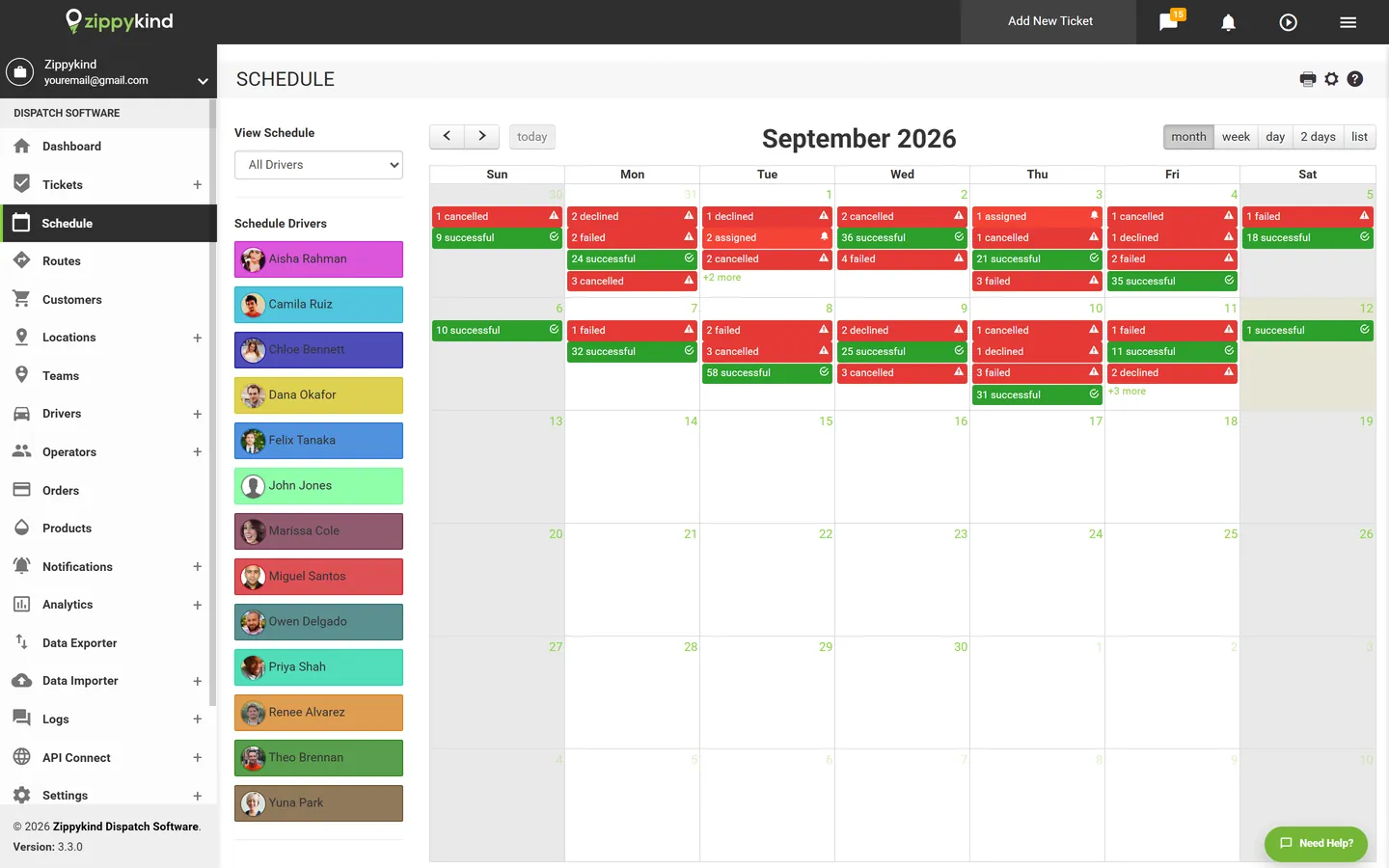
The schedule rolls every ticket up by day and by driver, coloured by outcome, so one look tells you which days ran cleanly and which did not. Drop to week, day or list when you need the detail.

The schedule showing a month of deliveries coloured by outcome
Successful in green, failed and cancelled in red, counted per day, with the driver list beside it.

Data Importer

Bring the deliveries you already have

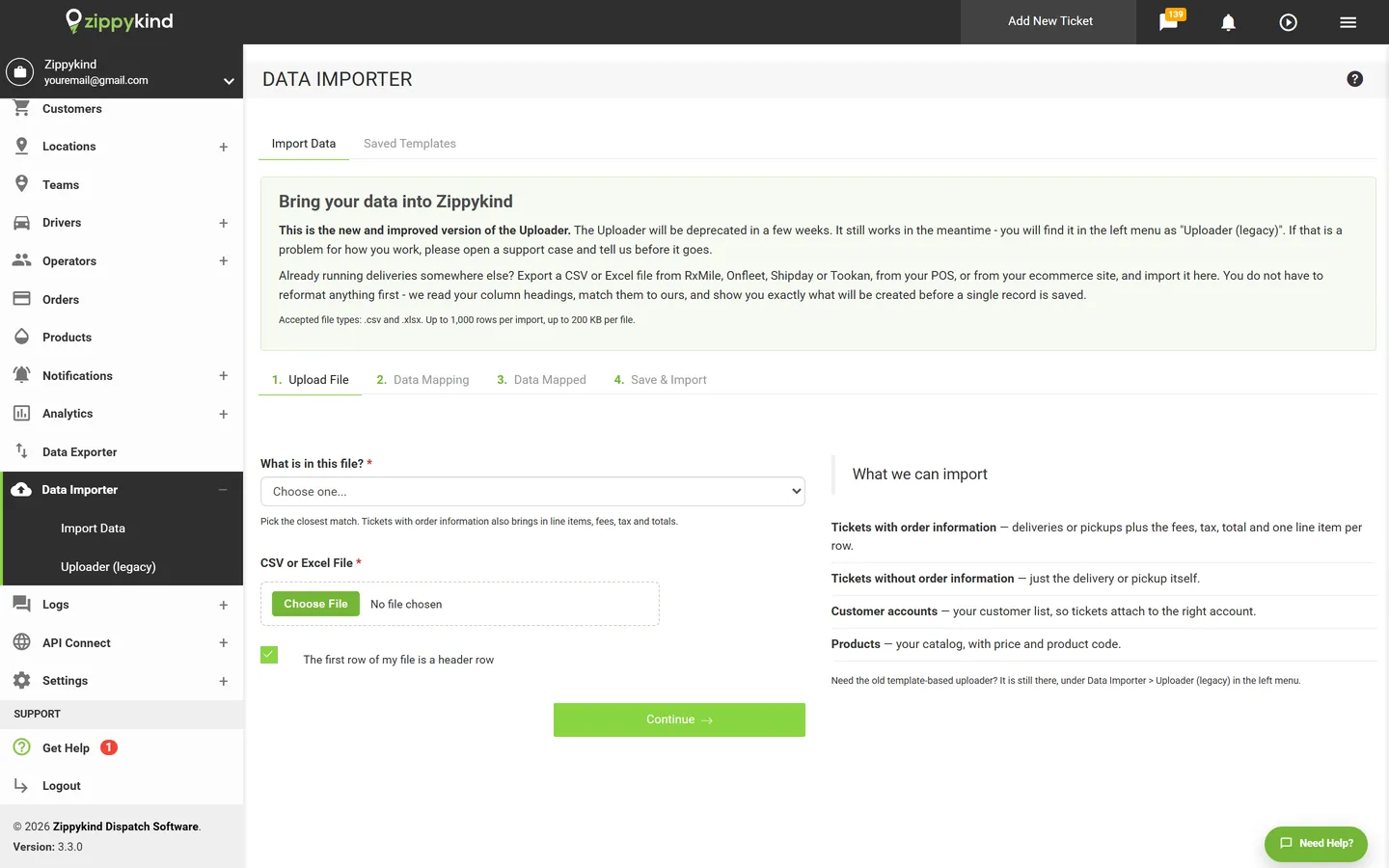
Export a CSV or Excel file from RxMile, Onfleet, Shipday or Tookan, from your POS, or from your online store, and import it here. You do not reformat anything first: Zippykind reads your column headings, matches them to its own, and shows you exactly what will be created before a single record is saved.

The data importer with its four step flow and a list of importable record types
Four steps — upload, map, confirm, import — and a list of what it can take: tickets with or without order lines, customer accounts, product catalogues.

Data Exporter

Your data, in the columns you want

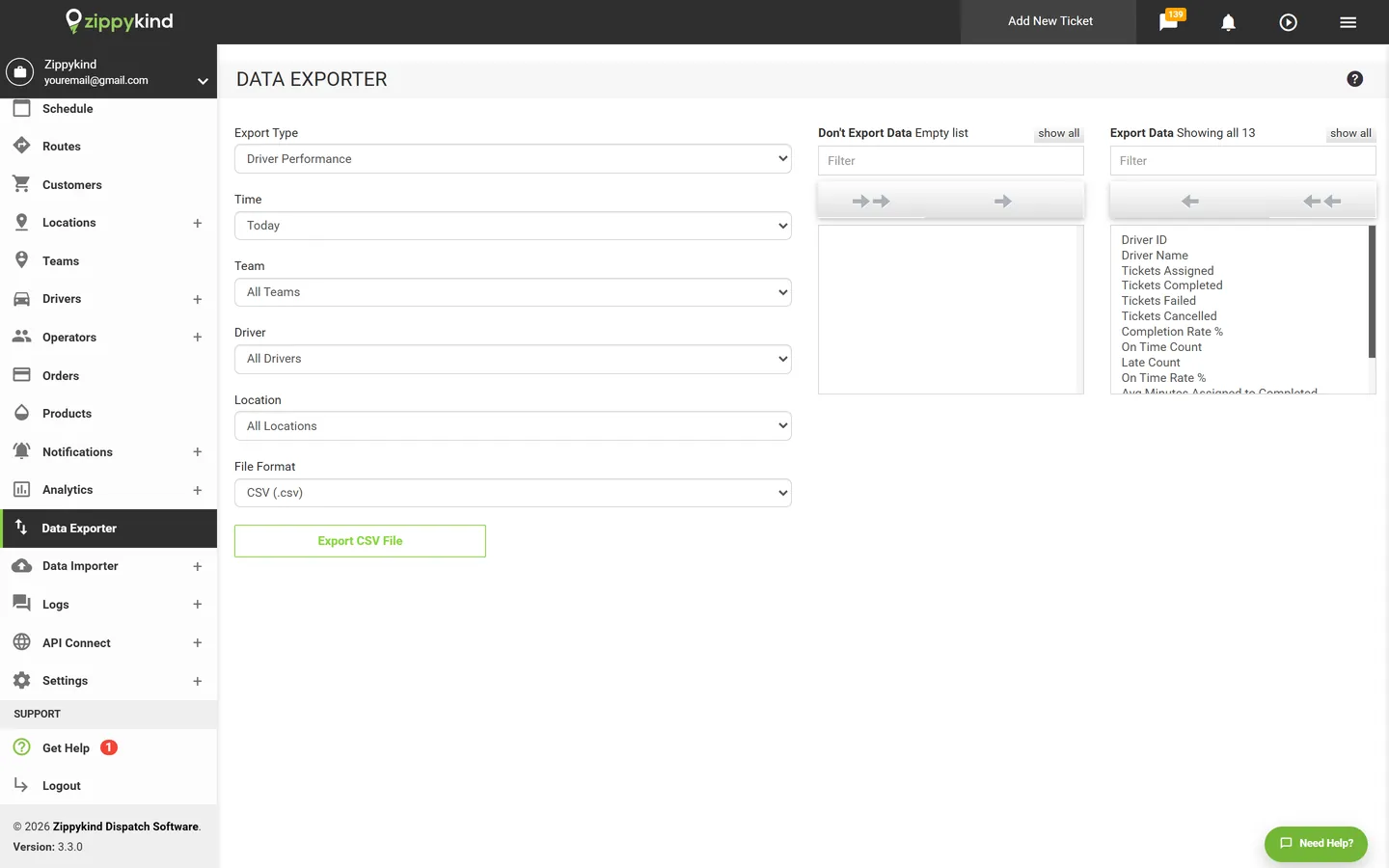
Pick an export, a date range and the filters, then choose the columns themselves — drag the ones you do not need out of the list. It is your data, and it leaves as a CSV you can open anywhere.

The data exporter with export type, filters and a column picker
A driver performance export with thirteen columns selected, from completion rate to average minutes assigned-to-completed.

Logs

Every message the platform sent, kept
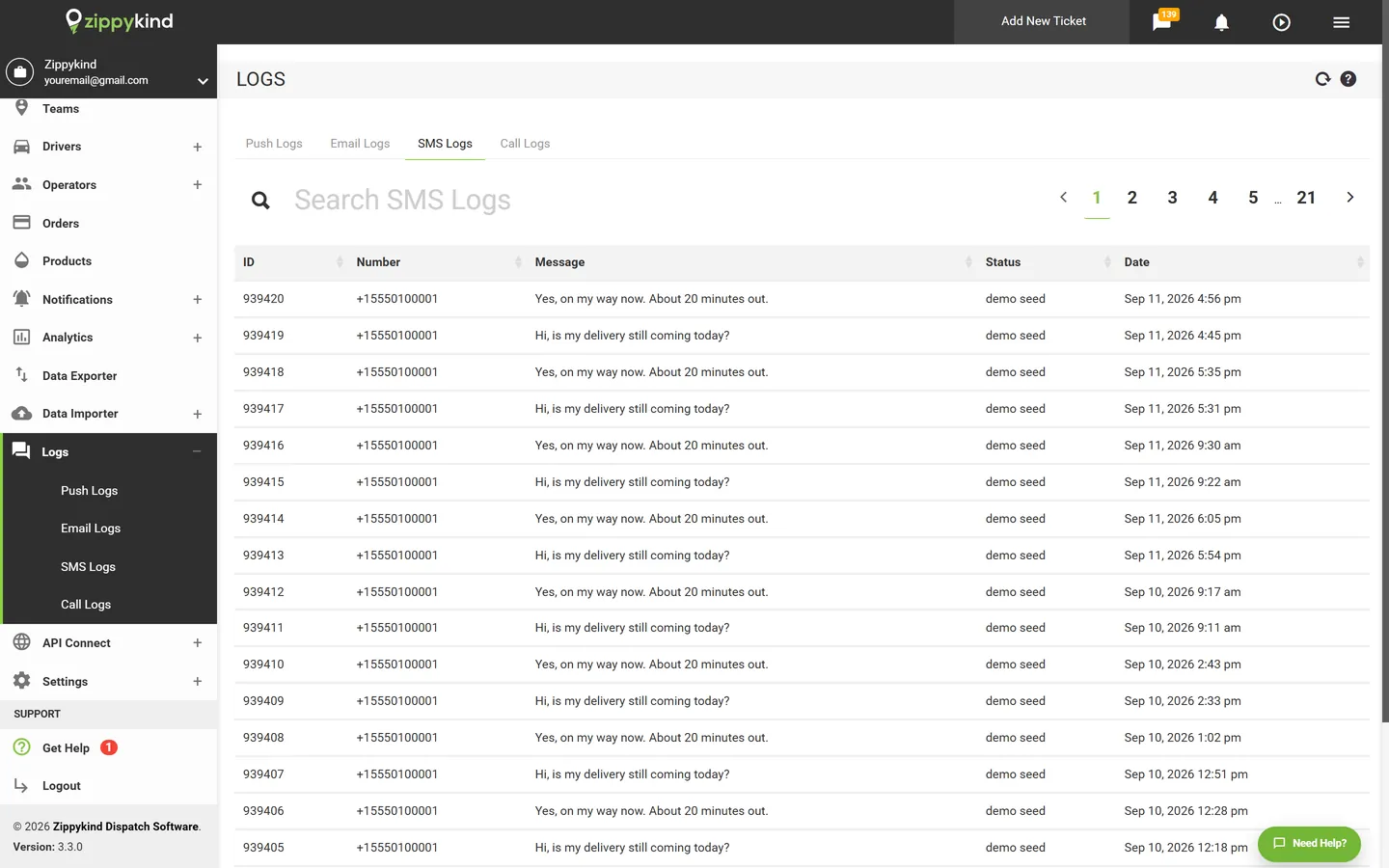
Push, email, SMS and voice each get their own log with a delivery status against every row. When a customer says they were never told, this is the screen that answers it.

The SMS log listing outbound messages with delivery status
The SMS log: number, message body, status and timestamp, searchable across the whole history.
Products

A catalogue, so a ticket can carry line items

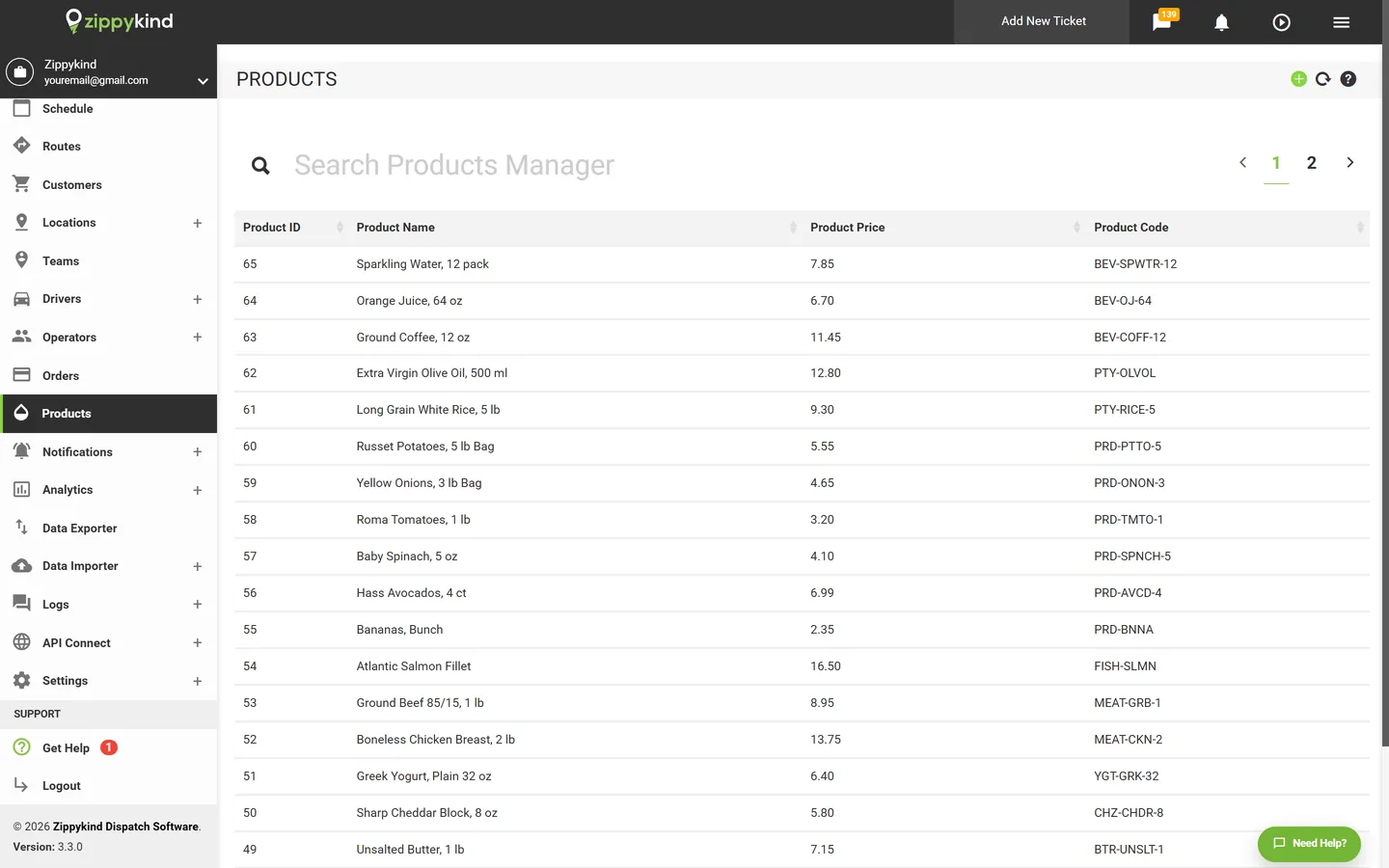
Products give an order its contents: a name, a price and a code per item, which is what turns a delivery into a packing slip with barcodes on it and a PDF with a subtotal.

The products manager listing items with prices and product codes
The catalogue, searchable, with a product code on every line for scanning.

Teams

Drivers, grouped the way you run them

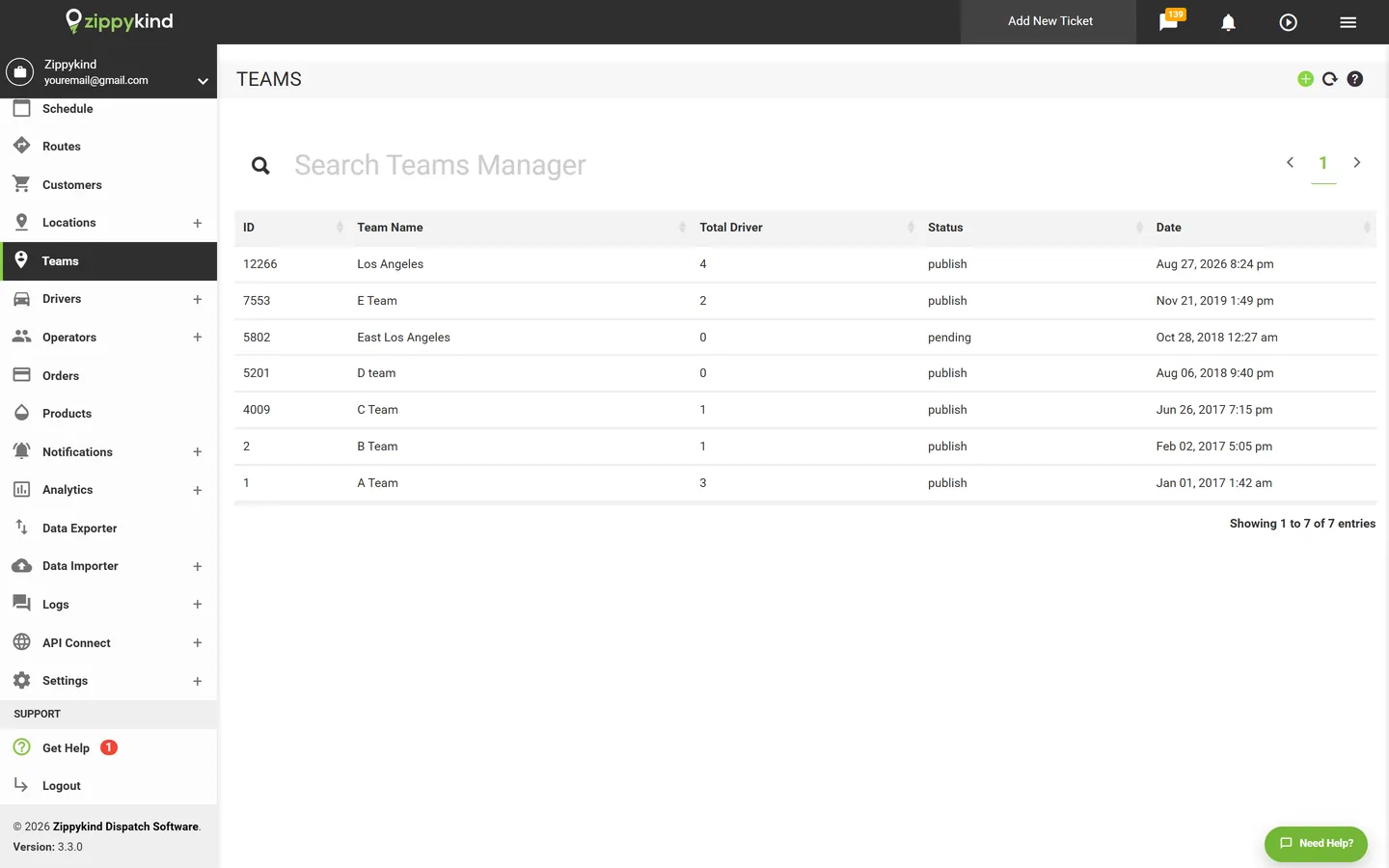
A team is how you split a fleet by depot, shift or service area. Tickets, analytics and exports all filter by it, so a team is a lens on the whole operation rather than a label.

The teams manager listing teams with driver counts and status
Teams with their driver counts, published or still pending.
The drivers manager listing driver accounts with their team, app version, rating and on or off duty status
Every driver account with its team, app version, rating, and whether the driver is on duty right now.

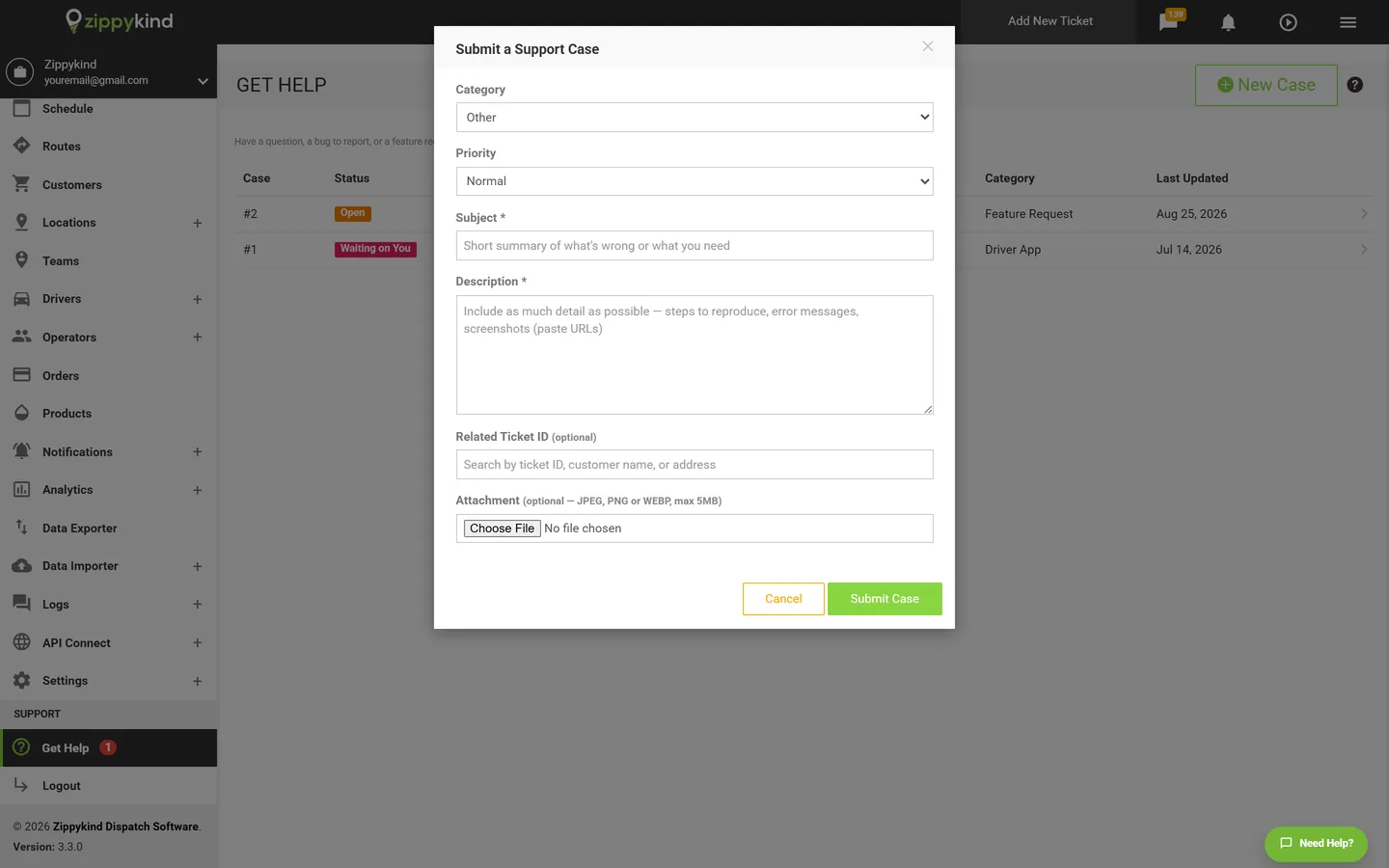
Get Help

Support that stays attached to the delivery

Raise a case from inside the software and link it to the ticket it is about. No separate portal, no re-explaining which delivery you mean.

The support case form with category, priority and a related ticket lookup
A case with a category, a priority, the related ticket, and an attachment if a screenshot says it faster.
AI Dispatch Assistant

Meet Charles, your AI dispatch assistant

Every dispatcher you hire has to learn the software. Charles is built into it. He sits on every page of the Zippykind dispatch app, knows which page you are on, and answers in plain English so your team gets moving instead of hunting through a help site. He has no access to your account, your tickets or your drivers. He is there to explain the software, not to read your business. Included on every plan.
On every page, not in a help site

Charles opens from the corner of the dispatch software wherever you are, and he already knows which page you are looking at.

Answers about your software

Ask how to set up a delivery zone, what a setting changes, or why a ticket did not auto-dispatch. Answers come from the Zippykind knowledgebase, not a guess.

Included, and it stays out of your data

No AI add-on and no per-seat fee. Charles never sees your account, your tickets, your customers or your drivers.

Dispatch tools

Everything dispatch reaches for

Optimize routes

On foot, on a bike, on transit, or driving, route optimization finds the best path between up to 200 stops in a single run.

Automate dispatch

Stop sending tickets one by one. Auto-dispatch each new ticket to the closest driver, or to whoever accepts it first.

Autonomous driver assignment

Set up your map zones once. The algorithm matches on driver proximity and availability from then on.

Drag-and-drop scheduler

Schedule deliveries by dragging them onto a driver. Day, two-day, list, week, and month views.

Recurring subscriptions

Daily, weekly, bi-weekly, or monthly repeat orders, including multiple concurrent subscriptions for one customer.

Real-time tracking & alerts

Take orders over the phone, push them to drivers, and watch every driver move on the dashboard map.

Routing Suite

Route optimization in the dispatch software and the driver app, a manual and automatic route planner with a 200-stop capacity, map zones and zone-based auto-dispatch, flash routes, and Predictive ETA notifications.

Flash Routes

Draw a polygon on the map and it instantly builds a route from every ticket inside it. Saved map zones also drive auto-dispatch, delivery fees and driver payroll.

Driver payroll

Pay per drop, per mile, per minute, or by the zone a delivery lands in. Every completed delivery writes an immutable ledger entry, and payouts split taxable earnings from non-taxable mileage reimbursement.

Back office

Run the business, not the spreadsheet

Enhanced analytics

Review deliveries as a heatmap, line chart, or column chart, and filter by team, driver, or date range to spot your busier areas and trends.

Driver track log

Every driver's GPS is logged minute by minute and their whole day is drawn on the map, look up any driver's past route on demand.

Open API, webhooks & Zapier

Connect to Shopify, QuickBooks, BigCommerce, Salesforce and hundreds more. Automate ticket creation straight from your store.

Industry Filters

Free vertical presets that tune terminology and workflow to your industry, pharmacy, cannabis, alcohol, restaurant, or courier.

CSV exporter

Export customers, drivers, tickets, GPS track logs, status history, product logs, and SMS/call/email/push logs, all customizable.

Notification templates

Create custom messages that auto-send to customers and drivers at every milestone of the delivery, and keep dispatch in the loop too.

Customer experience

What the customer actually sees

“Uber-like” customer tracking

When your driver is in route, the customer gets an SMS or email with a tracking page showing ETA, live GPS, and call and text buttons.

Autonomous communication

Automated SMS and email status updates. A dedicated virtual number routes every call and text, so driver numbers stay private.

Spending rewards program

Track customer spending and sort customers into reward tiers automatically, based on what they spend each month.

Customer view

What the person waiting at the door sees

Your customer never installs anything. They get a text, open a branded page that shows the driver moving toward them, and sign on their own phone when the driver arrives.

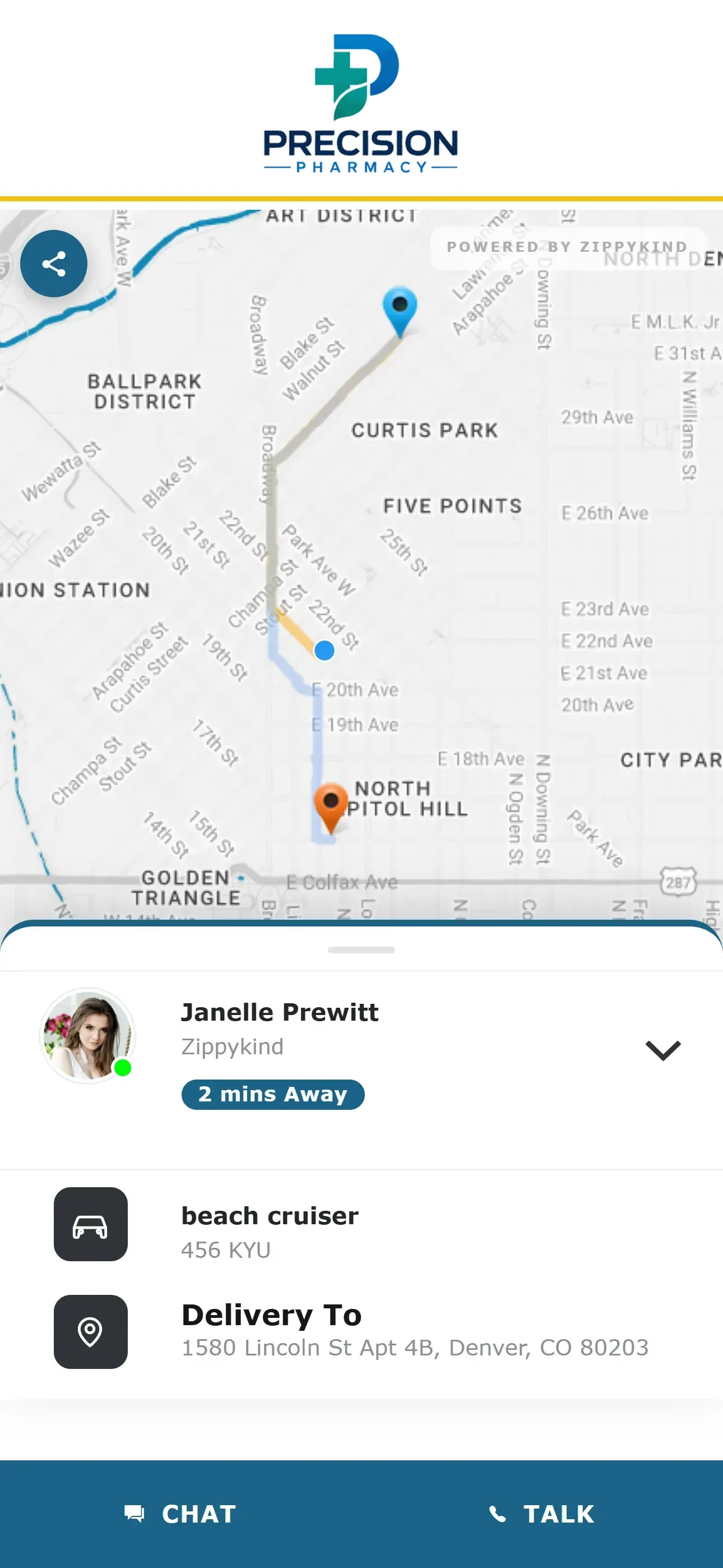
Tracking

A link, not an app

Your customer gets a text with a link. It opens a page in your colours showing the driver moving toward them, how many minutes out they are, the vehicle to look for, and a button to chat or call. No download, no account, nothing to install.

2 mins away counted from the stops still ahead on the driver’s route, not from a fixed window

The Zippykind driver tracking page on a phone, showing the driver approaching with a two minute ETA
The driver approaching, the vehicle to look for, and chat or call along the bottom.

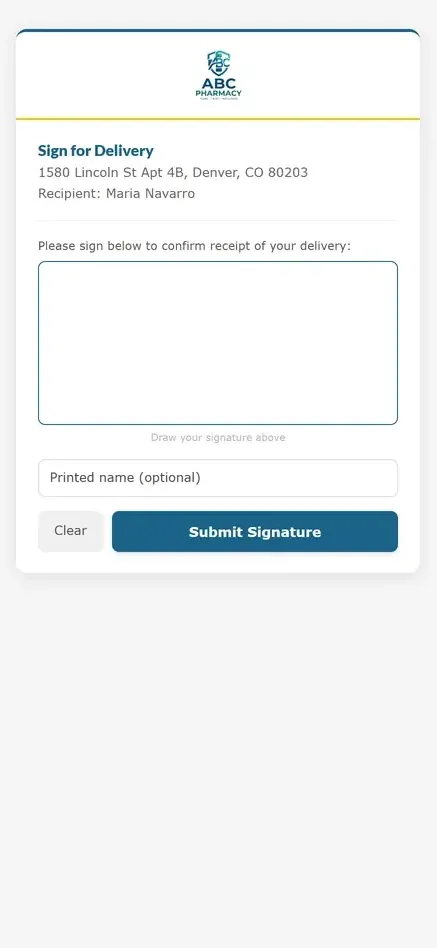
Contactless signature

They sign on their own phone

When the driver arrives, the recipient signs on their own device instead of a shared stylus. The page carries your logo and the delivery address, the disclaimer is yours, and the signature lands on the ticket as proof.

The Zippykind contactless signature page branded with a pharmacy logo
Branded, addressed to the right recipient, and asking for a printed name alongside the signature.

See it on your own deliveries

Start free, add your drivers, and dispatch your first ticket today.